

Kollect Voice Agent
Admil Domanuel · Voice & Language · Productivity
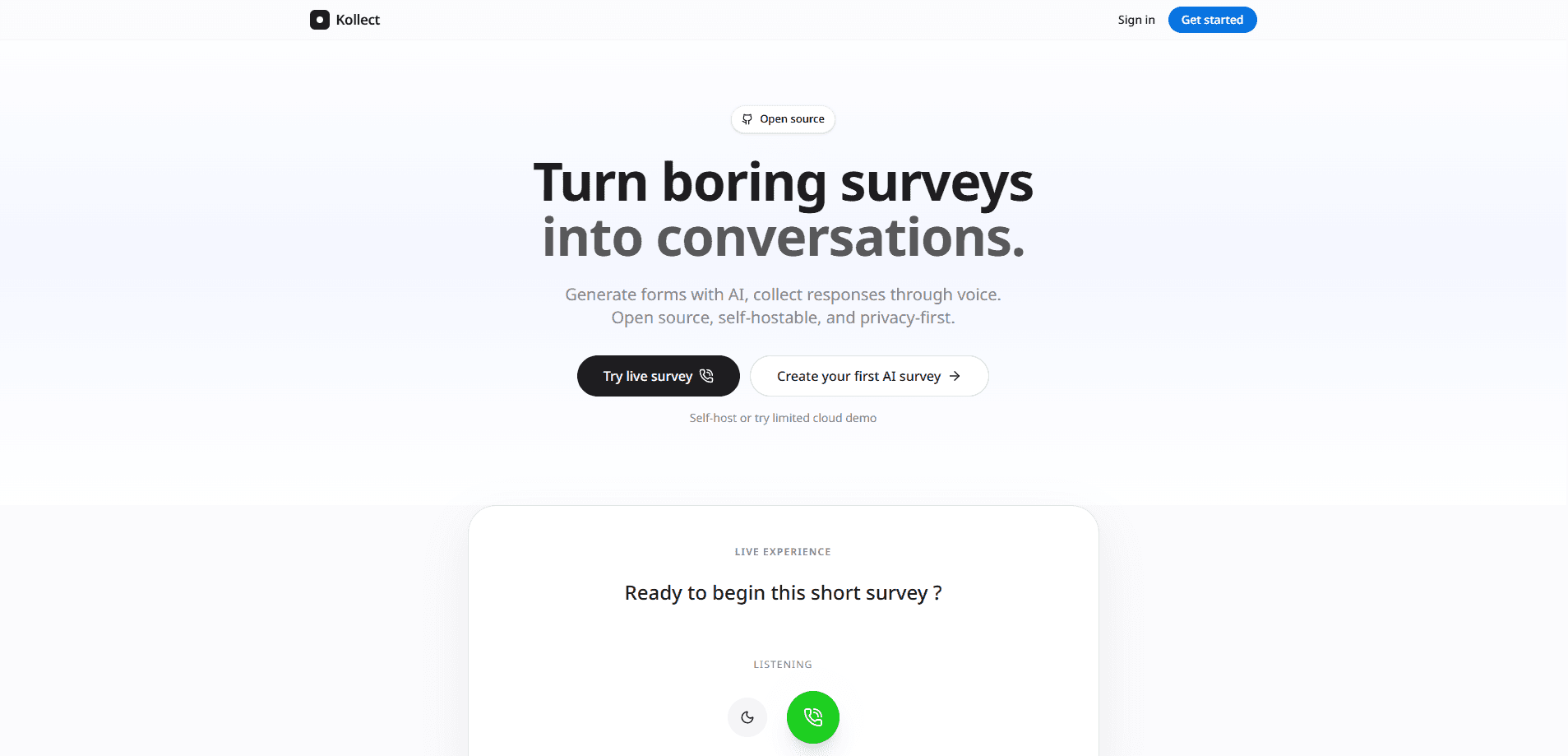
Kollect Voice Agent is an open-source voice form builder that turns ordinary surveys into natural conversations. Think of it as a conversational survey tool, not a form. Instead of clicking through static fields, respondents just talk, and the AI asks follow-up questions when an answer is vague. You describe the form you want in plain language, share a link, and read the transcripts afterward. It's built for teams that want richer feedback than a checkbox grid can give. Because it's self-hostable, your data stays on your own infrastructure.
About Kollect Voice Agent
What Is Kollect Voice Agent
Kollect Voice Agent is a voice-first form builder that swaps the usual text boxes for spoken back-and-forth. You type a goal, something like "collect post-purchase feedback from new customers," and the AI survey generator writes questions meant to be answered out loud. When someone gives a thin answer, it probes deeper the way a trained interviewer would.
The main problem it solves is flat data. Written surveys push people toward one-word replies and skipped questions, while a conversation keeps them talking and surfaces the reasoning behind an answer. That extra detail matters if you're running product research, hiring screens, or customer interviews, because the reason behind a low score is usually worth more than the score itself.
The most important limit is reach. Voice surveys need a working microphone and a quiet-enough setting, so they fit phone and desktop sessions better than a quick tap on a crowded train. The project is also young. It listed at #6 on Product Hunt and ships under an MIT license, but you shouldn't expect the polish and integrations of a decade-old survey platform.
Getting Started
- Open the Kollect site and describe the form you want to build in the prompt box.
- Review the AI-generated questions and adjust any wording before you publish.
- Share the link with respondents. No app or download is needed on their side.
- Collect the spoken responses and read the transcripts once they come in.
- For full data control, deploy the open-source build on your own infrastructure instead of the hosted version.
Product Information
A quick look at Kollect Voice Agent's pricing, supported platforms, and performance.
Best for
The users, tasks, and scenarios where this tool fits best.
Users
- UX and product researchers who need the "why" behind an answer, not just a score, and can run sessions where people can actually speak.
- Founders and small teams doing customer discovery on a tight budget, since the starter tier is free and the code is open.
- Developers who want a self-hosted survey tool and are willing to run it on their own servers to keep responses private.
Tasks
- Post-purchase or churn interviews, where a follow-up question pulls out the real reason a customer left.
- Hiring and screening calls, using a shared link so candidates can answer on their own schedule.
- User feedback rounds, when you want longer, more candid responses than a rating scale produces.
Scenarios
- Early product research before you commit to a roadmap, when you need open-ended input fast.
- Collecting feedback from people who won't sit through a long written form but will talk for a few minutes.
- Internal teams auditing a form's code and data handling before roll-out, since the source is open and MIT licensed.
Key features
Voice-First Responses
Kollect Voice Agent lets people answer by speaking rather than typing. This voice survey app captures tone and detail that plain text tends to flatten, which is useful when the feeling behind an answer matters as much as the answer itself. Anyone with a microphone can respond through a browser link.
AI-Powered Form Generation
You describe what you're trying to learn, and the tool writes the questions for you. The generated prompts aim to get answered. They avoid the leading or confusing phrasing that kills response rates. You still edit them before publishing, so the AI is a starting point, not the final word.
Smart Follow-Ups
When a response is vague, the AI asks a deeper question in the moment, similar to how a skilled researcher handles an interview. This is the part that separates it from a static form. A text box can't notice a half-answer. Kollect can, and it keeps the conversation moving until the answer is actually useful.
Self-Hostable and Open Source
The project is MIT licensed, so you can deploy it on your own infrastructure and keep every response in-house. You can audit the code. You can contribute fixes if something bothers you. That control is the trade-off against the convenience of a fully managed cloud tool.
Transcript Review
After responses come in, you read the transcripts and let the AI highlight the insights that stand out. It saves the tedious part of re-listening to every recording. You get the spoken nuance without scrubbing through audio by hand.
Pros and cons
Pros
- Voice input pulls out more detail and honesty than a checkbox survey, especially on sensitive topics.
- The AI writes the first draft of your questions, which cuts setup time on a new form.
- Follow-up probing happens automatically, so you don't need a live interviewer for every session.
- MIT license and self-hosting mean you keep full control of respondent data.
- The free tier and no-credit-card start let you test it before spending anything.
Cons
- Voice capture needs a microphone and a reasonably quiet space. That won't suit every respondent.
- The project is new and small, so expect fewer integrations and less documentation than established survey platforms.
- API availability isn't confirmed, which makes it hard to plan automated pipelines around it today.
- Hosting it yourself puts updates, backups, and uptime on your own team.
Frequently asked questions
It's used to run surveys and interviews as spoken conversations instead of written forms. You'd reach for it when you want richer, more candid feedback than a standard questionnaire delivers, which is usually the moment a simple rating form stops telling you anything new.
Related content
Explore related tools, skills, and articles for Kollect Voice Agent.
Kollect Voice Agent Alternatives

Foley
Hanamori Labs, LLC · Voice & Language · Productivity · AI AssistantFoley is a voice to-do list that turns a spoken sentence into a filed task, complete with project, date and time, then helps you plan the day around what is already there.

HireKey
HireKey · Voice & Language · Productivity · LeaningHireKey is an AI job search copilot built by a former tech recruiter. It checks role fit, tailors resumes, runs interview practice and tracks every application.

Fluence
Yay Software (Yannick Huchard) · Writing · Voice & Language · ProductivityFluence is an Android app that reads PDFs, EPUBs, Word files and web articles aloud, follows each sentence as it speaks, and answers questions about the text on the phone itself.