

Kolosal AI
Genta Technology · Other
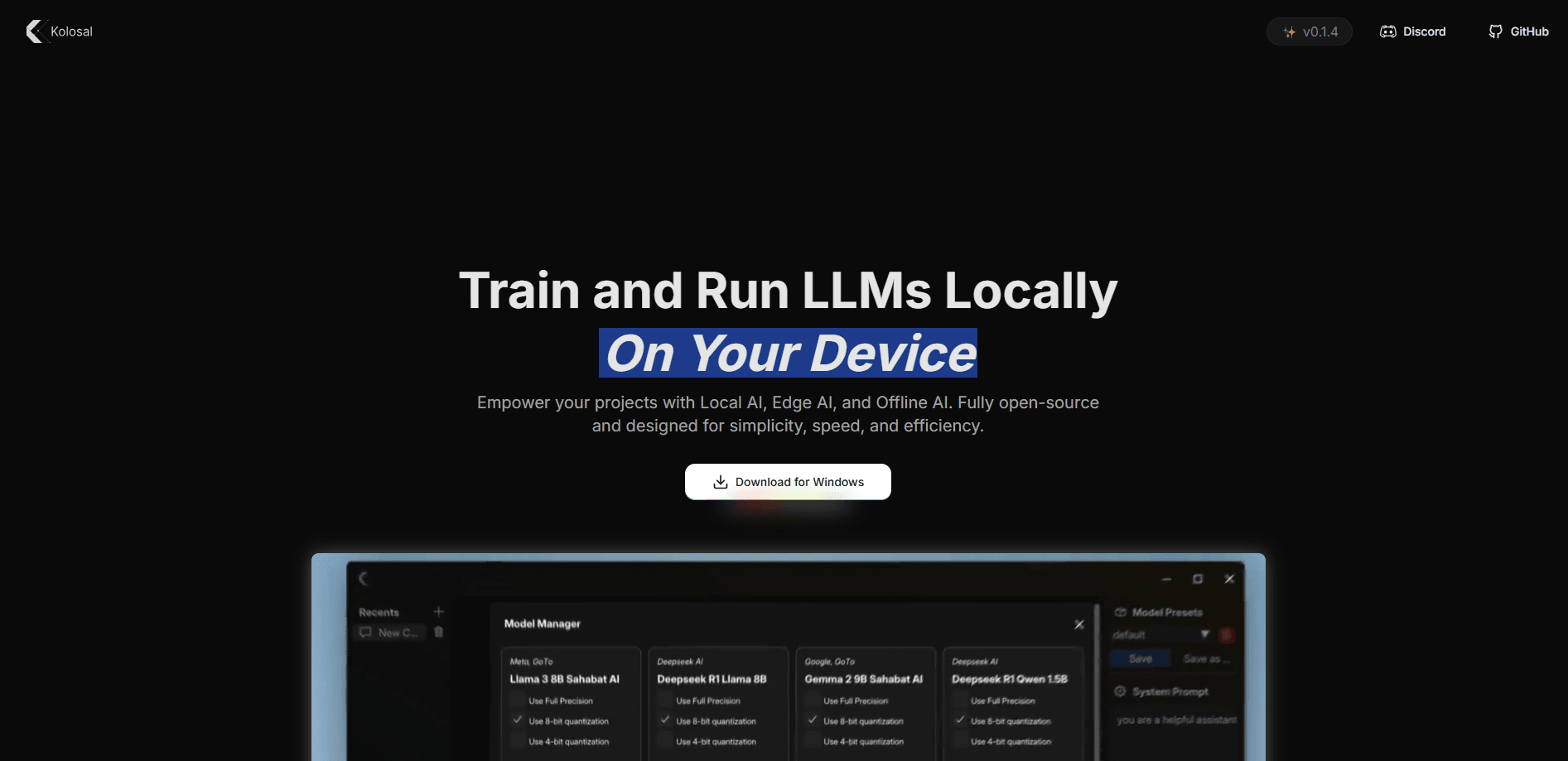
Kolosal AI is a lightweight open source desktop app for running and training large language models offline on your own hardware, built for privacy and edge devices.
About Kolosal AI
What Is Kolosal AI
Kolosal AI is an open source desktop application for running and training large language models on your own machine. It comes from the team at Genta Technology, a group focused on energy, privacy and on-premise computing. The app is written in C++ and compiled down to roughly 20 MB, so it stays light enough for a laptop, a mini PC or a single-board computer like a Raspberry Pi.
The pitch is simple. You keep your prompts, documents and model weights on hardware you control, and you stop paying per token to a cloud API. That suits people who work with sensitive material, and anyone who wants a private AI assistant that still works when the internet does not. This local LLM desktop app runs models like Mistral, LLaMA and Qwen, and it handles both inference and fine-tuning, so you can tweak a model on your own data and deploy it locally.
The catch is that everything runs on your hardware, and your hardware sets the ceiling. Bigger models need more memory and a stronger GPU, and a lightweight desktop app will not match a cloud cluster for the largest workloads. The project is also younger than the established local model runners, so its community and documentation are still growing.
Getting Started
- Download the desktop build for Windows or Linux, or compile it from source with CMake and a C++17 toolchain
- Launch Kolosal AI and let it detect your CPU and GPU, from AVX2 CPUs to AMD and NVIDIA cards
- Pick a supported model such as Mistral, LLaMA or Qwen and let the app pull the weights
- Chat with the model locally, or build a dataset and train a custom version on your own data
- Serve the finished model on your machine or across your local network when you need to share it
Product Information
A quick look at Kolosal AI's pricing, supported platforms, and performance.
Best for
The users, tasks, and scenarios where this tool fits best.
Users
- Developers who want a local LLM runtime
- Privacy-first users
- Hobbyists on limited hardware
- Edge and on-premise teams
- Researchers and students
Tasks
- Offline chat and Q&A
- Custom model training
- Local document work
- Model experimentation
- Local serving
Scenarios
- Sensitive contracts or records
- No reliable internet
- Low-power edge hardware
- Learning AI hands-on
- Prototyping before you scale
Key features
Run LLMs Entirely Offline
Kolosal AI runs large language models on your own device with no cloud round trip. Once the weights are downloaded, chat and question answering work without a network connection. Summarising runs on device too. For anyone who does not want prompts to leave the machine, that offline design is the main reason to pick it over a hosted chatbot. It is a local LLM desktop app first, not a browser tab.
Lightweight Build for Edge Devices
Kolosal AI is a popular LM Studio alternative for people who want a smaller footprint. The compiled app is about 20 MB, which is tiny next to most local model runners. That small size is what lets it run on low-power hardware such as a Raspberry Pi or a fanless mini PC, where a heavier desktop client would struggle. For an edge AI deployment, that is the feature that keeps it usable.
Broad Hardware Support
Kolosal AI supports any CPU with AVX2 instructions, and it also runs on AMD and NVIDIA GPUs. That spreads it across a wide range of laptops, desktops and edge boards rather than locking you to one vendor. The app detects the hardware you have and uses it, so you do not need a top-tier GPU to get started.
Model Compatibility with Mistral, LLaMA and Qwen
Kolosal AI is an open source LLM tool, and it runs popular open models such as Mistral, LLaMA and Qwen on a personal inference engine built on top of llama.cpp. The models most people already know and download are the ones that work here. If you have a model in mind, there is a good chance it runs without extra setup.
Dataset Generation and Local Training
Kolosal AI does not stop at inference. You can build a custom dataset with minimal overhead and train language models locally with frameworks such as Unsloth, then deploy the result on your machine or as a small server. That makes it useful for tuning a model to your own data rather than only running someone else's weights.
Simple Local Deployment
Getting a model from weights to a working assistant takes a few steps rather than a full server setup. You load the model, run it locally, and serve it on your machine or across your network when you want to share it. For a small team that wants a private endpoint without a DevOps project, that low friction matters.
Open Source Under Apache 2.0
The project is licensed under Apache 2.0, so you can read the code, modify it and ship it in your own work without a license fee. That openness is part of the appeal for teams that need to audit what runs on their machines. It also means the project moves with the community rather than a single vendor's roadmap.
Pros and cons
Pros
- Runs models fully offline, so prompts and documents never leave your device
- Small compiled size of about 20 MB keeps it usable on low-power edge hardware
- Supports AVX2 CPUs plus AMD and NVIDIA GPUs for a wide range of machines
- Handles both inference and local fine-tuning, so you can build on your own data
- Free and open source under Apache 2.0, with no per-token cost
Cons
- Your hardware sets the ceiling, so larger models need more memory and a stronger GPU than a laptop usually has
- A lightweight desktop app is not matched to the largest training or inference workloads that cloud clusters handle
- Documentation and community are thinner than for more established local model runners, which can slow down troubleshooting
- There is no published desktop API in the repo, so integration work often leans on the separate Kolosal CLI
Frequently asked questions
Kolosal AI is an open source desktop application for running and training large language models on your own device. It comes from Genta Technology and is licensed under Apache 2.0. The app focuses on private, offline AI on laptops and edge hardware rather than cloud services.
Related content
Explore related tools, skills, and articles for Kolosal AI.
Kolosal AI Alternatives

Odyssey 3
Odyssey · OtherOdyssey-3 is Odyssey's foundation world model. It simulates physics in real time, turns a prompt into an interactive environment, and adapts to robots, cars and games.

JarvisCore
Prescott Data · Coding · Productivity · OtherJarvisCore is an open source Python runtime where AI agents work as equal peers on an agent mesh, claim tasks from a shared ledger, and reach external services through a zero-trust broker.
Clef
Cloudflare · Business · OtherClef is Cloudflare's open-source decision model for Workers AI. It returns calibrated probabilities for typed questions, not generated text, so agents can classify, route, and act fast.