

Kore.ai
Kore.ai · Voice & Language · Chatbot
Kore.ai is an enterprise AI agent platform built on its Artemis foundation. It builds, governs, and improves voice and digital agents for customer service, HR, IT, and recruiting.
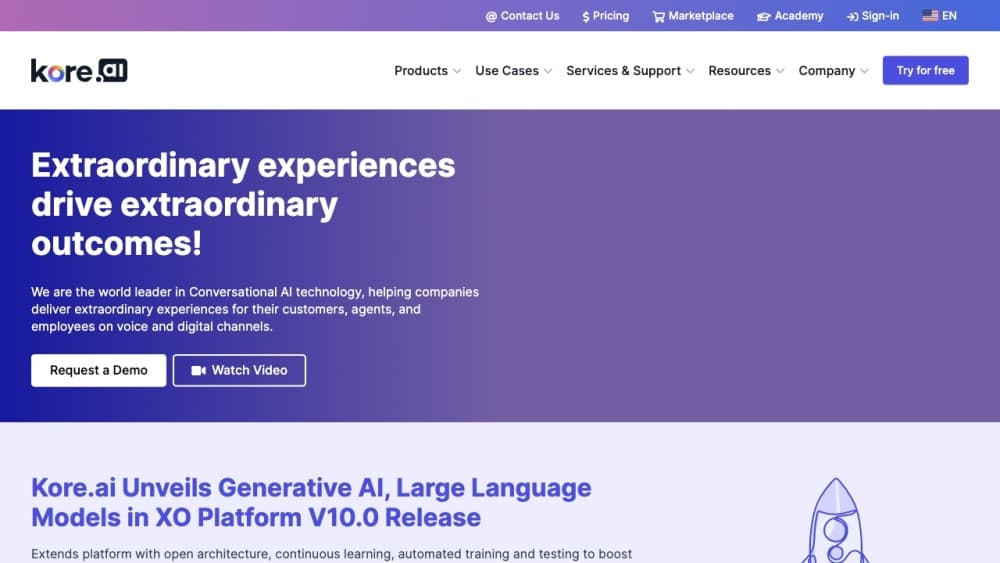
About Kore.ai
What Is Kore.ai
Kore.ai is an enterprise platform for building, running, and improving AI agents that handle real business work. It targets voice and digital customer service, employee support across HR and IT, recruiting, and knowledge-intensive processes. The core is Artemis, an AI-native foundation that has three parts. Arch turns plain-language intent into a full agent system with workflows, tools, and handoffs. ABL, the Agent Blueprint Language, is a typed way to define what an agent can do and which guardrails apply. Autoloop keeps testing and fixing agents against goals after they go live.
The pitch is reliability in places where other agents break. Kore.ai is built for complex, high-volume, and regulated workflows, with policy enforcement that sits outside the large language model so a response can't override a compliance rule. Every agent action is traced and auditable, and the company claims 100% observability over agent sessions rather than a sample.
Two things frame when this fits. This is an enterprise product, so pricing, deployment, and support run through a sales conversation, not a sign-up page with a monthly fee. And the value shows up in service and employee-support workflows. If you need a general-purpose chatbot for a personal project, it's heavier than what you need. For a large organization moving support volume off human queues, it's aimed straight at that problem.
Getting Started
- Request a demo on kore.ai and talk through your use case. Kore.ai runs a proof concierge that tests the platform against your own scenario before you commit.
- Design the agent. Business experts describe intent in plain language, and Arch turns it into agents, workflows, tools, policies, and handoffs written in ABL.
- Connect your systems. Agents draw on enterprise search across 100+ pre-built connectors and call live systems through API and MCP-based tools, so answers reflect current data.
- Test against goals. Set the goals an agent must meet for production readiness, and Autoloop builds, evaluates, and improves the agent until it passes.
- Deploy and keep improving. Agents go live on voice and digital channels, and Autoloop keeps evaluating them against the same goals from real interactions.
Product Information
A quick look at Kore.ai's pricing, supported platforms, and performance.
Best for
The users, tasks, and scenarios where this tool fits best.
Users
- Customer service teams
- HR and IT departments
- Enterprise AI and engineering teams
- Regulated industries
Tasks
- Auto-resolving customer cases
- Answering employee questions
- Automating repetitive workflows
- Screening and scheduling candidates
Scenarios
- Cutting contact center cost at high volume
- Offloading HR ticket volume
- Governing AI in a regulated workflow
Key features
Artemis Agent Platform
Artemis is the foundation everything else runs on. It's built for complex, high-volume, regulated workflows where agents have to behave the same way every time. Artemis handles the infrastructure, so teams start at business logic instead of plumbing. The company reports a 5x faster time to value and zero unauthorized agent actions as the design target, built around compiled intermediate representation, explicit memory contracts, and typed trace events for every decision.
AI for Service
The customer experience side covers voice and digital AI agents, agent assist, and AI-native quality management. Voice agents handle natural turn-taking, reason over context, and act across your systems in real time. Agent assist feeds human agents real-time suggestions and actions during live calls. Quality management auto-scores every call rather than the under-8% that manual review typically reaches, and surfaces compliance gaps and trends.
AI for Work
The employee side bundles enterprise search, HR, IT, and recruiting agents. Enterprise search retrieves permissioned, real-time answers from every connected system and shows where each answer came from. HR agents handle leave, documents, and payroll questions; IT agents reset passwords and triage tickets; recruiting agents source, screen, and schedule. The idea is one place for employees to ask and get something done, without a portal or a ticket.
Enterprise Search and Connectors
Search runs on agentic AI retrieval across 100+ pre-built connectors, combining semantic and keyword results, re-ranking them, then filtering to only what the person is allowed to see. It queries live systems directly through API and MCP-based tools, so answers reflect current data instead of a stale index. Answers stay grounded in chat history, connected apps, and the user's role.
Agent Blueprint Language and Arch
ABL is a typed, schema-driven language for defining agent behavior, tools, guardrails, orchestration, and handoffs in a structured way. Policies live outside the LLM, so an agent can reason while staying inside business, security, and compliance boundaries. Arch is the built-in solution architect that turns plain-language intent into ABL, so business experts can contribute and technical teams ship faster from tested patterns.
Autoloop and Governance
Autoloop is the optimization engine. You set the goals an agent must meet for production readiness, and it builds, evaluates, diagnoses, and re-fixes the agent until it passes, then keeps checking against the same goals after deployment. StateTrace captures the full execution path, and ABL maps a failed step back to the construct that caused it, so fixes target the cause instead of the whole agent. Compliance rules are enforced at the engine level, outside the model, with 100% observability over agent sessions.
Pros and cons
Pros
- Agents are built for complex, regulated workflows where many general-purpose agents stall, with policies enforced outside the model.
- Arch and ABL let business experts contribute in plain language while giving engineers a structured, governed definition.
- Autoloop keeps testing and fixing agents against goals in production, which reduces ongoing maintenance work.
- Pre-built use cases for banking, healthcare, and retail shorten the path to a working deployment.
- Pre-built connectors and agentic search pull permissioned answers from 100+ enterprise systems.
Cons
- There's no free plan or self-serve tier. Pricing is a custom quote, so a small team can't just try it and see.
- Deploying it needs your HR, IT, and service systems connected, which is real integration work before anything runs.
- The full value shows up at enterprise scale. For a personal or single-team use case, it's more platform than you need.
- Because it's an AI-native foundation, getting the most from it means committing to Kore.ai's way of defining agents, not dropping in a model you already use.
Frequently asked questions
Kore.ai builds and runs enterprise AI agents for customer service, employee support, recruiting, and process automation. Agents handle voice and digital conversations, resolve requests end to end, and connect to the systems where the work happens.
Related content
Explore related tools, skills, and articles for Kore.ai.
Kore.ai Alternatives

Foley
Hanamori Labs, LLC · Voice & Language · Productivity · AI AssistantFoley is a voice to-do list that turns a spoken sentence into a filed task, complete with project, date and time, then helps you plan the day around what is already there.

HireKey
HireKey · Voice & Language · Productivity · LeaningHireKey is an AI job search copilot built by a former tech recruiter. It checks role fit, tailors resumes, runs interview practice and tracks every application.

Fluence
Yay Software (Yannick Huchard) · Writing · Voice & Language · ProductivityFluence is an Android app that reads PDFs, EPUBs, Word files and web articles aloud, follows each sentence as it speaks, and answers questions about the text on the phone itself.