

Koreshield
Koreshield · Business · Other
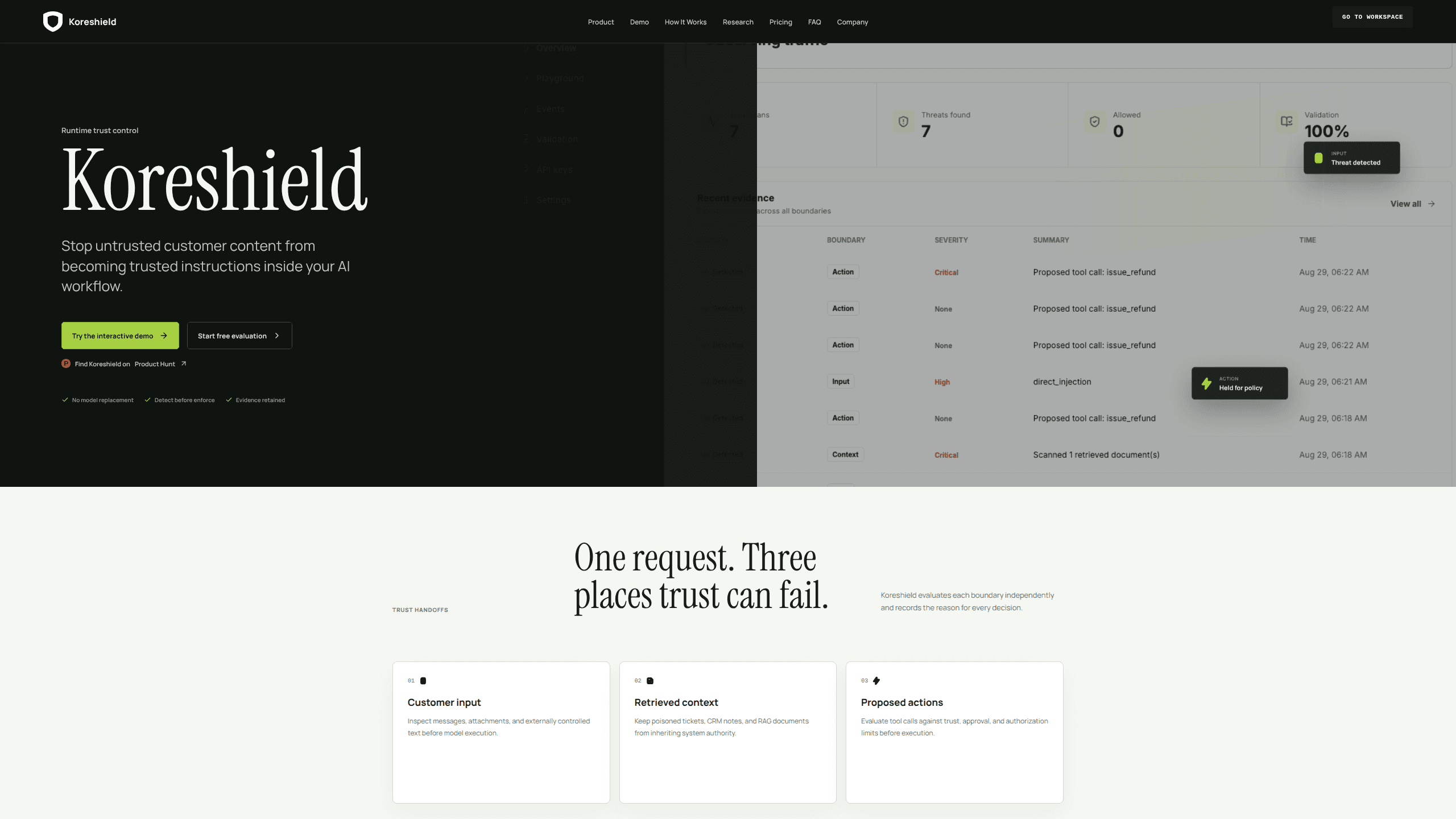
Koreshield is a runtime security and evidence layer for AI support agents. It checks customer input, retrieved context, and proposed actions before they reach the model or trigger a refund.
About Koreshield
What Is Koreshield
Koreshield is an LLM security platform built in the United Kingdom for companies that let AI support agents read customer messages, pull account data, and propose refunds or account changes. It sits between your application and the model as a runtime checkpoint. The model still does the reasoning. Koreshield decides whether the workflow should trust the input, the retrieved material, or the action that comes next.
The product targets a narrow gap. Model providers protect the model itself, yet they do not know your customer, your refund limit, or whether an agent may close an account. Koreshield adds that business context at three boundaries and records why each request was allowed, held, or blocked. The checks work as AI guardrails for the request path, not as a replacement for your approval rules. Those records matter when security, compliance, or legal asks for proof weeks after an incident.
Its limits are stated on the site and they are real. Koreshield does not replace identity or authorization systems, it does not promise complete attack coverage, and it does not inspect arbitrary files or images today. Treat it as one control in a wider AI workflow security program, not as a substitute for your approval rules.
Getting Started
- Create a workspace at koreshield.ai/access. The evaluation runs for 7 days, includes 10,000 protected requests and one API key, and needs no credit card.
- Generate a server-side scan key in the console. Store it in your secret manager, because the key should never ship in browser JavaScript.
- Choose one boundary to start with: customer input at /v1/scan, retrieved context at /v1/rag/scan, or a proposed action at /v1/tools/scan.
- Run detect mode beside live traffic and review the decisions, including the requests that would have been blocked.
- Switch on enforce mode once the customer-facing fallback, operator escalation path, and retry behavior are clear. Store each returned request ID next to your own trace.
Product Information
A quick look at Koreshield's pricing, supported platforms, and performance.
Best for
The users, tasks, and scenarios where this tool fits best.
Users
- Support operations leads at e-commerce and DTC brands
- Security and GRC teams at B2B SaaS companies
- Engineering teams at regulated financial services firms
Tasks
- Screening customer messages before prompt assembly
- Checking retrieved ticket notes and policy documents
- Reviewing proposed refunds and account changes before execution
- Collecting evidence for a security review
Scenarios
- An AI support pilot is about to touch production traffic
- A customer message looks like an attempt to extract another account's data
- A security questionnaire asks how AI agents are controlled
Key features
Input Scans Before the Model
Every support workflow starts with text from someone outside your company. The input scan inspects that text before it enters the model context. It looks for instruction overrides, attempts to pull private data, and other hostile patterns, then returns a decision with a severity and a confidence score. This is the first place teams add prompt injection protection, and it is often the easiest to verify with real tickets.
Retrieved Context Checks for RAG
Support agents rarely answer from the model alone. They pull policy pages, order history, ticket notes, and CRM snippets into the prompt. The RAG scan checks selected documents and chunks before prompt assembly. That step matters when a knowledge base can be edited by customers, partners, or a compromised internal account. A poisoned article that never reaches the prompt cannot steer the answer.
Action Review Before Tool Execution
The third checkpoint evaluates proposed tool calls. A refund, a payment link, an account closure, or a data export is a business action, and the model does not know your approval limits. Koreshield reviews the arguments and the authorization context before execution, then returns a decision your application can follow. Your application still owns identity, permissions, and the final call.
Detect Mode With Decision Evidence
Detect mode records threats without interrupting traffic. Each event includes a request ID, a severity, a confidence score, and the indicators that fired. Support and security teams can review false positives and misses against live behavior before changing what customers see. The approach fits companies that need proof before they put a block in front of a revenue workflow.
Enforce Mode With a Fallback Path
Enforce mode stops requests that violate policy. It is designed to be turned on after detect mode has shown what normal traffic looks like. The site tells teams to define the customer message, the operator escalation path, and the retry behavior first. That advice is practical: a blocked refund with no fallback creates a support ticket, not a security win.
Hosted Console and Scoped API Keys
The hosted console handles keys, evidence review, policy changes, mode switching, and validation. Scan keys are separate and revocable, and the scan-only OpenAPI contract lets an agent platform import the three checks without exposing billing, team administration, or evidence review as model-selectable tools. Koreshield can run as a hosted service or as a FastAPI service with PostgreSQL inside your own infrastructure.
Pros and cons
Pros
- Works beside your current model provider. There is no model replacement and no need to move prompts to a new vendor.
- Three checkpoints map to the way a support request actually moves: customer text, retrieved context, then a proposed action.
- Detect mode produces evidence before enforcement, which lowers the risk of blocking legitimate refunds during a rollout.
- The decision record includes a request ID, severity, confidence, and indicators, so an engineer can trace a block back to a real event.
- Pricing is published. Starter covers 250,000 protected requests for £20 per month, and Growth covers 2 million for £99.
Cons
- It does not replace your authorization system. Identity, approval limits, tenant isolation, and execution stay in your application.
- Files and images are not inspected today, so an agent that reads attachments needs another control for that path.
- The company does not promise complete attack coverage, which means the tool cannot be your only defense against prompt injection.
- Integration needs server-side work. Teams without backend engineers will struggle, and no-code agent builders have no direct path.
Frequently asked questions
Koreshield protects the point where untrusted content becomes trusted inside an AI support workflow. It scans customer input, retrieved context, and proposed tool actions, then returns a decision with evidence. The model and your application keep their existing roles.
Related content
Explore related tools, skills, and articles for Koreshield.
Koreshield Alternatives

Knocket
Knocket (Tencent RTC team) · Productivity · Business · ChatbotKnocket is a free live chat and contact page tool that lets visitors message you from your website, app, or a shareable link, with every reply handled from Telegram or one inbox.

shippedit.me
Krawlup · Marketing · Businessshippedit.me now redirects to Krawlup, a web platform that audits SEO, AEO and page speed every week, then hands the fixes to AI coding agents over MCP.

Ayven
Alknoma · Productivity · BusinessAyven is an AI control centre by Alknoma that turns a plain-language goal into a dated plan, hands the work to your people and AI agents, and asks for your approval only when the call is yours.