

KugelAudio
KugelAudio · Voice & Language
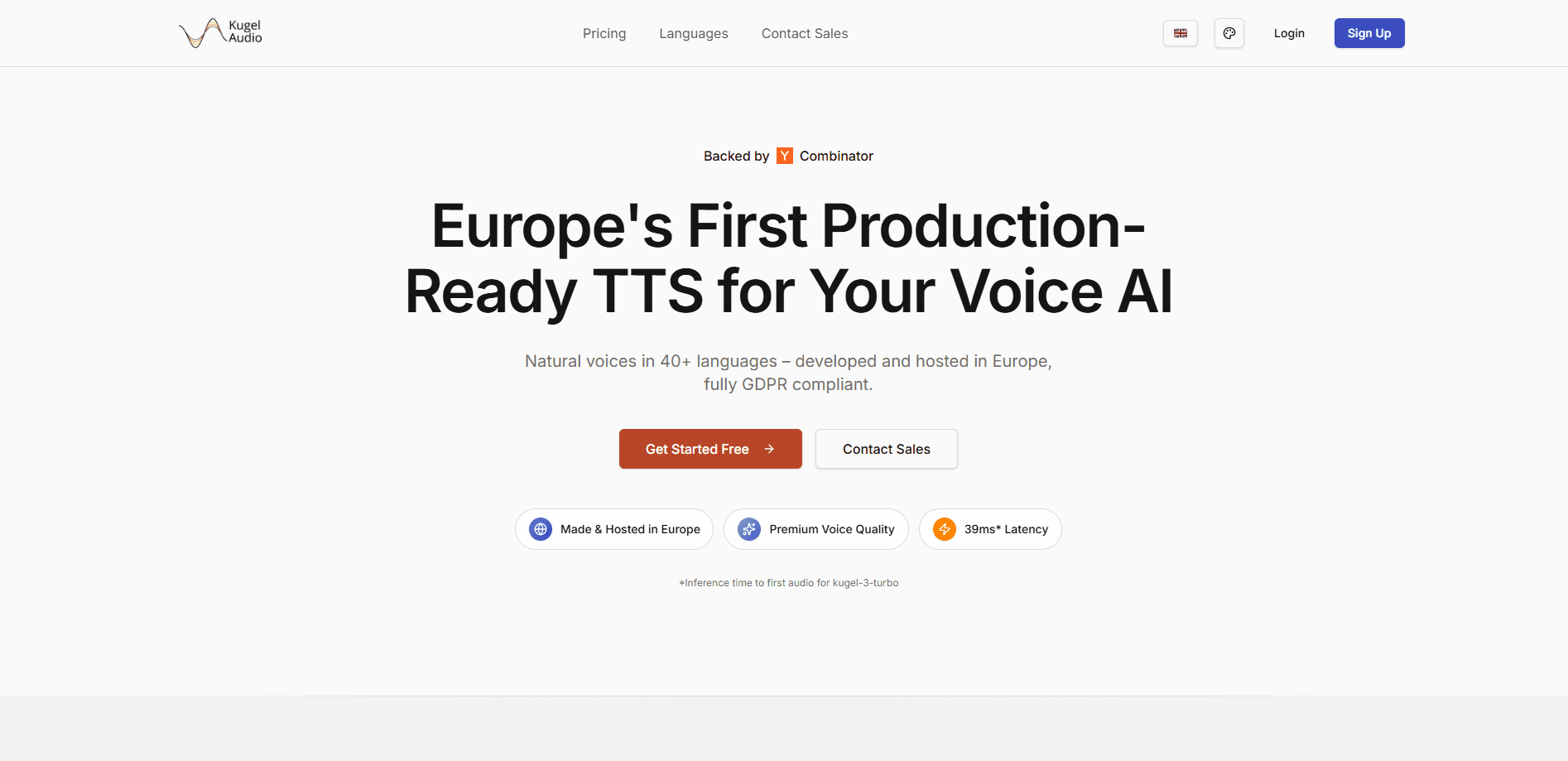
KugelAudio is a text-to-speech API built for real-time voice AI, and it ships from Europe. The platform runs a multilingual TTS model called Kugel 3 that speaks 39 languages, clones a voice from a short audio sample, and streams audio to your app in 60 to 80 milliseconds. If you're wiring speech into a voice agent, a call center tool, or a narration pipeline, KugelAudio is aiming at the latency and data-residency problems that usually slow those projects down.
About KugelAudio
What Is KugelAudio
KugelAudio is a text-to-speech platform for developers who need voice output fast and want their audio processed inside the EU. It exposes one main production model, Kugel 3, through a hosted API with a direct European endpoint. You send text, pick a voice, and get back audio you can stream or save. Simple as that.
The core pitch is control. European teams often get stuck between cheap US-hosted TTS and expensive self-managed infrastructure. KugelAudio sits in the middle, offering guaranteed EU hosting, an EU Sovereign Cloud option, and an on-premise tier for companies that can't send audio data off their own servers. Support runs across 39 languages, so a single model covers a multilingual product instead of forcing you to stitch several vendors together.
There are limits worth knowing up front. It's an API product, not a consumer app, so you'll need some coding to use it. Pricing is billed per generated audio minute. That rewards predictable usage but can surprise teams with spiky traffic. And you can't just download it and run it on a laptop unless you're on the enterprise on-premise plan.
Getting Started
- Sign up at kugelaudio.com and grab your API key from the dashboard.
- Install the SDK for your stack, either
pip install kugelaudiofor Python ornpm install kugelaudiofor JavaScript. - Send a request with your text, a
model_idofkugel-3, and a voice ID. Addbreaktags if you want pauses in the delivery. - Pick streaming or a full file. WebSocket streaming pushes audio chunks as they're generated, which is what you want for a live conversation.
- Clone a custom voice if you need one, using 10 to 30 seconds of clean reference audio.
Product Information
A quick look at KugelAudio's pricing, supported platforms, and performance.
Best for
The users, tasks, and scenarios where this tool fits best.
Users
- Backend and voice-app developers
- European product teams
- Enterprises with strict data policies
Tasks
- Building voice agents
- Cloning brand voices
- Narrating content at scale
- Localizing speech
Scenarios
- Customer support lines that need quick, natural-sounding responses in multiple languages.
- Interactive apps where a slow reply breaks the experience, like language tutors or accessibility tools.
- Regulated industries such as healthcare and finance, where keeping audio in-region isn't optional.
- Teams replacing a self-managed TTS stack to cut the engineering overhead of running their own inference.
Key features
Real-Time Streaming Over WebSocket
KugelAudio streams audio chunks as the model generates them rather than waiting for a whole file. That matters most when your text arrives token by token from a language model, since the voice can start speaking before the sentence is finished. For a voice agent, this is the difference between a natural back-and-forth and an awkward pause.
Kugel 3's Low Latency
The flagship model hits roughly 60 to 80 ms time to first audio, and the lighter kugel-2-turbo model gets down to about 40 to 50 ms. According to KugelAudio, these figures are measured server-side. That's fast. If you're building something conversational, the gap is small enough to disappear in normal use.
Voice Cloning From Short Samples
You can create a custom voice from just 10 to 30 seconds of clean reference audio, with no fine-tuning round required. Brands use this to keep a narrator consistent across hundreds of clips, and support teams use it to give a bot a recognizable identity that customers learn to trust over time. The recording needs to be clean. Noisy source audio will hurt the result.
39-Language Multilingual Model
Kugel 3 covers 39 languages, from English and German to Japanese, Korean, Arabic, and Chinese, all through a single model. You don't pick a different engine per language, which simplifies a codebase that serves users in several countries. This is the low-latency TTS setup multilingual products usually have to assemble from several vendors. You can also use IPA notation to control exactly how a word is pronounced.
EU Hosting and Sovereign Cloud
Every plan includes guaranteed EU hosting, and the EU Sovereign Cloud is bundled in for EU and EEA customers. Need hardened EU-hosted TTS? This is one of the few low-latency options that makes the European angle the headline. For teams that treat data residency as a hard requirement rather than a nice-to-have, it removes a common blocker before a project even starts.
Fine-Grained Delivery Control
The API supports break tokens for pauses, speed control, word-level timestamps, and custom dictionaries. Timestamps are handy for captioning and lip-sync work, while dictionaries let you fix how the model says product names and jargon. These are the details that decide whether generated speech sounds polished or robotic.
Python and JavaScript SDKs
KugelAudio ships SDKs for the two most common stacks, plus a plain cURL path for anything else. You install one package and call a generate method with your text and voice ID. It's a short path from sign-up to your first clip, which helps when you're prototyping something small.
On-Premise and Enterprise Deployment
Larger organizations can move to on-premise or dedicated deployment with higher concurrency limits, 24/7 support, and a dedicated account manager. Committed usage brings lower rates. This tier exists for companies that need to own the whole pipeline, from the model to the server it runs on, and to keep every byte of customer audio inside their own network.
Pros and cons
Pros
- EU hosting comes standard, which satisfies data-residency rules without extra work.
- Kugel 3 reaches 60 to 80 ms time to first audio, fast enough for live conversation.
- One model handles 39 languages, so multilingual products avoid a patchwork of vendors.
- Voice cloning needs only 10 to 30 seconds of reference audio.
- Streaming, cloning, timestamps, and dictionaries are included at every price tier.
Cons
- There's no free plan, so trying it means paying per generated minute from the start.
- It's an API-only product, which shuts out non-technical users who want a click-to-generate app.
- On-premise deployment sits behind enterprise pricing, so smaller teams can't easily test the self-hosted path.
- Costs scale with audio minutes. High-volume or always-on voice agents can rack those up fast.
Frequently asked questions
KugelAudio turns text into speech for real-time applications, most often voice agents, interactive apps, and large-scale narration. Developers call its API to get audio back as a stream or a file. It's built for products where speed and language coverage matter more than a friendly consumer interface.
Related content
Explore related tools, skills, and articles for KugelAudio.
KugelAudio Alternatives

Foley
Hanamori Labs, LLC · Voice & Language · Productivity · AI AssistantFoley is a voice to-do list that turns a spoken sentence into a filed task, complete with project, date and time, then helps you plan the day around what is already there.

HireKey
HireKey · Voice & Language · Productivity · LeaningHireKey is an AI job search copilot built by a former tech recruiter. It checks role fit, tailors resumes, runs interview practice and tracks every application.

Fluence
Yay Software (Yannick Huchard) · Writing · Voice & Language · ProductivityFluence is an Android app that reads PDFs, EPUBs, Word files and web articles aloud, follows each sentence as it speaks, and answers questions about the text on the phone itself.