

Kusho AI
KushoAI · Coding
Kusho AI is an AI testing platform that reads your API spec and writes runnable contract tests, adds security scans, and repairs the suite when your endpoints change.
About Kusho AI
What Is Kusho AI
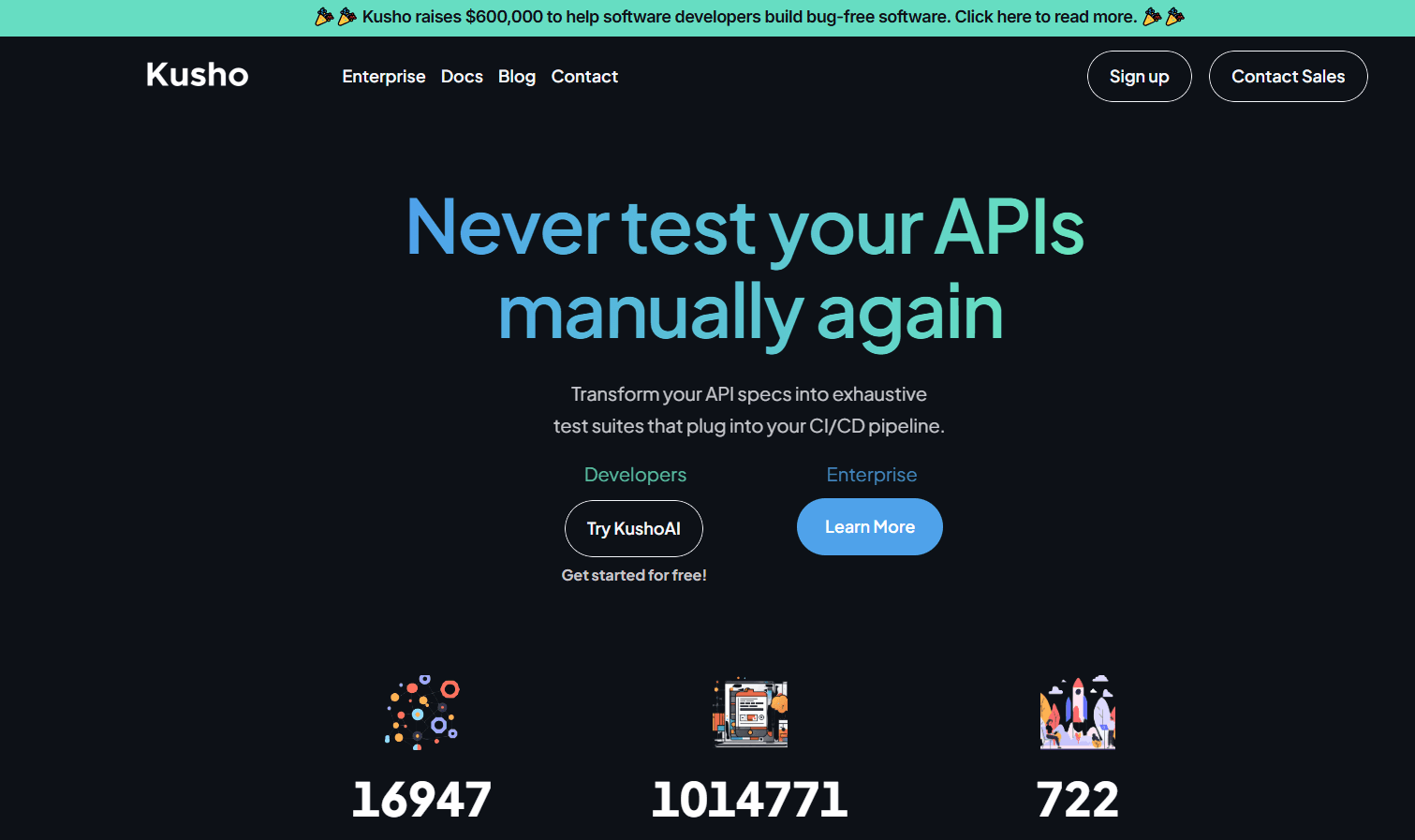
Kusho AI is a testing platform for teams that ship APIs and web apps. You point it at an OpenAPI file, a Postman collection, or a cURL command, and it returns a working suite of contract tests instead of a folder of empty templates. The company sells the product as reliability infrastructure: generation, execution, security scanning, and repair in one workspace.
The problem it targets is familiar to anyone who has kept an API suite alive. Tests get written once, the schema shifts, and half of them fail for reasons that have nothing to do with real bugs. Kusho AI watches for contract drift and updates the affected assertions, so the suite stays usable without a weekly cleanup session.
The pitch behind AI API testing tools is simple: stop paying engineers to rewrite the same checks. Whether Kusho AI delivers that depends on how much of your system is described in a spec. Teams with tidy OpenAPI files get results fastest. Teams with a decade of undocumented endpoints should expect a slower start.
Getting Started
- Sign up at app.kusho.ai with a work email or SSO, and start on the Developer Edition to check fit.
- Import your API definition as an OpenAPI spec, a Postman collection, or a single cURL call.
- Open the workspace, set environments and variables, then adjust auth headers and assertions where the generated defaults miss your rules.
- Connect your repository or CI pipeline so the suite runs on every change, and read the failure report after the first run.
Product Information
A quick look at Kusho AI's pricing, supported platforms, and performance.
Best for
The users, tasks, and scenarios where this tool fits best.
Users
- QA engineers
- Backend developers
- Engineering managers
Tasks
- API contract testing after a schema change
- Covering a legacy API with no tests
- Adding security checks to the pipeline
- Validating a multi-step workflow
Scenarios
- Pre-release gate before a merge
- Post-incident cleanup
- Tool evaluation before a wider rollout
Key features
API contract testing from a spec
Kusho AI reads request structures, response formats, auth setup, and the dependencies between endpoints, then checks every change against that contract. Breaking changes get flagged before they ship. You don't write the assertions by hand, which is the whole point.
Automated test generation for happy paths and edge cases
The generator produces positive and negative scenarios, boundary conditions, and response validation logic. Everything it outputs is executable from the first run. In practice you spend your time deleting a few irrelevant cases and tightening the rest, not building a framework.
Self-healing test suite when contracts drift
When an API evolves and tests start failing for structural reasons, Kusho AI detects the drift and updates the affected tests. Your suite stays current as the codebase moves. The feature is the strongest argument for teams that abandoned a previous automation project because maintenance ate the budget.
OWASP security scanning in the pipeline
Security tests run automatically in CI and look for vulnerabilities, misconfigurations, and access control risks based on how your API is actually built. That makes protection continuous rather than a quarterly exercise. Findings land in the same report as functional failures, so nobody has to reconcile two dashboards.
Release risk score for go or no-go calls
Each release gets a risk score computed from what changed, what was tested, and where failures happened before. Leaders get a signal without reading through logs. Treat it as an input to the decision, not a replacement for judgment on a Friday deploy.
CI/CD and tool integrations
The platform connects to code repositories, build pipelines, test management systems, issue trackers, and chat tools, and imports OpenAPI specs or Postman collections directly. CI/CD testing runs inside the build you already have, and results show up in Slack, Teams, and your existing QA reporting. Observability connectors for Datadog, Splunk, and Elastic are listed as coming soon, so don't plan around them yet.
Pros and cons
Pros
- Test generation starts from artifacts your team already maintains, so there's no migration project before the first run.
- The self-healing layer addresses the real reason API suites die: maintenance cost after schema changes.
- Security scanning and functional testing share one workspace, which cuts the number of tools a release depends on.
- The free Developer Edition covers up to 50 endpoints and a small team, enough for a real evaluation on your own code.
- Cloud, on-premise, and hybrid deployment options exist, which matters for regulated industries that can't send API traffic to a vendor cloud.
Cons
- Enterprise pricing is quoted per deal, so you can't compare costs without a sales call. Budgeting from the website alone isn't possible.
- Output quality drops on APIs with thin or missing documentation, and cleaning up those tests can cost more than writing them.
- Observability integrations are marked coming soon, so teams that want test results correlated with live metrics have to wait.
- The platform is built around CI-driven workflows. Teams without a pipeline get much less from the automation and end up running tests manually.
Frequently asked questions
It generates API tests from your spec, runs them in your pipeline, scans for security issues, and repairs tests when your contracts change. The output is a maintained suite rather than a one-time script.
Related content
Explore related tools, skills, and articles for Kusho AI.
Kusho AI Alternatives

Base Code
Base44 (Wix) · Coding · ProductivityBase Code is a shared cloud development environment from Base44. Teammates describe changes to an existing GitHub codebase in chat, preview them live and send them back as pull requests.

Google EmbeddingGemma 2
Google DeepMind · Writing · Image · CodingGoogle EmbeddingGemma 2 is a 740M-parameter open model that turns text, code, images, audio, and video frames into vectors in one 768-dimension space, running on phones and laptops.

GitGlow
GitGlow · Coding · ProductivityGitGlow is a local-first desktop Git client that lets independent developers review their own code and their AI agents' changes in one place before shipping.