

Kusion
KusionStack · Coding
Kusion is an open-source, intent-driven platform orchestrator for an internal developer platform. Developers write one AppConfiguration spec, and Kusion deploys the Kubernetes and cloud resources.
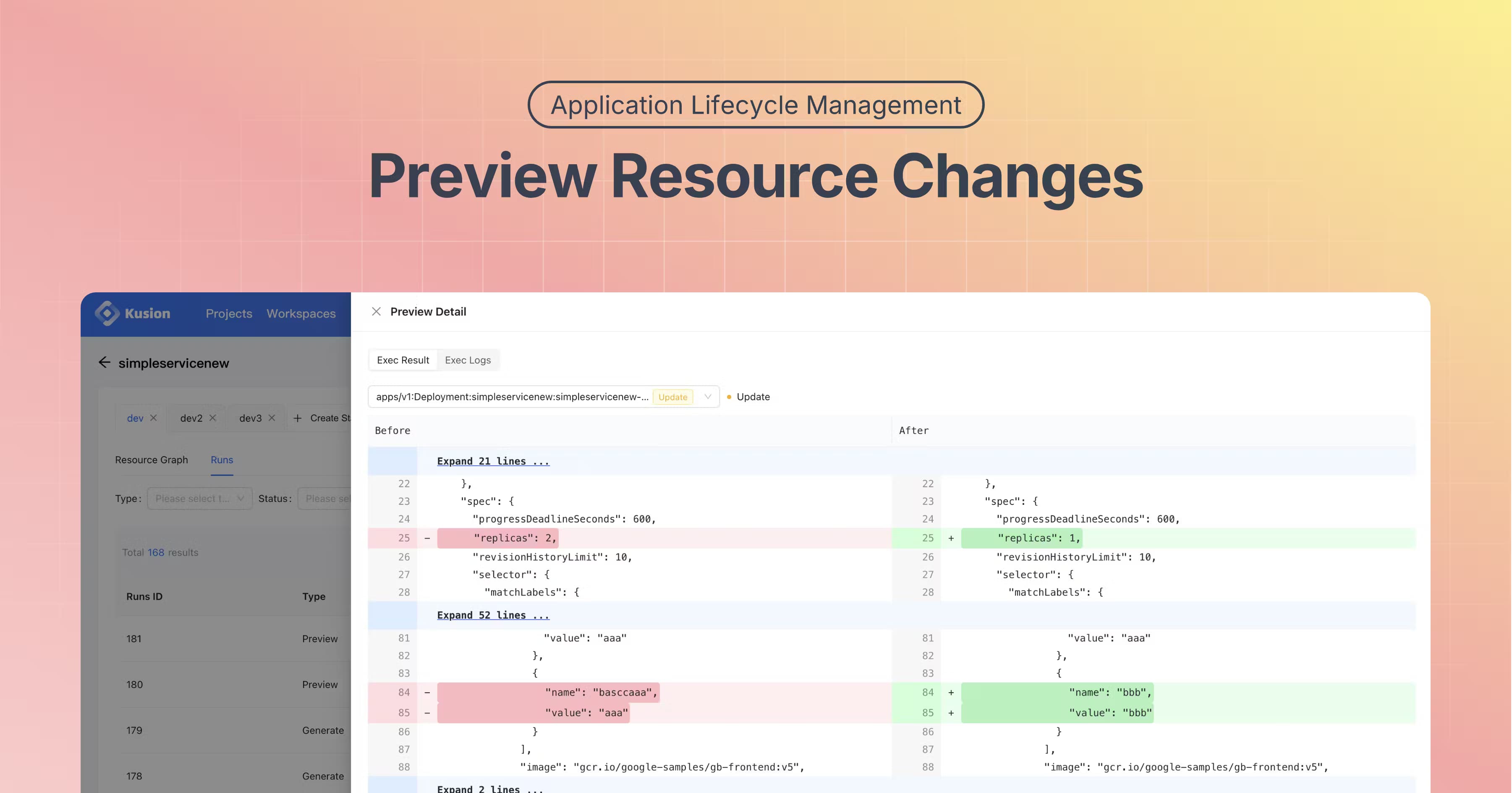
About Kusion
What Is Kusion
Kusion is a platform orchestrator built for teams that run an internal developer platform (IDP). It takes a single application specification and turns it into the workloads and supporting infrastructure an app needs to run. The project started at Ant Group and now lives under KusionStack as a CNCF Sandbox project, released under the Apache 2.0 license.
The problem it targets is familiar to anyone doing platform engineering. App developers face a pile of Kubernetes manifests, Terraform modules, and cloud settings before their code ever reaches a cluster. Kusion splits that work. Platform engineers build reusable modules and workspaces once, and app developers describe their intent without touching environment-specific values.
The main limit is scope. Kusion assumes you already run Kubernetes and want an IDP, so it is not a fit for a small team deploying a single service by hand. It is also an early-stage project, and the team says it is iterating quickly.
Getting Started
- Install the Kusion CLI with Homebrew, Scoop, or a shell script on macOS, Linux, or Windows.
- Set up a workspace that points at your Kubernetes cluster and any cloud providers you use.
- Write an AppConfiguration file that describes the workload, accessories, and dependencies for your app.
- Run
kusion applyto preview the planned resources and deploy them to the cluster. - Inspect the release record and repeat the flow through your CI/CD or GitOps pipeline.
Product Information
A quick look at Kusion's pricing, supported platforms, and performance.
Best for
The users, tasks, and scenarios where this tool fits best.
Users
- Platform engineers
- Application developers
- DevOps and SRE teams
Tasks
- Defining an app and its infrastructure in one spec
- Enforcing security and compliance rules
- Reusing infrastructure across environments
- Managing application metadata and resource graphs
Scenarios
- Rolling out an internal developer platform
- Standardizing multi-cloud delivery
- Wiring deployment into CI/CD or GitOps
- Onboarding developers to Kubernetes
Key features
Intent-Driven AppConfiguration
AppConfiguration is the single spec that describes an application. It covers the workload and all resource dependencies, and it does not require environment-specific values. Developers describe what they want, and Kusion works out how to provide it. The model breaks down into Workload, Accessory, Pipeline, and Dependency concepts.
Platform as Code
Kusion pushes infrastructure into declarative configuration code. You express the desired application intent, then any CI/CD system or GitOps flow drives deployment to match it. There are no ad-hoc scripts and no hand-maintained custom workflows to keep alive as teams grow.
Dynamic Configuration Management
Platform teams set baseline templates that control how and where workloads deploy and which accessory resources get provisioned. App developers keep freedom through a workload-centric spec. That split lets one team enforce standards while another moves fast on application logic.
Built-In Security and Compliance
Kusion ships base models that encode security and infrastructure best practices, and it works with third-party policy-as-code tools to add guardrails. Validation is codified and runs early, so configuration risks surface before a deploy. Accessory resource secrets are injected into workloads automatically.
Lightweight Client and Open Module Library
Kusion is a pure client-side solution, so it stays portable and easy to automate through its APIs. A growing module library covers the application lifecycle and connects to a range of infrastructure capabilities. Modules are decoupled enough that teams can write their own custom workloads.
Kusion Server and Developer Portal
Since v0.14.0, Kusion ships a long-running server with a Developer Portal. It offers the same functions as the CLI and adds application metadata management and visualized resource graphs. Projects, stacks, workspaces, and runs are managed centrally, with RESTful APIs for other systems to integrate.
KCL Configuration Language
Kusion builds on KCL, a configuration language from the same stack. KCL lets platform engineers write models and abstractions rather than repeating raw YAML. It keeps configuration validated and reusable, which is what makes the module model practical at scale.
Pros and cons
Pros
- Open source under Apache 2.0, with no license fee for the core tool.
- One AppConfiguration spec replaces scattered Kubernetes and cloud configuration.
- Runs as a lightweight client, so it fits existing CI/CD and GitOps setups.
- Modular design lets platform teams codify standards without blocking app developers.
- Kusion Server adds a Developer Portal and REST APIs for central management.
Cons
- Assumes you already run Kubernetes and want an IDP, so small teams gain little.
- Still an early-stage project with a fast-moving release cycle.
- Writing KCL and modules carries a learning curve for teams new to config languages.
- The module library is smaller than mature infrastructure-as-code tools, so some needs require custom work.
Frequently asked questions
Kusion deploys and manages applications on Kubernetes and cloud infrastructure through a single declarative spec. It fits the platform engineering role in a larger internal developer platform.
Related content
Explore related tools, skills, and articles for Kusion.
Kusion Alternatives

Base Code
Base44 (Wix) · Coding · ProductivityBase Code is a shared cloud development environment from Base44. Teammates describe changes to an existing GitHub codebase in chat, preview them live and send them back as pull requests.

Google EmbeddingGemma 2
Google DeepMind · Writing · Image · CodingGoogle EmbeddingGemma 2 is a 740M-parameter open model that turns text, code, images, audio, and video frames into vectors in one 768-dimension space, running on phones and laptops.

GitGlow
GitGlow · Coding · ProductivityGitGlow is a local-first desktop Git client that lets independent developers review their own code and their AI agents' changes in one place before shipping.