

l1m.io
l1m.io · Coding · Other
l1m.io is a structured data extraction API that turns text to JSON and image to JSON in one call. You define a schema, send the content, and get back exactly the fields you asked for.
About l1m.io
What Is l1m.io
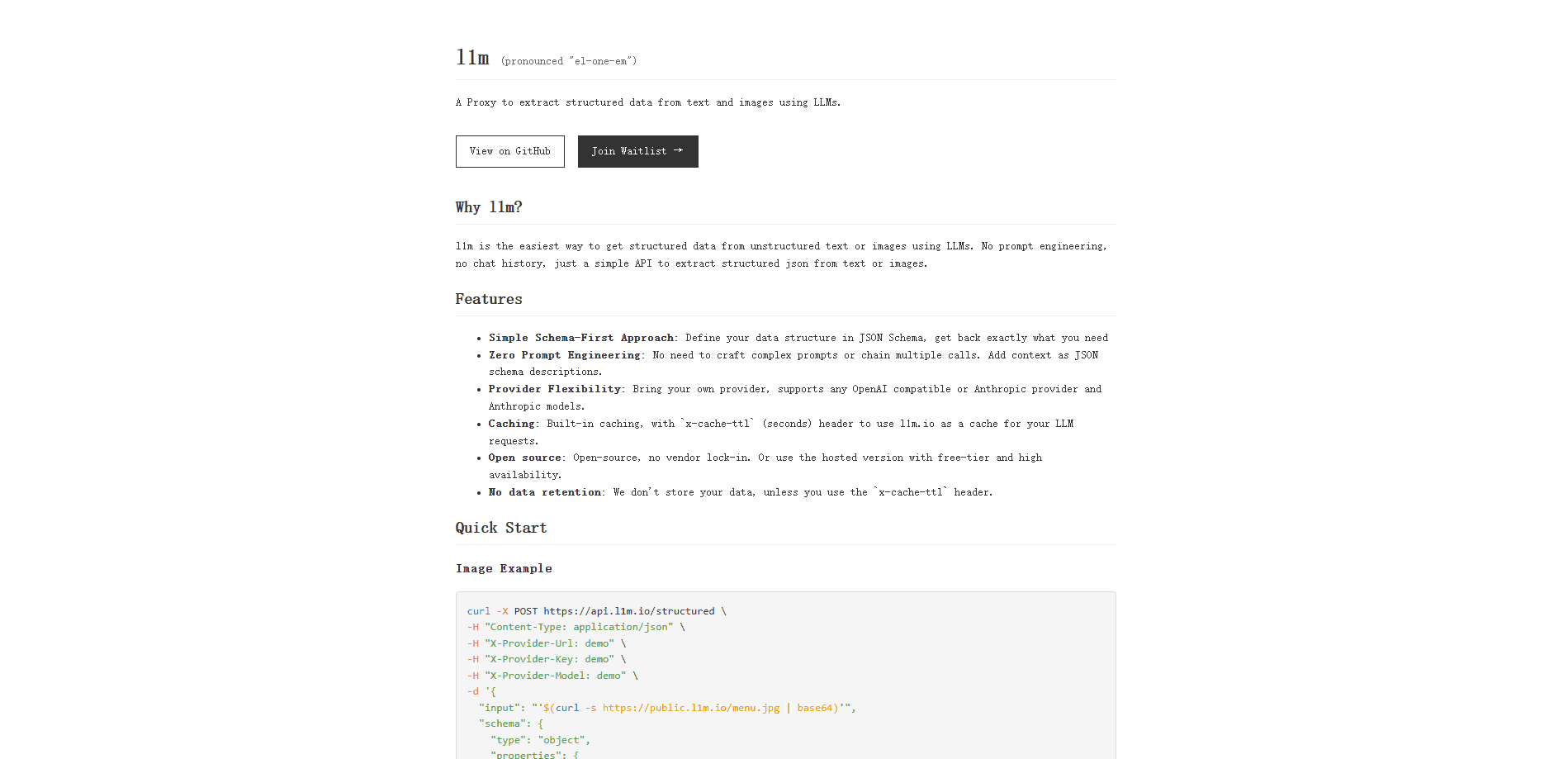
l1m.io is a small developer tool for pulling structured data out of unstructured text or images using large language models. The pitch is narrow and clear: skip prompt engineering entirely. You describe the shape of the answer you want as a JSON schema, send your input, and the service returns a matching JSON object. There's no chat history to manage and no multi-step prompt chain to tune.
The problem it solves is the messy last step of LLM data extraction. Getting a model to answer in a fixed, machine-readable shape is fiddly, and brittle prompts break the moment an input shifts. This structured JSON API moves that job into the schema itself, so the contract for the output lives in a data structure instead of a paragraph of instructions. If the model fails to return something that fits the schema, you get a 422 error rather than a malformed blob.
The main limits are worth knowing before you commit. The hosted version is still in open beta, so the team is asking people to join a waitlist for the production release. The supported schema is a subset of JSON Schema, not the full spec, so advanced constructs like one/any/allOf and min/maxLength are off the table. It's also a developer-facing API rather than an app, so you'll need a little coding to use it at all.
Getting Started
- Create an API key, or start with the demo provider headers the docs hand you for a first test call.
- Point the request at a provider by setting the provider URL, key, and model headers. Bring your own OpenAI-compatible or Anthropic account, or use a local model.
- Send a POST request to the structured endpoint with your input and a JSON schema that describes the fields you want.
- Read the JSON object back from the data property, and optionally set a cache TTL header to reuse the same result.
Product Information
A quick look at l1m.io's pricing, supported platforms, and performance.
Best for
The users, tasks, and scenarios where this tool fits best.
Users
- Developers building on LLMs
- Backend and data engineers
- Prototypers and indie builders
Tasks
- Pulling line items from a receipt or menu photo
- Tagging freeform text into fields
- Routing a request to the right action
- Caching repeat LLM lookups
Scenarios
- Adding a extraction layer to an existing app
- Testing an idea on a shoestring
- Building a private pipeline with local models
Key features
Schema-First Extraction
You describe the output with a JSON Schema object, and the service returns data shaped to match. It's the core of how l1m.io works: your requirements live in the schema rather than in a clever prompt. Nested arrays and enums are supported, which covers most real extraction jobs.
Zero Prompt Engineering
There's no prompt to write or chat history to manage. Extra context goes into schema field descriptions, so the wording that guides the model sits right next to the field it affects. That keeps extraction recipes readable and easy to change later.
Provider Flexibility
l1m.io doesn't lock you to one model vendor. You bring your own provider by setting a few headers, and any OpenAI-compatible endpoint or Anthropic account works. A demo provider returns pre-rendered answers so you can try the API before wiring up a real key.
Built-in Caching
A cache TTL header turns l1m.io into a cache for your extraction calls. The key is a hash of the input, schema, provider key, and model, and repeat requests within the window come back with a cache hit header instead of another model call. That trims cost on lookups you run often.
Open Source, No Lock-In
The project is open source, so you can run it yourself and avoid depending on the hosted service. The hosted version adds a free tier and higher availability for teams that would rather not manage the infrastructure. There's no data retention unless you turn caching on.
Official SDKs
l1m.io ships SDKs for Node.js, Python, and Go, so you don't have to hand-build requests in those languages. The REST endpoint stays callable from anything else, which keeps your options open if your stack isn't covered.
Pros and cons
Pros
- Schema-first design replaces fragile prompt chains with a structure you can version and reuse.
- Works with any OpenAI-compatible or Anthropic provider, so you keep your existing model stack.
- Free tier covers the first 500 requests, which is enough to prototype an idea.
- Caching header cuts repeat LLM costs without extra code.
Cons
- The hosted service is still in open beta, so you may need the waitlist before relying on it in production.
- The schema is a subset of JSON Schema, so advanced constructs like oneOf and min/maxLength aren't available.
- It's an API for developers, and non-coders have no point-and-click interface to fall back on.
Frequently asked questions
It turns text or images into structured JSON. You supply a schema describing the fields you want, and the API returns an object that matches it, which saves you from writing your own parsing or prompt logic.
Related content
Explore related tools, skills, and articles for l1m.io.
l1m.io Alternatives

Base Code
Base44 (Wix) · Coding · ProductivityBase Code is a shared cloud development environment from Base44. Teammates describe changes to an existing GitHub codebase in chat, preview them live and send them back as pull requests.

Google EmbeddingGemma 2
Google DeepMind · Writing · Image · CodingGoogle EmbeddingGemma 2 is a 740M-parameter open model that turns text, code, images, audio, and video frames into vectors in one 768-dimension space, running on phones and laptops.

GitGlow
GitGlow · Coding · ProductivityGitGlow is a local-first desktop Git client that lets independent developers review their own code and their AI agents' changes in one place before shipping.