

Laburen.com
Laburen · Coding · Chatbot
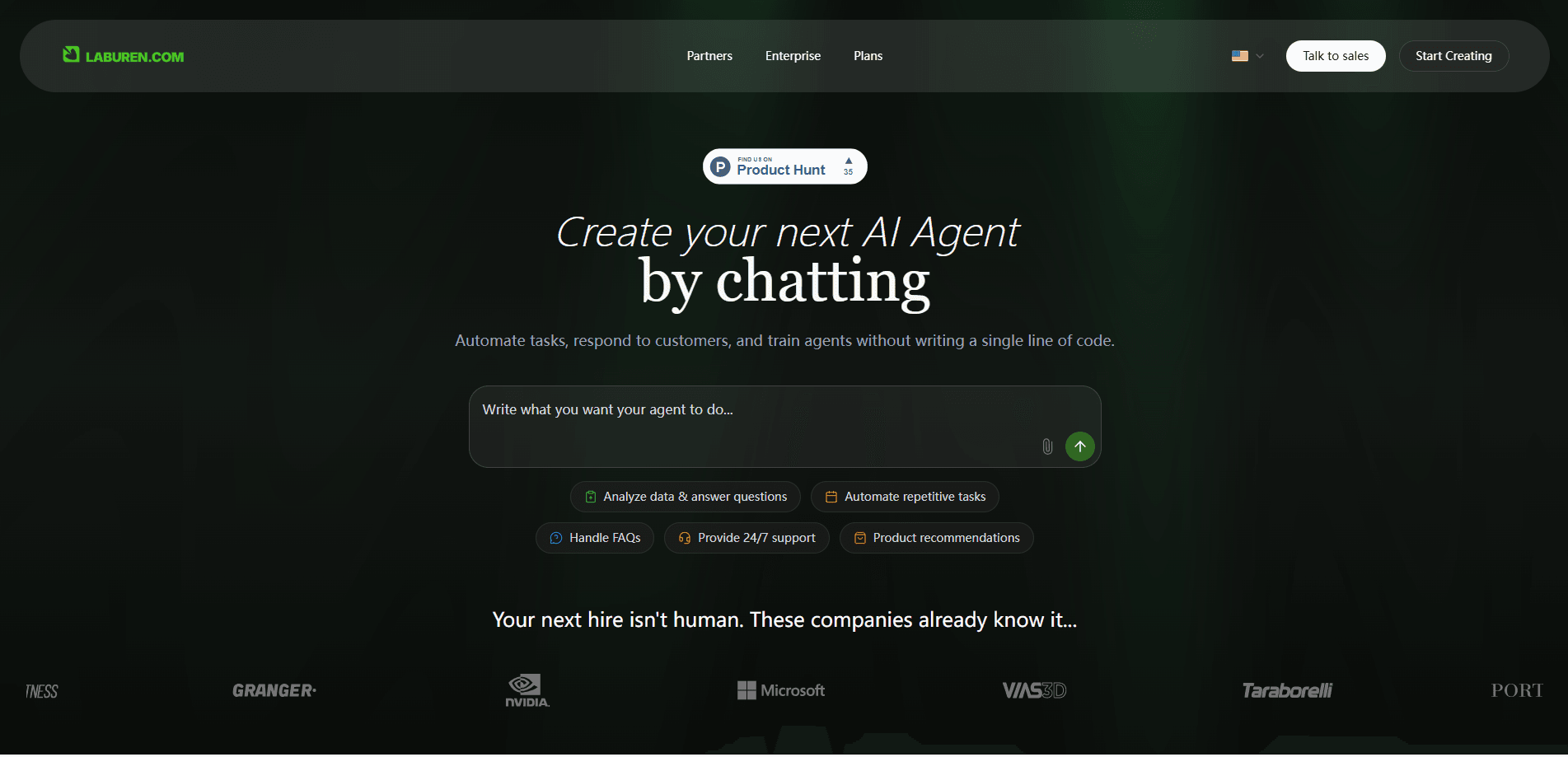
Laburen.com is a no-code AI agent builder for teams that want AI Employees handling sales, support and back-office work. Think of it as business automation you configure by describing a role, not by writing code. You connect it to the systems you already use, train each agent on your own data, and let it run tasks around the clock. The pitch is aimed at companies that want automation without hiring an engineering team to build it. Sounds ambitious. The site backs it with logos from Audi, Ford and Hertz, so the claims aren't coming from nowhere.
About Laburen.com
What Is Laburen.com
Laburen.com is a platform for creating AI Employees, which is the company's term for task-focused AI agents. Instead of writing code, you describe a role, connect your tools, and let the agent pick up repetitive work like answering tickets, qualifying leads or chasing unpaid invoices. The company says its agents run inside your existing stack rather than as a separate chatbot window. Put simply, AI agents trained on your data do the boring parts of the job.
The pitch from Laburen is blunt: AI projects fail on implementation, not on the technology itself. The platform leans on a mix of software and a human team that sets up the first agents with you. That setup help matters if you've never deployed an agent before. What you're buying is less a self-serve tool and more a guided rollout.
There are real limits. Laburen leans on assisted onboarding, so you can't just sign up and have a fully trained agent in an afternoon. Pricing isn't published on the site, and quotes come through a call. If you want a free, plug-and-play toy to poke at, this isn't it.
Getting Started
- Create an account at dashboard.laburen.com and pick the agent role you want to start with, such as support or sales.
- Connect the systems the agent needs, like your help desk, CRM or internal knowledge base.
- Feed it your data and documents so answers match how your business actually works.
- Review the agent's responses and adjust its scope before it goes live with real customers.
- Turn it on, then track results and expand it to other teams over time.
Product Information
A quick look at Laburen.com's pricing, supported platforms, and performance.
Best for
The users, tasks, and scenarios where this tool fits best.
Users
- Small and mid-size businesses that want to automate support or admin work without hiring engineers, as long as they can dedicate someone to setup.
- Sales and operations teams buried in repetitive follow-ups, provided the agent can reach their CRM and inbox.
- Founders and operators who've tried AI tools before and found them too generic to actually deploy.
Tasks
- Answering routine customer questions from your own help center and past tickets.
- Qualifying inbound leads and routing them before a human ever reads them.
- Chasing late payments with polite, scheduled reminders.
- Sorting and drafting responses to high-volume admin requests.
Scenarios
- A support inbox that never sleeps and floods every Monday morning.
- Onboarding new customers who ask the same ten questions.
- A small team that can't justify a full-time hire for one narrow chore.
Key features
AI Employees Trained on Your Data
Each agent learns from the documents, tickets and processes you feed it, so it answers in your company's language instead of generic boilerplate. Laburen stresses that agents are integrated with your systems, not bolted on as a standalone widget. That's the difference between an agent that quotes your real return policy and one that guesses. That's the difference between an agent that quotes your real return policy and one that guesses.
No-Code Agent Building
You set up an agent without touching code. Pick a role, connect tools, and describe what the agent should do. The trade-off is that Laburen pairs this with its own team for the initial rollout, so the fastest path to a working agent usually runs through a setup call rather than a solo weekend project.
Role-Based Agents Across Departments
What roles does it cover? Laburen ships templates for common jobs, including sales, support, admin, collections, operations and HR. That range means one platform can cover several teams instead of you juggling separate tools. It also sets an expectation: a single agent won't do everything well, so you're really configuring several narrow specialists.
Integration With Existing Systems
The agents plug into the tools you already run, so work moves through your normal channels. For teams worried about adoption, that's a plus. It also means your results depend on how well those connections are set up, which is why the onboarding help exists.
Human Team Behind the Rollout
Laburen doesn't just hand over software. It combines the platform with people who diagnose where automation will help most and configure the first agents. That's a real advantage if you lack in-house AI skills, and a downside if you wanted something you could run entirely on your own.
Guardrails and Scoped Autonomy
Agents are meant to stay inside the boundaries you set, so they handle routine work and hand off anything unusual. You decide how much autonomy each one gets. The practical effect is fewer runaway responses. It also means you need to define those boundaries up front.
Pros and cons
Pros
- No coding required, so non-technical teams can launch an agent.
- Agents trained on your own data tend to sound like your business, not a generic bot.
- Covers several departments, from sales to collections, on one platform.
- Backed by a human team that helps with setup and diagnosis.
- Runs inside your existing tools instead of forcing a new workspace.
Cons
- Pricing isn't public, so you have to book a call before you know what it costs.
- Heavier reliance on assisted setup means slower self-serve onboarding.
- Best results depend on clean data and well-connected systems you may not have.
- Little documentation on API access, which limits deeper custom builds and any hope of wiring Laburen into a larger internal stack the way a developer-led team would want.
Frequently asked questions
It's a platform for building AI agents, which Laburen calls AI Employees, that automate customer support, sales follow-ups and back-office tasks. You train each agent on your own data and connect it to the systems your team already uses.
Related content
Explore related tools, skills, and articles for Laburen.com.
Laburen.com Alternatives
Forefront
Forefront · CodingForefront is a web platform for building with open-source AI. It lets you fine-tune leading open-source language models on your own data, evaluate how they perform, and run them through an API or export them to host yourself. Developers who want the convenience of a closed-source platform but insist on owning their models and data are the target audience here.

Startkit
StartKit.AI · CodingStartkit is a boilerplate for building AI SaaS and AI wrapper products. Think of it as an AI startup boilerplate with the boring parts already wired up: authentication, Stripe and Lemon Squeezy payments, usage limits, transactional email, and an AI API starter that talks to OpenAI, Anthropic, Groq, or Llama. You clone the repo, set your price, and start on the part of your product that people actually pay for. It's Next.js under React and Tailwind, so most of the boilerplate code already feels familiar.
Testim
Tricentis · CodingTestim is an AI-powered test automation platform for building and running end-to-end tests across web, mobile, and Salesforce applications. It leans on machine learning to keep tests stable when an interface changes, so teams spend less time fixing broken selectors. Not bad for an automated testing tool you can start using today. You create tests by recording actions in a browser, then optionally add JavaScript when you need more control. It's a solid pick for busy QA teams.