

LakeSail
LakeSail · Other
LakeSail is a Rust-native data and AI platform built on Sail, a drop-in Apache Spark replacement that runs your Spark SQL and DataFrame code with no JVM and no rewrites.
About LakeSail
What Is LakeSail
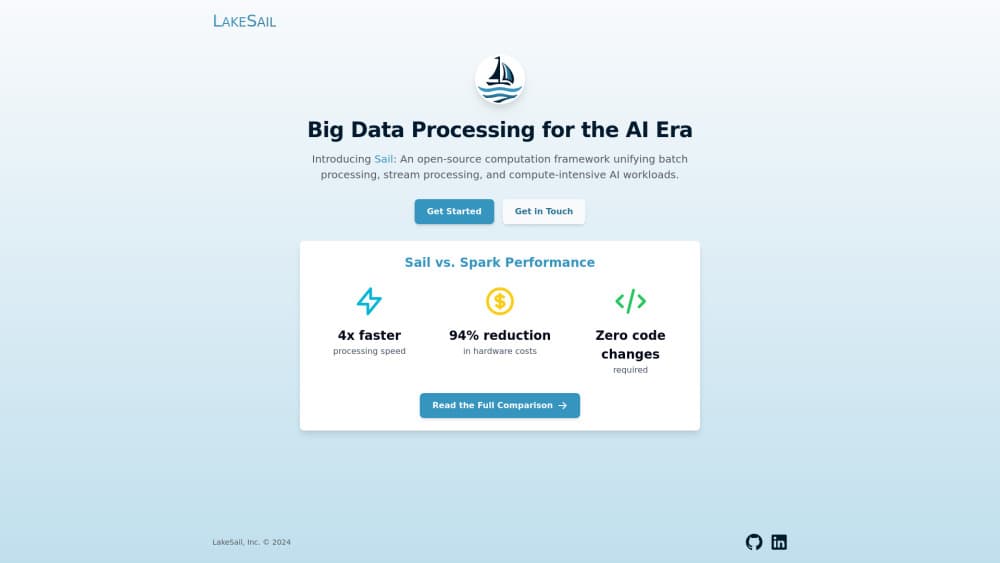
LakeSail is the company and platform behind Sail, an open source query engine written in Rust. Sail keeps the Apache Spark API and replaces the runtime underneath it. You point existing Spark Connect code at a Sail endpoint, and the same jobs run on smaller machines.
The pitch is narrow, which makes it easy to test. Most data teams don't want a new language or a new table format. They want last night's pipeline to finish before the morning standup and the cloud bill to stop climbing. Sail aims at that gap with native Delta Lake and Iceberg support, so your lakehouse tables stay exactly where they are.
The limits matter just as much. Sail is younger than Spark, and unusual workloads can still hit calls it doesn't support yet. LakeSail's free scanner tells you which ones before you commit. The managed platform also lives inside your own AWS account, so an admin has to launch a CloudFormation stack before the first query runs.
Getting Started
- Run the free Spark-to-Sail scanner on your SQL and PySpark code. It reports supported calls one by one and flags blockers.
- For a local test, install the Python package with pip and start a Sail server on your laptop. For the managed route, sign up with an email code instead.
- Connect AWS by launching the CloudFormation template in your account, then create a cluster with your own VPC range.
- Point your Spark session at the Sail endpoint, run a real job, and compare wall clock time and cost against what you pay today.
Product Information
A quick look at LakeSail's pricing, supported platforms, and performance.
Best for
The users, tasks, and scenarios where this tool fits best.
Users
- Data engineers with production Spark jobs
- Analytics leads on a fixed compute budget
- AI engineers who prepare training data
Tasks
- Moving batch pipelines off JVM Spark
- Generating embeddings at scale
- Killing idle cluster spend
Scenarios
- A nightly ETL job that keeps missing its SLA on the current cluster.
- A pilot where finance wants proof before approving a platform change, which fits the 14-day managed trial.
- Multimodal prep work over PDFs, images, audio, or robot logs, where Python libraries do the heavy lifting.
Key features
Drop-in Spark Connect compatibility
Sail reads the same Spark Connect protocol as Apache Spark. Swap the remote URL and existing notebooks, jobs, and orchestration DAGs keep working. That compatibility is the reason a migration can take one config line instead of a quarter of engineering time.
Rust-native engine with no JVM
The engine is written in Rust and executes on Arrow buffers without a garbage collector. Startup takes seconds rather than minutes, and there's no heap tuning to guess at. For teams who've spent years babysitting executor memory settings, that alone changes the job.
Native Delta Lake and Iceberg tables
Sail reads and writes Delta Lake and Iceberg directly from the engine. No connector layer, no conversion step, and no proprietary format locking your data to one vendor. Your lakehouse stays open, and other tools can still read the same tables tomorrow.
Python that runs inside the engine
Sail embeds a Python interpreter in the engine process, so PySpark UDFs read data in place instead of serializing rows to a worker. Vector work, model scoring, and text cleanup all get faster without changing your function signatures. It also means fewer moving parts when a job fails at 2 a.m.
Autoscaling and per-job provisioning
Clusters are provisioned per job and scale back down when the job ends. You pay for compute while it's working, not while it sits idle waiting for tomorrow's schedule. The cost dashboard shows the split between your AWS bill and the platform fee.
Runs inside your own AWS account
The managed platform deploys into your VPC. Data files, query results, and Glue catalogs stay in buckets you own, and LakeSail reaches them through a scoped IAM role you can revoke by deleting the stack. For regulated teams, that's often the difference between a pilot and a purchase order.
Free migration scanner and built-in orchestration
The Spark-to-Sail scanner checks SQL and DataFrame code in the browser and reports blockers before a trial starts. Jobs also get dependencies, cron schedules, and retries without a separate scheduler, and Airflow or Dagster can still drive them. Both features shorten the path from curiosity to a running pipeline.
Pros and cons
Pros
- Zero code rewrites for standard Spark SQL and DataFrame workloads, which removes the biggest cost of switching engines.
- Transparent per-vCPU and per-GiB pricing with no proprietary billing unit on top of your cloud bill.
- Python UDFs run in-process, so embedding and scoring pipelines avoid serialization overhead.
- Data stays in your AWS account, and the open source engine is Apache 2.0 licensed if you'd rather self-host.
Cons
- Spark compatibility isn't total. Edge-case APIs can still be missing, so the scanner result deserves a close read before you commit.
- The managed setup needs AWS admin rights for CloudFormation, which slows down teams with tight security review.
- Support on the managed plan runs on a 24-hour SLA, so a production incident may still need your own on-call engineer.
Frequently asked questions
The engine is free and open source under Apache 2.0, so self-hosting costs only your cloud bill. The managed platform adds a 14-day free trial, then charges $0.01 per vCPU-hour and $0.002 per GiB-hour of memory on top of AWS compute.
Related content
Explore related tools, skills, and articles for LakeSail.
LakeSail Alternatives

Odyssey 3
Odyssey · OtherOdyssey-3 is Odyssey's foundation world model. It simulates physics in real time, turns a prompt into an interactive environment, and adapts to robots, cars and games.

JarvisCore
Prescott Data · Coding · Productivity · OtherJarvisCore is an open source Python runtime where AI agents work as equal peers on an agent mesh, claim tasks from a shared ledger, and reach external services through a zero-trust broker.
Clef
Cloudflare · Business · OtherClef is Cloudflare's open-source decision model for Workers AI. It returns calibrated probabilities for typed questions, not generated text, so agents can classify, route, and act fast.