

Lamatic.ai
Lamatic AI · Coding
Lamatic.ai is an AI middleware platform where teams build agents visually, deploy them on serverless hosting, and monitor how they run, with 300+ models and prebuilt integrations.
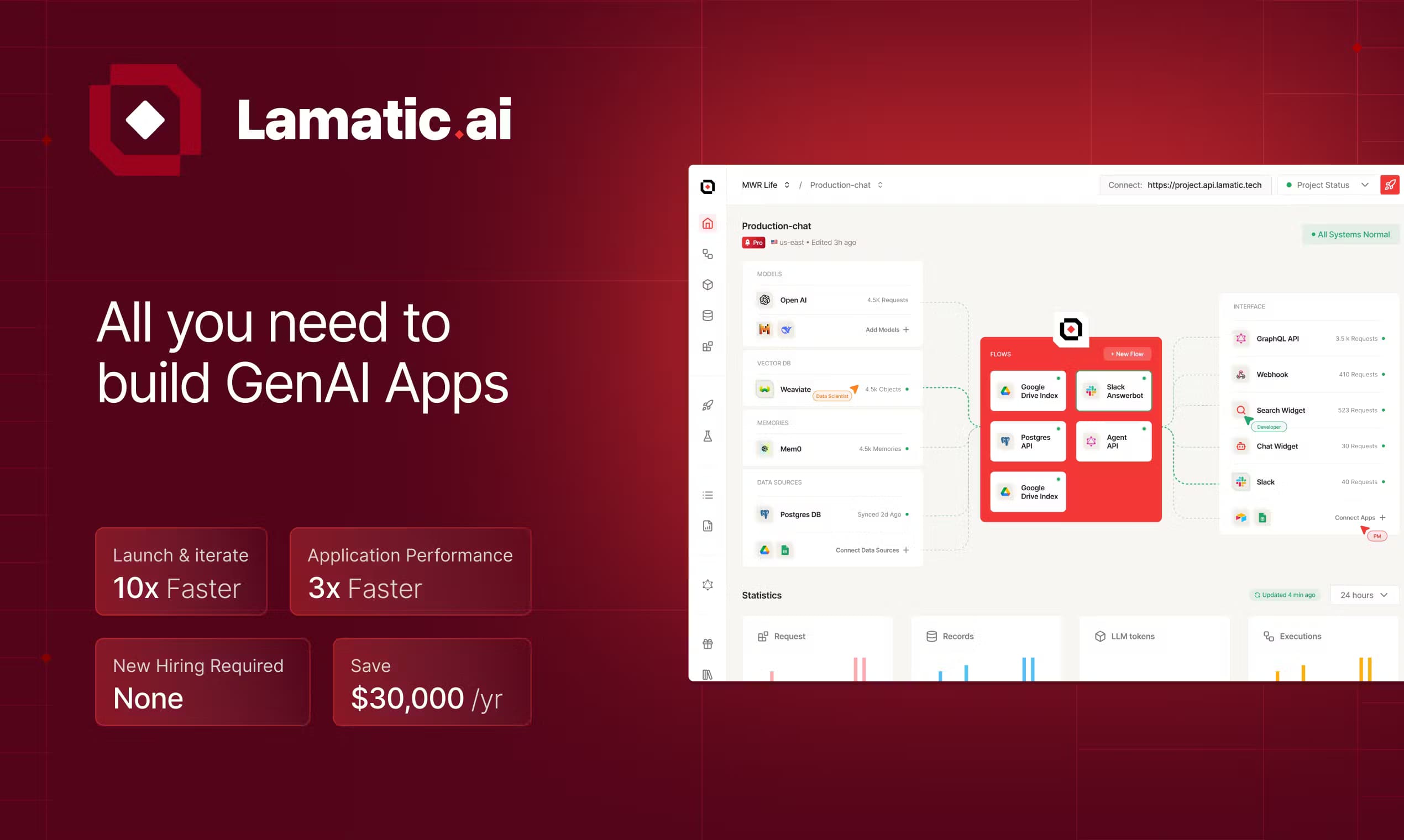
About Lamatic.ai
What Is Lamatic.ai
Lamatic.ai is an end-to-end platform for turning an idea into a working AI agent without writing the plumbing yourself. The company calls its approach AI middleware: you drag nodes onto a visual canvas to build a flow, connect the tools and data you already use, and let Lamatic handle the hosting and scaling underneath.
It sits between raw model APIs and a finished app. Instead of stitching together an LLM call, a vector database, a retriever and a backend by hand, you get those pieces as nodes you wire together and test in one place. That suits teams that have a clear use case, such as a support bot or a document search tool, but not the engineers to spare on infrastructure. Think of it as an AI agent builder and AI deployment platform rolled into one: you assemble the agent, then push it live from the same screen.
The tradeoff is control. Lamatic hides a lot of the stack, which speeds up common jobs but limits how far you can tune a single component. Teams with unusual requirements often end up dropping to the code node or calling models directly. The free plan is also capped at 3,000 requests a month, so heavier builds move to a paid tier quickly.
Getting Started
- Create a free account in Lamatic Studio; no credit card is required to start.
- Pick a template from the marketplace or open a blank flow, then drag AI, data, app, and logic nodes onto the canvas.
- Configure each node: choose a model, add your API keys and secrets, and connect a data source such as Google Drive or Airtable.
- Test the flow in the built-in IDE, then deploy it and call it from your app with the GraphQL API, a webhook, or the JavaScript and Python SDKs.
Product Information
A quick look at Lamatic.ai's pricing, supported platforms, and performance.
Best for
The users, tasks, and scenarios where this tool fits best.
Users
- Startup founders building an AI product
- Product and operations teams without backend engineers
- Developers who want speed over control
Tasks
- Building a chatbot on your own data
- Automating a recurring workflow
- Wiring AI into an existing app
Scenarios
- Shipping an MVP before a deadline
- Turning a manual research task into a flow
- Scaling a prototype to real traffic
Key features
Visual flow builder
This is where no-code AI workflows take shape. You build agents by placing nodes on a canvas rather than writing code end to end. AI nodes handle text, JSON, images, classification, and retrieval; data nodes cover search, memory, and vector stores; logic nodes add branches, loops, and conditions. The RAG workflows here are the common starting point: drop in a retriever, a vector store, and a text node, and you have a working answer pipeline. A flow editor with sticky notes keeps large graphs readable, and you can test each step as you go.
AI automation platform with 300+ text, image, and embedding models
Lamatic gives you one place to call text, image, and embedding models from major providers alongside open models. You swap the model per node, so a cheap model can draft while a stronger one reviews. Teams that want a specific provider can add a custom model instead of waiting for it to land in the catalog.
Prebuilt integrations and data sources
Connectors cover tools such as Google Drive, Google Sheets, Gmail, Airtable, AWS S3, GitHub, Firecrawl, and SQL databases. They act as the ingestion layer, pulling files and rows into a flow for vectorization or indexing. This is the part that usually takes a month of setup when you build it yourself, and here it is a click.
Serverless deployment and scaling
Once a flow works, Lamatic hosts it on serverless infrastructure and scales it as traffic grows. Edge deployment and request caching aim to keep latency low, and the company states you can cut latency in half and serve millions of users without managing servers.
Monitoring and iteration
Real-time tracing, logs, and performance dashboards show what each agent actually did on a run. You can spot a failing step before customers report it, and log retention and scheduled jobs support ongoing tuning. Reports and failover handling cover the operational side.
Developer SDK, GraphQL API, and widgets
The platform ships JavaScript, Next.js, and Python SDKs plus a GraphQL API, so you can execute a flow from your own code in a line or two. Webhooks let external systems trigger flows, and embeddable widgets let you drop an agent into a web page without building a front end.
Pros and cons
Pros
- A genuinely free tier with 3,000 requests a month and no credit card, so you can build and test before paying.
- Visual builder plus 300+ models in one place, which cuts the setup that normally goes into a working agent.
- Prebuilt connectors for Google Drive, Gmail, Airtable, S3, and more remove the usual data-pipeline work.
- Serverless hosting, tracing, and dashboards mean you ship without standing up your own infrastructure.
Cons
- The free plan caps you at 3,000 requests, 5 flows, and 5 integrations, so anything real hits a paid tier fast.
- Hiding the stack speeds things up but limits fine control, and unusual needs push you into the code node.
- Integration and record add-ons bill separately ($20 per integration, $60 per 10K records), so the true cost climbs above the headline price.
- Documentation and templates assume some familiarity with flows and APIs, so a pure beginner faces a learning curve.
Frequently asked questions
Lamatic.ai is used to build, deploy, and monitor AI agents and agentic apps. Teams create a flow in a visual builder, connect models and data sources, and run it on hosted infrastructure in production.
Related content
Explore related tools, skills, and articles for Lamatic.ai.
Lamatic.ai Alternatives

Base Code
Base44 (Wix) · Coding · ProductivityBase Code is a shared cloud development environment from Base44. Teammates describe changes to an existing GitHub codebase in chat, preview them live and send them back as pull requests.

Google EmbeddingGemma 2
Google DeepMind · Writing · Image · CodingGoogle EmbeddingGemma 2 is a 740M-parameter open model that turns text, code, images, audio, and video frames into vectors in one 768-dimension space, running on phones and laptops.

GitGlow
GitGlow · Coding · ProductivityGitGlow is a local-first desktop Git client that lets independent developers review their own code and their AI agents' changes in one place before shipping.