

Landing Page Roast
Shuffle · Coding
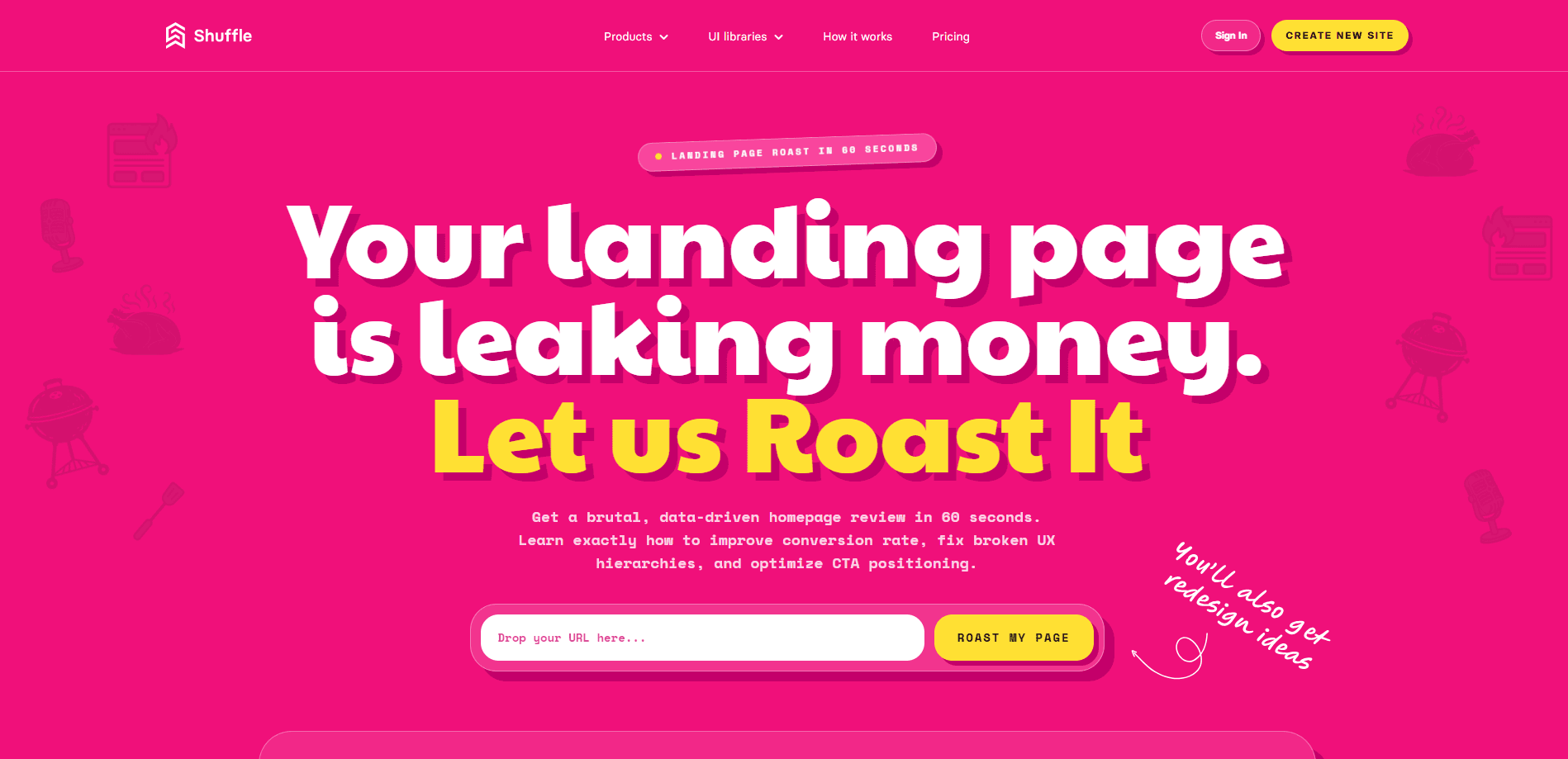
Landing Page Roast is an AI landing page audit tool from Shuffle that reads your page the way a picky visitor would. It scans the whole thing in about 60 seconds, then points out where conversions leak: foggy headlines, buried calls to action, trust signals missing above the fold. Instead of just listing problems, it hands you editable redesign concepts you can tweak and export, so founders, marketers, and developers get a sharper page without booking a designer.
About Landing Page Roast
What Is Landing Page Roast
Landing Page Roast is a critique tool built by Shuffle, the company behind a visual website editor. You give it your page URL and it comes back with a structured review of what is working and what is quietly bleeding signups. The focus is on the first impression: whether the hero says who the page is for, whether the primary action is unmissable, and whether proof points show up before doubt sets in.
The appeal is speed. A human designer might take a day to deliver a conversion audit, and a full agency review costs real money. Landing Page Roast runs its check in about a minute, which makes it practical to roast several page variants in one sitting and compare them. That's the actual workflow it's built for: iterate fast, not wait on a queue.
The limit worth knowing up front: it reviews the page, it doesn't rewrite your copy for you. So who is this for, really? Founders and marketers who can read feedback and act on it themselves. You still decide what to keep. The redesign concepts it produces are starting points to edit, not finished pages to ship untouched. And because it lives inside the Shuffle product, some of the export and editing flow assumes you're comfortable inside that editor.
Getting Started
- Go to the Landing Page Roast page on shuffle.dev and paste the URL of the landing page you want reviewed.
- Let the scan run. It takes roughly 60 seconds to read the page and assemble the review.
- Read the roast: weak headlines, unclear calls to action, and missing trust signals are called out with the reasons behind each flag.
- Open the redesign concepts it generated and tweak the ones that fit your brand and offer.
- Export the version you like into your stack, or hand the concepts to whoever ships the page.
Product Information
A quick look at Landing Page Roast's pricing, supported platforms, and performance.
Best for
The users, tasks, and scenarios where this tool fits best.
Users
- Founders shipping a first landing page
- Marketers running paid traffic
- Developers handed a page to build
Tasks
- Auditing a hero section for a clear promise and a single obvious action.
- Finding trust signals that got pushed below the fold where visitors never scroll.
- Comparing two versions of a page to see which one reads as a more persuasive argument.
- Turning a rambling page into a cleaner reading path without a designer in the loop.
Scenarios
- Launch week, when the page is live but signups feel lower than the traffic should justify.
- A quick pass before a campaign goes out, to avoid sending clicks to a page that leaks conversions.
- Handing a non-technical founder a concrete list of fixes instead of vague advice to "make it pop."
Key features
Sharper First Impression
The hero gets one job: say who the page is for, why it matters, and where to click. Landing Page Roast checks whether yours does that or makes visitors decode a slogan. When the promise is buried in clever wordplay, it says so plainly and points at the line that should lead instead.
CTA With Gravity
A primary action should be visually unavoidable. The tool looks at whether your main button pulls the eye or gets lost among secondary links, and whether visitors who still need convincing have a clear second path. Weak or competing calls to action are one of the most common leaks it catches.
Trust Above the Fold
Proof points, client outcomes, review snippets, and risk reducers belong before doubt settles in. The audit promotes these to attention when they've been pushed down the page. If your best evidence sits three scrolls deep, that's a fix worth making, and the roast tells you where to move it.
Cleaner Reading Path
Sections get evaluated for order. A good landing page reads like a persuasive argument, not a drawer full of marketing leftovers. The tool flags when the sequence works against you, so the page guides a visitor from problem to proof to action instead of meandering.
Editable Redesign Concepts
The review doesn't stop at criticism. You get redesign concepts you can open, adjust, and export. They're starting points rather than finished pages, but they cut the blank-page problem and give you something concrete to react to, which speeds up the whole revise-and-test loop.
Pros and cons
Pros
- Fast turnaround. A landing page review completes in about 60 seconds, so you can run several pages in one session.
- Feedback is specific. It names weak headlines, unclear calls to action, and missing trust signals rather than offering generic advice.
- Design concepts come attached, so you leave with editable starting points instead of a to-do list alone.
- Fits a real workflow. Forms part of Shuffle's editor, so concepts can move into export rather than getting stuck in a slide deck.
Cons
- It reviews but doesn't rewrite your copy. If you can't act on the critique yourself, the value is limited to awareness of the problems.
- The editing and export flow leans on the Shuffle product, so people outside that stack get less from the redesign concepts.
- Judgments are AI-driven, which means an occasional flag will read as a matter of taste rather than a clear-cut issue. Worth a second look before you rip out a section.
Frequently asked questions
It runs an AI review of a landing page and reports where the page loses conversions. You get flagged issues like weak headlines and buried calls to action, plus editable redesign concepts you can adjust.
Related content
Explore related tools, skills, and articles for Landing Page Roast.
Landing Page Roast Alternatives
Forefront
Forefront · CodingForefront is a web platform for building with open-source AI. It lets you fine-tune leading open-source language models on your own data, evaluate how they perform, and run them through an API or export them to host yourself. Developers who want the convenience of a closed-source platform but insist on owning their models and data are the target audience here.

Startkit
StartKit.AI · CodingStartkit is a boilerplate for building AI SaaS and AI wrapper products. Think of it as an AI startup boilerplate with the boring parts already wired up: authentication, Stripe and Lemon Squeezy payments, usage limits, transactional email, and an AI API starter that talks to OpenAI, Anthropic, Groq, or Llama. You clone the repo, set your price, and start on the part of your product that people actually pay for. It's Next.js under React and Tailwind, so most of the boilerplate code already feels familiar.
Testim
Tricentis · CodingTestim is an AI-powered test automation platform for building and running end-to-end tests across web, mobile, and Salesforce applications. It leans on machine learning to keep tests stable when an interface changes, so teams spend less time fixing broken selectors. Not bad for an automated testing tool you can start using today. You create tests by recording actions in a browser, then optionally add JavaScript when you need more control. It's a solid pick for busy QA teams.