

Langtail
Langtail · Coding · Productivity · Other
Langtail is an LLMOps platform that helps product teams build, test, and deploy AI prompts through a spreadsheet-style interface, with logs, deployments, and an AI Firewall.
About Langtail
What Is Langtail
Langtail is an LLM prompt management platform for teams shipping AI-powered products. It gives product managers, engineers, and marketers one place to write prompts, run them against real inputs, and compare how each change affects the output before anything reaches users.
The problem it targets is simple: a prompt buried in source code is hard to test, hard to share, and easy to break. As a prompt engineering tool, Langtail pulls prompts out of the codebase, lets non-developers edit them, and turns them into API endpoints the app can call. A TypeScript SDK and an OpenAPI interface cover the developer side.
Teams that compare prompt tools often rank Langtail against other LLM testing platforms on how much of the loop it covers. Its answer is to keep prompt management, AI prompt testing, deployment, and monitoring in one workspace rather than spread across separate services.
The main limits are scope and price. It is a management layer rather than a model, so it depends on the LLM providers it connects to, and it won't score prompts for you without test data. The collaboration tiers also get expensive fast, and the free plan caps projects at 2 prompts and 1,000 logs a month.
Getting Started
- Create a free account at langtail.com and open the Playground to draft a prompt.
- Add variables and connect a provider such as OpenAI, Anthropic, or Google Gemini.
- Switch to Tests, feed real user inputs, and add scorers like natural language checks or custom code.
- Publish the prompt as a deployment and call it from your app through the TypeScript SDK or the OpenAI-compatible endpoint.
- Watch live traffic in Logs and Metrics, then enable the AI Firewall on higher plans to block unsafe inputs.
Product Information
A quick look at Langtail's pricing, supported platforms, and performance.
Best for
The users, tasks, and scenarios where this tool fits best.
Users
- Product managers
- Engineers
- QA and test engineers
- Marketing and support teams
Tasks
- Prompt testing
- Model comparison
- Deployment
- Cost tracking
Scenarios
- Shipping an AI feature into production
- Handing prompts off between roles
- Switching providers as prices change
Key features
Collaborative playground
The Playground is where prompt drafts start. It supports variables, multi-step assistants, and a chat mode, so a team can test ideas in the browser before writing any code. Anyone who can use a spreadsheet can pick it up.
Spreadsheet-style test suites
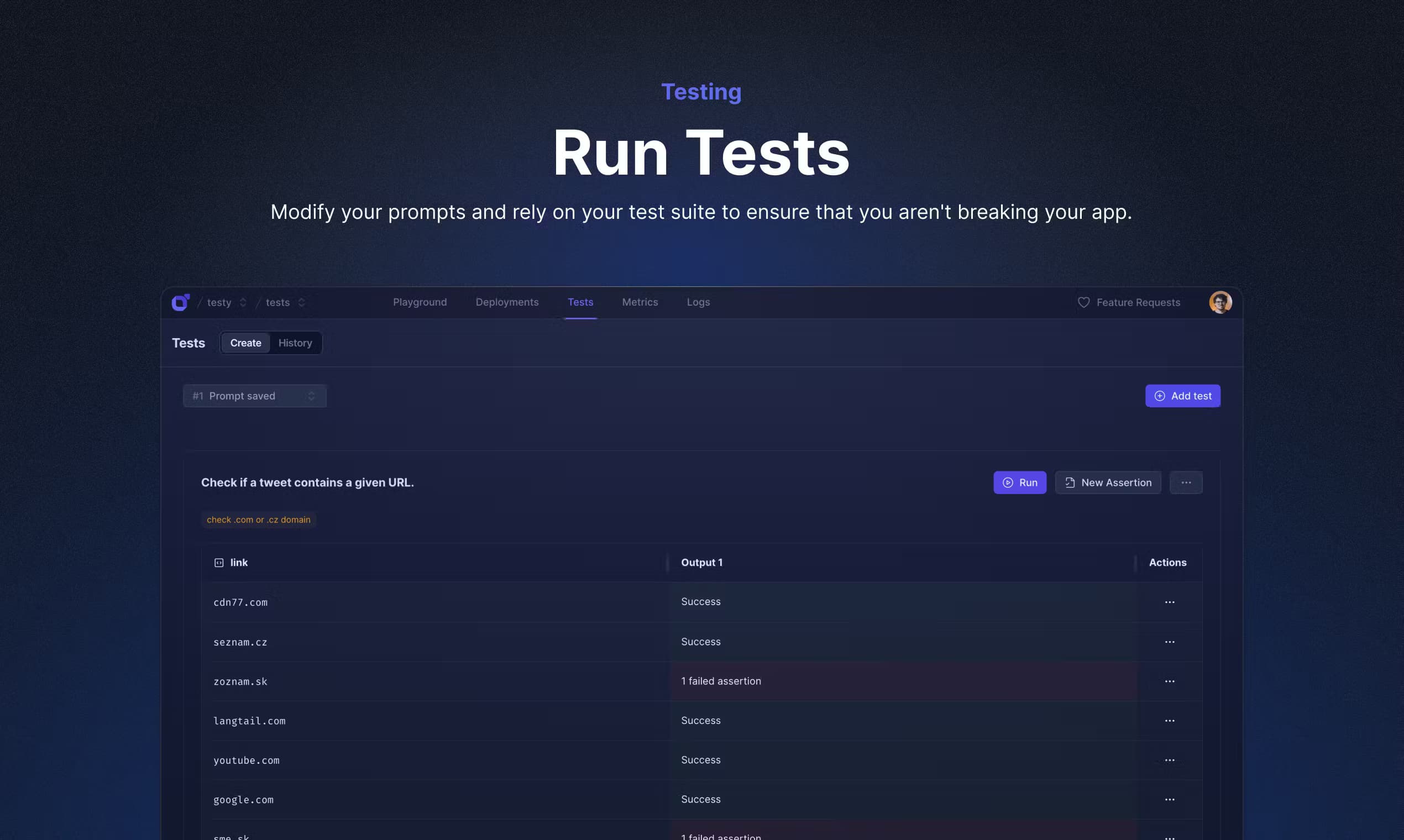
Tests run a prompt against a table of real inputs. Each row has its own expected behavior, and outputs are scored automatically through natural language evaluation, pattern matching, or custom code. That makes regressions visible instead of relying on spot checks.
Deployments as API endpoints
A prompt can be published as a versioned endpoint and called from an app. Langtail also works as a proxy for the OpenAI client, so existing code keeps working while requests route through the platform for logging and metrics. There is a proxyless option too.
Logs and metrics
Every request run through Langtail is logged with its input, output, latency, and cost. Teams use this to spot expensive users, catch slow calls, and see how people actually talk to the product. Free plans keep 30 days of data, and Team plans extend that to a year.
AI Firewall
The AI Firewall is an Enterprise feature that inspects inputs and outputs to block prompt injections, denial-of-service attempts, and information leaks. Rules are customizable and can trigger alerts when something unusual shows up.
Provider coverage and SDK
Langtail connects to OpenAI, Anthropic, Google Gemini, Meta, Mistral, and other providers. A fully typed TypeScript SDK ships with code completion, and self-hosting is available for teams that need to keep data on their own infrastructure.
Pros and cons
Pros
- Non-developers can edit and test prompts without touching the codebase.
- Test suites and scoring turn prompt changes into measurable results.
- Deployments decouple prompt updates from application releases.
- Logs expose latency and cost per request, which is hard to get for free otherwise.
- Supports self-hosting for teams with strict data rules.
Cons
- Pricing jumps sharply: the Pro tier covers one user, and collaboration needs the $499 Team plan.
- The free plan is capped at 2 prompts and 1,000 logs a month, so it works only for small experiments.
- The AI Firewall is locked to Enterprise, which pushes basic security behind a custom quote.
- It manages prompts but does not write or fix them, so quality still depends on the team.
Frequently asked questions
Langtail is used to manage the full lifecycle of AI prompts: writing them, testing them against real inputs, deploying them as API endpoints, and monitoring how they perform in production. It is aimed at teams building LLM-powered products.
Related content
Explore related tools, skills, and articles for Langtail.
Langtail Alternatives

Base Code
Base44 (Wix) · Coding · ProductivityBase Code is a shared cloud development environment from Base44. Teammates describe changes to an existing GitHub codebase in chat, preview them live and send them back as pull requests.

Google EmbeddingGemma 2
Google DeepMind · Writing · Image · CodingGoogle EmbeddingGemma 2 is a 740M-parameter open model that turns text, code, images, audio, and video frames into vectors in one 768-dimension space, running on phones and laptops.

GitGlow
GitGlow · Coding · ProductivityGitGlow is a local-first desktop Git client that lets independent developers review their own code and their AI agents' changes in one place before shipping.