

LangWatch
LangWatch B.V. · Coding · Marketing
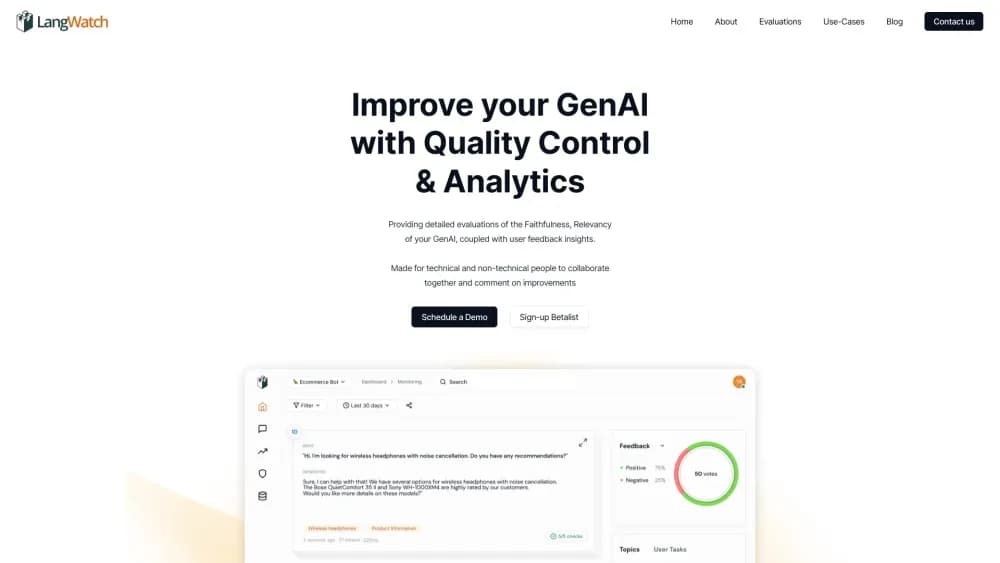
LangWatch is an open source LLM observability platform for tracing, testing, and evaluating AI agents, with an AI gateway and prompt management in one place.
About LangWatch
What Is LangWatch
LangWatch is an open source LLMOps platform built by LangWatch B.V., a company based in Amsterdam. It covers four jobs that normally sit in separate tools: LLM tracing, agent testing, LLM evaluation, and prompt management. A gateway sits on top, so every model call can pass through one endpoint with a budget attached.
The project went public as open source in September 2023 and still ships its core under Apache 2.0. You can run the platform on your own infrastructure with Docker or Helm, and LangWatch Cloud runs the same codebase. Enterprise features, such as multi-source governance and anomaly detection, live in a licensed folder and need a paid plan.
The gap it fills is visibility. Once an agent reaches production, a bad answer rarely comes with an explanation. You need to know which tool call failed, which retrieval returned nothing, and what the conversation cost. LangWatch records each step as a trace and lets you replay it. The catch is that this is a developer tool. Someone on the team has to read a stack trace and write a test, and there's no no-code path for a product manager working alone.
Getting Started
- Create a project at app.langwatch.ai. The Developer plan asks for no card.
- Connect your app with the Python or TypeScript SDK, or point an OpenTelemetry exporter at the ingestion endpoint. LangChain, LangGraph, CrewAI, Mastra, and Pydantic AI send traces without a rewrite.
- Run the agent once, then open the trace view to inspect spans, token counts, latency, and the full conversation.
- Add an evaluator or a simulated user scenario, then gate a merge on the score inside CI.
- Move prompts into the prompt manager when you want versioning and A/B tests outside the codebase.
Product Information
A quick look at LangWatch's pricing, supported platforms, and performance.
Best for
The users, tasks, and scenarios where this tool fits best.
Users
- AI engineers shipping an agent
- Platform teams at mid-size companies
- Engineering managers watching AI spend
Tasks
- Debugging a wrong answer
- Regression testing before a release
- Comparing prompt versions
- Auditing coding assistant usage
Scenarios
- An agent fails for one customer segment
- A provider raises prices overnight
- A regulated rollout needs self-hosting
Key features
LLM Tracing Across Every Framework
Every LLM call, tool call, retrieval, and evaluation lands as a span inside one trace, with nested spans and an execution graph for agent runs. Token and cost accounting is automatic per provider, prompt, and model. Traces group into sessions by thread id, so you can read a whole chat instead of a single request. Text, image, and audio payloads are captured, which matters when an agent handles screenshots or voice notes.
Simulated Agent Testing
AI agent testing here starts with a written scenario, and an LLM plays the user by generating realistic messages from it. The run covers multi-turn dialogue instead of a single prompt. A judge agent scores each turn and can call pass or fail at any point. Tool-call verification checks that the right tool fired at the right moment across a long conversation. There's a visualizer for replaying a run step by step and pausing mid-conversation to annotate it. Voice testing supports ElevenLabs, OpenAI Realtime, Twilio, Pipecat, and Gemini Live, with time-to-first-byte, p50 and p95 latency, plus background noise and interruption injection. Adversarial runs use Crescendo escalation and refusal detection to find weak spots before a user does.
Evaluations for Experiments and Live Traffic
Built-in evaluators cover RAGAS metrics, hallucination, toxicity, PII detection, and LLM-as-a-judge scoring. You can run offline experiments from the SDK or from a no-code wizard in the UI, then compare runs on quality, cost, and latency. Production monitors score live traffic and alert when quality drops. Scoring works on a whole thread as well as a single message, which fits support bots and multi-step agents. Datasets can be built from real traces, generated with AI, or uploaded with image inputs, and an annotation inbox handles human review. Custom evaluators can be defined once and shared across projects, and the same checks can run inline as guardrails.
AI Gateway With Per-Team Budgets
One endpoint speaks both the OpenAI and Anthropic APIs, and routes to OpenAI, Anthropic, Google, Bedrock, Mistral, or any other provider with your own keys. Each caller gets a virtual key with its own budget, set per person, team, or customer. The company claims 11 microseconds of overhead. Every request that passes through lands as a trace in the same project, so gateway traffic and SDK traffic sit in one place.
Versioned Prompt Management
Prompts live as structured objects with messages, inputs, and config, editable from code, the UI, or the API. Liquid templating adds variables and logic. GitHub sync lets a team review prompt changes like any other pull request, and tags mark staging and production versions. A playground runs variants side by side across models, and A/B tests report quality, cost, and latency for each version. Webhooks and Slack notifications fire when a prompt changes.
Coding Agent and AI Governance Tracking
A single command, npx langwatch claude, brings Claude Code, Codex, Copilot, Gemini CLI, and opencode onto the same observability standard. Sessions show tokens, cost, and cache usage per engineer and per repository, which answers the question of where AI spend actually goes. The AI governance side adds an inventory of every AI tool and provider in use, anomaly rules on activity, and an audit log for security reviews.
Pros and cons
Pros
- Open source core: the Apache 2.0 platform runs on your own ClickHouse with Docker or Helm, so trace data never has to leave your network.
- Four tools in one account: tracing, agent testing, evaluation, and prompt management share the same traces, which removes the copy and paste between vendors.
- Wide framework coverage: LangChain, LangGraph, CrewAI, Mastra, Pydantic AI, the Vercel AI SDK, and plain OpenTelemetry all send traces without a rewrite.
- Free tier that works: 50,000 events a month, two users, and 14-day retention cost nothing and need no card, which is enough for a prototype.
- Gateway keeps control: provider keys and per-person budgets stay in your account, and every routed call is traced automatically.
Cons
- Developer tool first: there's no drag-and-drop path for building an agent, and the evaluation setup expects someone who can write Python or TypeScript.
- Usage billing needs watching: 200,000 events are included on Growth, then €5 per 100,000, and a chatty agent with tool calls and retrievals burns through events faster than a simple chatbot.
- Self-hosting carries ops work: you run ClickHouse and the platform yourself, and upgrades are your responsibility unless you pay for Enterprise support.
- Governance and SSO sit behind Enterprise: custom SSO, RBAC, audit logs, and data masking aren't available on the Growth plan, which rules out some regulated teams until they negotiate.
Frequently asked questions
LangWatch is an open source platform for observing, testing, and evaluating LLM applications. It records agent traces, runs simulated conversations, scores output quality, and manages prompt versions from one dashboard.
Related content
Explore related tools, skills, and articles for LangWatch.
LangWatch Alternatives

Base Code
Base44 (Wix) · Coding · ProductivityBase Code is a shared cloud development environment from Base44. Teammates describe changes to an existing GitHub codebase in chat, preview them live and send them back as pull requests.

Google EmbeddingGemma 2
Google DeepMind · Writing · Image · CodingGoogle EmbeddingGemma 2 is a 740M-parameter open model that turns text, code, images, audio, and video frames into vectors in one 768-dimension space, running on phones and laptops.

GitGlow
GitGlow · Coding · ProductivityGitGlow is a local-first desktop Git client that lets independent developers review their own code and their AI agents' changes in one place before shipping.