

LEAFIO
LEAFIO AI · Other
LEAFIO AI Retail Platform is retail automation software that forecasts demand, places orders, plans assortment and planograms, and runs promotions across chains of stores.
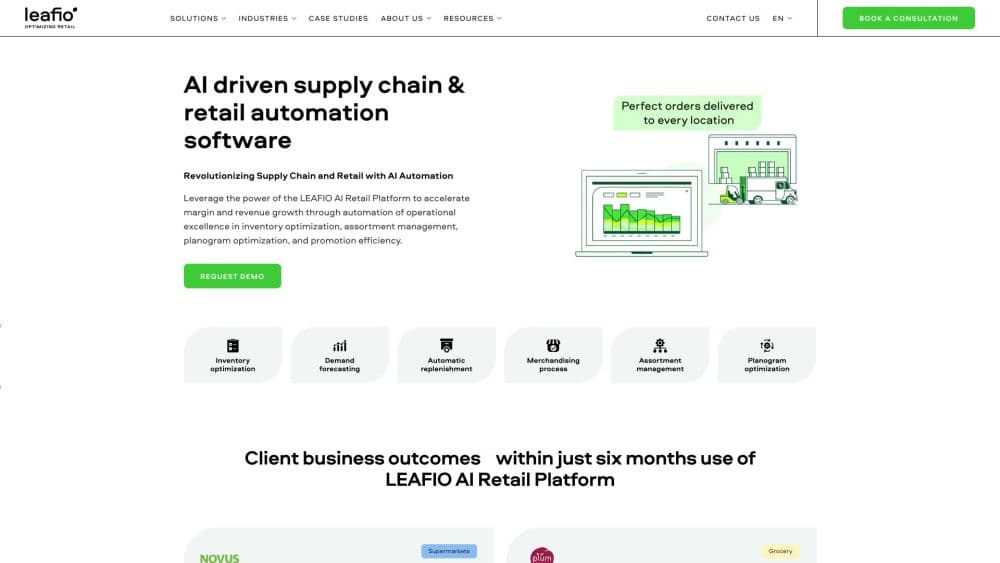
About LEAFIO
What Is LEAFIO AI Retail Platform
LEAFIO AI Retail Platform is a cloud based retail automation software suite for retailers, distributors, and consumer goods manufacturers. It handles the planning work that sits between a sales record and a shelf: how much to order, when it arrives, which products a store should carry, what the shelf should look like, and how a promotion will land. The company says its products run in more than 250 companies across 45 or so countries, with 30,000 stores connected.
The problem it targets is familiar to anyone running a chain. Ordering by gut, hand-built spreadsheets, and planograms that only head office can edit all break down once a network passes a few dozen stores. LEAFIO replaces those routines with forecasting models and rule logic that generate orders, suggest assortment changes, and draw planograms per store. The inventory optimization software side of the suite is the part most chains adopt first.
Its limits matter as much as its strengths. The platform is sold to businesses, not individuals, and the site lists no public price. Rollouts run around six months according to the vendor. Most of the value depends on clean sales history and inventory data sitting in your ERP, so a retailer with messy master data starts with a cleanup project rather than a quick setup.
Getting Started
- Talk to the LEAFIO team and scope which modules you need, since inventory, assortment, merchandising, and promotion work as separate parts of the platform.
- Connect your ERP, POS, and master data sources so the system can read sales history, stock balances, supplier terms, and product records.
- Run the models on your historical data and compare their forecasts and suggested orders against what your planners actually did.
- Set the guardrails planners will use: service levels by category, supplier lead times, order limits, and the exceptions that need a human check.
- Roll out store by store or category by category, then switch routine ordering and planogram work over to the system.
Product Information
A quick look at LEAFIO's pricing, supported platforms, and performance.
Best for
The users, tasks, and scenarios where this tool fits best.
Users
- Category managers at grocery and convenience chains
- Demand planners running replenishment
- Store operations managers in multi location retail
- Merchandisers and space planners
Tasks
- Replacing spreadsheet ordering with forecast driven purchase orders
- Deciding which products to list in each store cluster
- Preparing a promotion before it goes live
- Cutting fresh food write-offs
- Checking shelf compliance with a phone photo
Scenarios
- A regional chain moving from manual ordering to central replenishment across stores and warehouses
- A pharmacy or cosmetics chain with short shelf life and fast rotation
- A retailer launching a price promotion across hundreds of stores
- A national network that needs store level data daily
Key features
Demand Forecasting Across a Year
This demand forecasting software produces short, medium, and long term sales forecasts covering up to a year of planning. Planners can look at expected variance, warehouse load, and seasonal peaks before orders are written, which is the point where most manual processes fall over. Seasonal factors recalculate on their own when demand patterns shift.
Automatic Ordering With Three Algorithms
This is the core of the platform. Orders are generated and sent to suppliers or your own warehouse without a planner pushing a button, and LEAFIO puts the manual intervention rate at up to 99.5% of orders. Rather than one reorder point applied to everything, three algorithms cover standard SKUs, perishables, and distribution center to store flows. The system can also choose between suppliers, ranking them by the criteria your business sets.
Multi Echelon Replenishment
Stock moves through stores, regional warehouses, and a central DC, and the forecast has to respect lead times at every hop. The multi echelon model links supplier lead time to the central warehouse with the delivery schedule to stores, so an order upstream reflects what stores will actually need. Retailers with centralized logic report store ordering work dropping by up to 80%.
Assortment Planning and Store Clustering
The assortment planning software gives category teams store level and cluster level assortment plans instead of one chain wide list. Strategy automation computes the ideal SKU count for each segment down to sub levels such as price band or product type, tied to a sales, revenue, or gross profit goal. Products can be switched on or off for a whole cluster at once, and new or withdrawn items get first order forecasts and withdrawal tracking.
Planograms That Stores Can Execute
The planogram software builds micro space displays from sales, turnover, and ABC analysis, draws macro floor plans per store, and generates displays automatically from demand data. Planograms are tied to the specific store rather than the chain average, which helps sales per shelf meter. Associates see the planogram in the merchandising app, scan items to find them, and head office gets photo based compliance checks scored by AI recognition.
Trade Promotion Planning and Simulation
Trade promotion management starts with a forecast that accounts for the discount, mechanism, and store mix, and you can simulate several discount levels before going live. During the campaign the system tops up stock to the minimum level needed and flags where sales drift from the forecast. Afterwards, past campaign data feeds the next forecast.
SuperApp for Store Level Execution
This retail execution app puts the dashboard, barcode scanner, and task manager in one place. The scanner picks only the items that need a count before tomorrow's order, so staff scan a short list instead of walking the whole shelf. Tasks flow from head office with deadlines and per store subtasks, and the vendor reports up to 98% inventory accuracy and roughly half the time spent on task management.
Business Intelligence and S&OP
A BI module turns the operational data into margin, availability, and turnover views, and the S&OP layer compares your annual plan against the live forecast in money terms. Gaps show up by category and reason, so the conversation moves from who ordered wrong to what the plan should be next quarter.
Pros and cons
Pros
- The modules cover the whole loop from forecast to order to shelf to promotion, so planning data does not have to be stitched together from separate vendors.
- Automatic ordering with separate logic for standard, fresh, and DC flows is more realistic for grocery work than a single reorder rule.
- Store specific planograms and AI photo compliance checks close a gap most planning suites leave to manual audits.
- The SuperApp makes store level execution part of the same system, so counts and tasks feed back into replenishment.
- Case studies on the vendor site report double digit turnover and sales gains at named retailers, with the caveat that these are customer success stories rather than independent reviews.
Cons
- No public pricing and vendor led onboarding mean the total cost only becomes clear after a scoping conversation, which is hard for smaller chains to budget.
- A rollout of around six months needs internal data cleanup and process change, and that work usually lands on the retailer's own team.
- The platform is built for chains, so a single store owner, an online only shop, or a small brand gets no practical benefit from the multi echelon and cluster tools.
- There is no published API documentation, so teams that want to build custom integrations or feed models into their own stack can't plan around it.
Frequently asked questions
It automates retail planning and execution: demand forecasting, automatic ordering, multi echelon replenishment, assortment planning, planogram generation, promotion planning, and store task management. Retail chains, distributors, and consumer goods makers use it to replace spreadsheet driven planning with forecast based decisions.
Related content
Explore related tools, skills, and articles for LEAFIO.
LEAFIO Alternatives

Odyssey 3
Odyssey · OtherOdyssey-3 is Odyssey's foundation world model. It simulates physics in real time, turns a prompt into an interactive environment, and adapts to robots, cars and games.

JarvisCore
Prescott Data · Coding · Productivity · OtherJarvisCore is an open source Python runtime where AI agents work as equal peers on an agent mesh, claim tasks from a shared ledger, and reach external services through a zero-trust broker.
Clef
Cloudflare · Business · OtherClef is Cloudflare's open-source decision model for Workers AI. It returns calibrated probabilities for typed questions, not generated text, so agents can classify, route, and act fast.