

Lebesgue
Lebesgue · Marketing · Business
Lebesgue is an AI CMO for ecommerce brands. It pulls store, ad, and email data into one place, tracks profit and lifetime value, then has Henri AI explain what changed and what to do next.
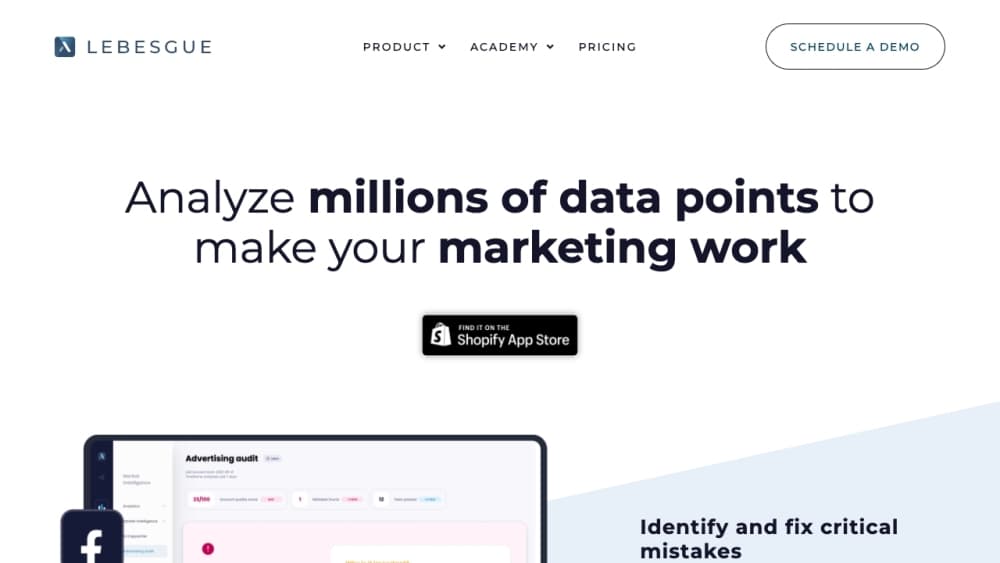
About Lebesgue
What Is Lebesgue
Lebesgue is an analytics platform built for online stores, with an AI layer on top that talks back in plain English. The core job is dull but vital: add up what you spent on ads, what it cost to ship and discount each order, and what actually landed as profit. Most small brands do that in a spreadsheet once a month, badly.
The platform connects to Shopify, Meta, Google, TikTok, and email tools, then runs the numbers through models trained on thousands of stores. Marketing attribution shows which channel really produced a sale, and customer lifetime value tells you whether a cheap first order turns into a repeat buyer. Henri, the built-in assistant, reads the same data and answers questions like why Meta ROAS dropped last week.
Two limits matter. This is ecommerce software, so a B2B lead-gen business or a SaaS company gets little from it. And the answers are only as good as the inputs. If your product costs or discount codes sit in a messy spreadsheet, the profit figures drift, and Henri will explain the drift with confidence.
Getting Started
- Install the app from the Shopify App Store and connect your store. Order history and product data sync in the first pass, and the Shopify analytics cover orders, discounts, shipping, and margins.
- Link your ad accounts. Meta, Google, and TikTok connect through their own sign-in screens, and email platforms join the same workspace.
- Add real costs. Enter COGS, shipping, payment fees, and any custom cost lines so profit reflects what you keep, not what you bill.
- Ask Henri a question or open a dashboard. Weekly summaries arrive on their own, and you can query the data whenever a number looks wrong.
Product Information
A quick look at Lebesgue's pricing, supported platforms, and performance.
Best for
The users, tasks, and scenarios where this tool fits best.
Users
- Ecommerce founders who run their own marketing
- In-house growth marketers at small brands
- Agencies managing several stores
Tasks
- Finding out why ROAS dropped
- Deciding where the next ad dollar goes
- Building a weekly profit report
- Auditing Meta, Google, and TikTok campaigns
Scenarios
- Stores between $50k and $5M a year with no data team
- Launching a new product line
- Heading into a slow season
Key features
Henri AI Explains the Numbers
Henri is the part people actually talk about. It reads the full dataset, then answers a question in a short paragraph with the cause attached: a creative fatigue issue on one ad set, a discount code that ate the margin, a shipping cost change. The assistant also proposes a next step, which is more useful than another dashboard tab. Ask it something narrow and the answer stays narrow.
First-Party Attribution Across Channels
Lebesgue builds marketing attribution from your own order data instead of relying on platform pixels alone. Meta, Google, TikTok, and email all report into the same model, so a sale gets credited once. The Le Pixel add-on adds first-party tracking for stores that want a cleaner signal after browser restrictions. Without it, some conversions land in an "unknown" bucket, which is honest but less precise.
Profit Tracking Down to the Product
Revenue is the easy number. Lebesgue subtracts COGS, discounts, shipping, taxes, and payment fees to show profit per order, per product, and per channel. Custom cost lines cover things like packaging or influencer fees. This is where the tool earns its keep, because a product with strong sales and thin margin stops looking like a winner.
Customer Lifetime Value Models
The platform groups customers by first order date, acquisition channel, and product, then models what each group spends over time. First time versus repeat order splits sit next to the LTV figures, so you can see whether a channel brings buyers or one-time discount hunters. Retention work gets easier to justify when the model shows the gap.
Competitor Intelligence
Competitor intelligence runs on ad library data from the major platforms. You see which competitors are scaling spend, which creative formats they repeat, and where their messaging shifts. It answers a simple question: is the market moving, or is this just your account? Treat the spend figures as estimates, since ad libraries never publish exact budgets.
Benchmarks From 20,000+ Brands
Every metric gets a comparison against a large pool of ecommerce brands, filtered by category and size. A 2.1 percent conversion rate means little on its own. Against similar stores it becomes a signal about whether the problem sits in your traffic or your offer. Benchmarks are directional, not gospel, and the pool skews toward Shopify stores.
Pros and cons
Pros
- One workspace for store profit, ad spend, email behavior, and competitor moves, which cuts the number of tabs open during a Monday review.
- Henri translates a metric change into a cause and a suggested action, so a non-analyst can act without opening a query builder.
- Flat monthly pricing with no usage charges, so a heavy reporting week costs the same as a quiet one.
- A free plan covers store performance and basic ad analytics, which is enough to judge the data quality before paying.
- Benchmark data from a large brand pool gives context that a solo founder can't build alone.
Cons
- Built for ecommerce only. SaaS, B2B lead gen, and content businesses will find most of the model irrelevant.
- First-party tracking and the cleanest attribution sit behind the Le Pixel add-on, so the base plan shows more "unknown" conversions than expected.
- No public API means teams can't pipe the modeled data into their own warehouse, and finance still exports CSV files by hand.
- Henri inherits bad inputs. Wrong COGS or duplicated orders produce confident explanations of numbers that were never right.
Frequently asked questions
It combines ecommerce marketing analytics and an AI assistant. The platform tracks orders, ad spend, profit, and customer lifetime value, then Henri explains what drove a result and suggests what to change. Think of it as a analyst who reads your store data every morning.
Related content
Explore related tools, skills, and articles for Lebesgue.
Lebesgue Alternatives

Emailwritr
Emailwritr · Writing · MarketingEmailwritr is an AI email copywriting tool built for affiliates, course creators, and online businesses that want more revenue from the list they already own. Instead of blank pages or generic chatbot prompts, this AI email writer generates welcome sequences, launch campaigns, cart recovery emails, and promo series from frameworks modeled on well-known direct-response copywriters. You connect your autoresponder, answer a few questions about your offer, and it writes the copy for you.

Prosp
Prosp · Writing · Voice & Language · MarketingProsp is an AI LinkedIn outreach tool built for agencies and sales teams, and it writes the message and the voice note in your own voice for each prospect so they actually reply. You connect your accounts, find leads, and let the AI draft and send personalized messages at scale, all from one inbox. It's built for people running outbound at volume. That's the whole pitch. Every touchpoint still has to feel human.

On Model
On Model · Image · MarketingOn Model is an AI fashion model tool that places your clothing on virtual models so online stores can get on-model product photos without booking a photoshoot. It runs as a Shopify app, letting you swap the model in an existing image, change backgrounds, and generate faces for cropped or headless shots. The goal is simple: match your product photos to your customers and stand out from competitors using the same supplier images.