

LetMeCheck.ai
LetMeCheck.ai · Coding
LetMeCheck.ai is a code health checkup tool that scans your GitHub repository for hidden bugs, security flaws, and messy AI-generated code, then returns a plain-English report.
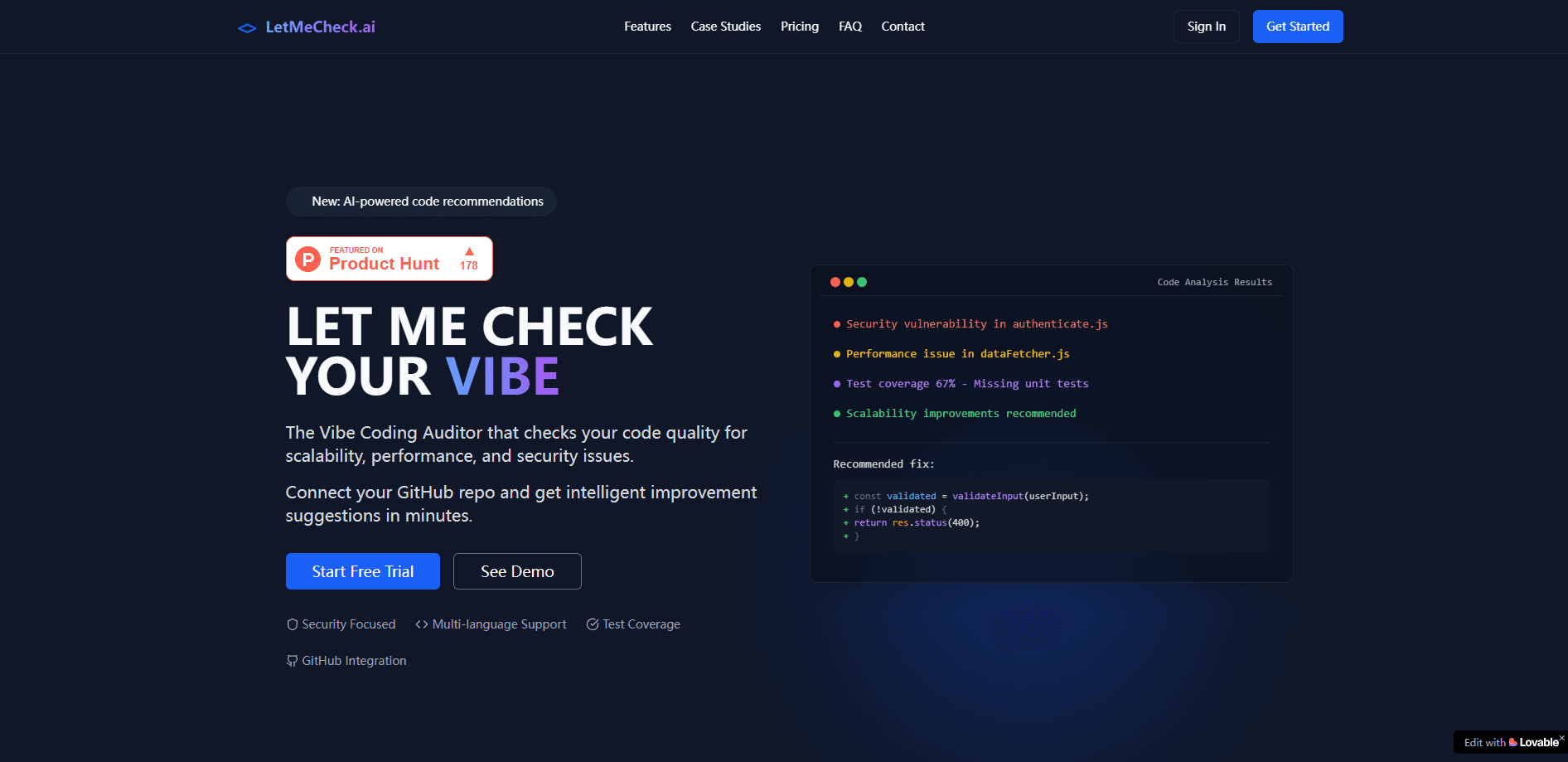
About LetMeCheck.ai
What Is LetMeCheck.ai
LetMeCheck.ai calls itself the blood test for your codebase. You connect a GitHub repository, and the platform runs a full analysis to surface the problems that normal testing misses. That means technical debt, architecture drift, security holes, and a newer category the team calls AI slop.
The product exists because AI coding tools changed the speed of software work, not the trust level. Code from Cursor, Copilot, or Claude often runs fine on day one but frays underneath. LetMeCheck.ai reads the whole repo end to end and turns the findings into something a founder can read and a developer can act on.
The main limit is scope. LetMeCheck.ai reviews code and reports on it. It doesn't write your features or replace a human architect on the hard calls. The free tier gives you a short diagnosis only, so the deeper reports and fix plans sit behind paid options.
Getting Started
- Sign in at app.letmecheck.ai and connect a GitHub repository. Access is read-only, and you pick which repos to expose.
- Let the scan run. The platform spins up a secure, temporary container and runs a SonarQube-powered analysis for bugs, code smells, duplicated code, security hotspots, and complexity issues.
- Wait for the AI pass. It reads the raw findings alongside live code snippets and writes context-aware notes instead of generic warnings.
- Open your dashboard. You get a Repo Health Score, an AI summary, and a breakdown of the biggest issues.
- Upgrade if you want the full Deep Dive Report, the Developer Recovery Pack, or Custom Skill Files for your AI coding agent.
Product Information
A quick look at LetMeCheck.ai's pricing, supported platforms, and performance.
Best for
The users, tasks, and scenarios where this tool fits best.
Users
- Developers who want to find weak spots in their own code
- Engineering teams buried in AI-generated debt
- CTOs and tech leads who need visibility without reading every pull request
- Startup founders facing a fundraise, acquisition, or key hire
Tasks
- Auditing a repo after a long AI coding sprint
- Sizing up technical debt before a big refactor
- Handing a fix to an AI coding agent
- Outsourcing fixes you don't want to touch
Scenarios
- Reviewing an unfamiliar codebase you just inherited
- Pre-diligence checks ahead of a sale or investment round
- Ongoing quality tracking for a small team with no dedicated QA
Key features
Repo Health Score
Every repository gets a single number that sums up its engineering quality, much like a credit score or a lab result. The dashboard breaks it into sub-scores for maintainability, security risk, technical debt, and AI slop. A score above 80 percent reads as healthy. Anything below 60 percent flags work worth doing before it slows a team or causes an outage.
AI Slop Detection
This is the feature the team treats as its signature. AI coding tools often produce code that works but sits poorly in the wider project, and the damage rarely shows up in a test run. LetMeCheck.ai hunts for telltale patterns: needless abstraction layers, duplicated business logic, fake enterprise scaffolding, bloated service layers, architecture drift, and dead utilities. One example insight flags a repo carrying eleven unnecessary abstraction layers around plain CRUD operations, a sign of complexity that does nothing for the product and everything to slow the next developer who touches it.
SonarQube-Powered Scanning
The scan runs on the same class of tools professional developers use daily. It catches bugs, code smells, duplicated code, security hotspots, complexity issues, and coverage gaps. Because the engine runs in a one-click cloud container, you skip the setup and maintenance that a self-hosted SonarQube install demands.
Deep Dive Report
For $5, the Deep Dive Report expands each major issue into a full breakdown. You get a plain explanation, a root cause, a risk analysis of what breaks if you ignore it, a priority order, and an effort estimate in hours. The aim is simple. Turn a wall of warnings into a short, ranked to-do list you can work through in order.
Developer Recovery Pack
The Recovery Pack is the premium layer, closer to a treatment plan than a diagnosis. It bundles fix recommendations with reasoning, step-by-step refactor plans, best practices fitted to your stack, and ready-to-use prompts for Claude Code, Cursor, or Devin. No more staring at a list of problems. You get something you can hand straight to your team.
Custom Skill Files
Skill Files are AI prompts written for your specific issues. Each one spells out what the issue is, the relevant code snippet, the rules to follow during the fix, and the steps that keep existing behaviour intact. You feed the brief to your AI coding agent. It doesn't have to guess.
Pros and cons
Pros
- Reads AI-generated code in context, so advice fits your repo rather than a generic checklist.
- AI slop detection targets a problem most scanners ignore entirely.
- Free first scan returns a health score and summary before you pay anything.
- Custom Skill Files connect the diagnosis to the AI coding tools teams already use.
- Read-only GitHub access and an ephemeral scan container keep your source out of storage.
Cons
- The free tier stops at a short diagnosis. Detailed issue breakdowns, fix plans, and Skill Files sit behind paid tiers, so the useful depth costs money.
- Scans run against GitHub repositories only, which leaves teams on GitLab, Bitbucket, or local-only setups out of the flow.
Frequently asked questions
LetMeCheck.ai is an AI-powered code intelligence platform, described by its team as a blood test for your codebase. It scans a repository to uncover technical debt, architecture drift, AI-generated code slop, security vulnerabilities, maintainability issues, and review bottlenecks.
Related content
Explore related tools, skills, and articles for LetMeCheck.ai.
LetMeCheck.ai Alternatives

Base Code
Base44 (Wix) · Coding · ProductivityBase Code is a shared cloud development environment from Base44. Teammates describe changes to an existing GitHub codebase in chat, preview them live and send them back as pull requests.

Google EmbeddingGemma 2
Google DeepMind · Writing · Image · CodingGoogle EmbeddingGemma 2 is a 740M-parameter open model that turns text, code, images, audio, and video frames into vectors in one 768-dimension space, running on phones and laptops.

GitGlow
GitGlow · Coding · ProductivityGitGlow is a local-first desktop Git client that lets independent developers review their own code and their AI agents' changes in one place before shipping.