

Lettertrace
Lettertrace · Coding
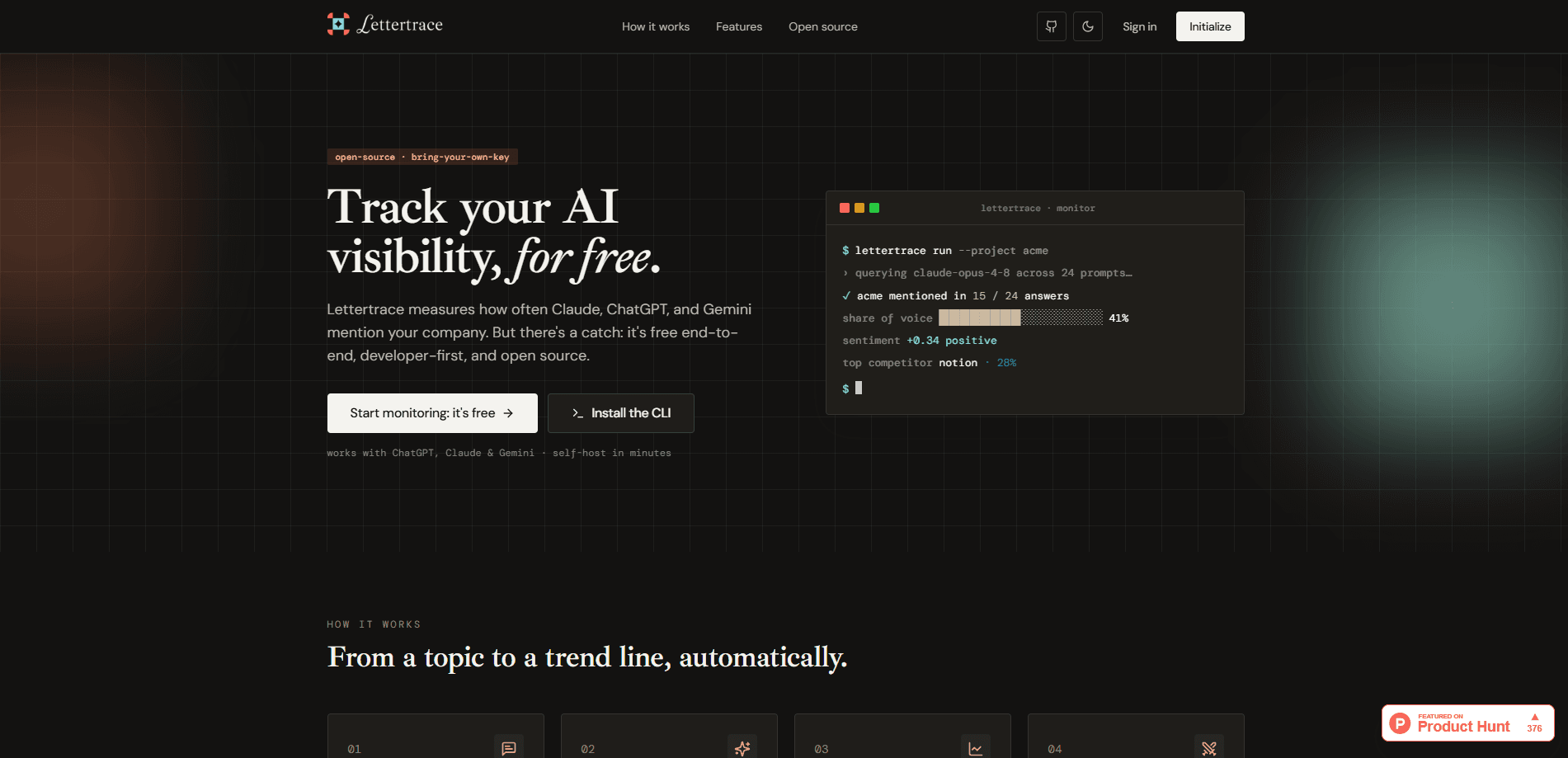
Lettertrace is a free, open-source AI brand monitoring tool that measures how often ChatGPT, Claude, and Gemini mention your company. It turns raw model answers into the metrics AEO and GEO teams track, including visibility, share of voice, prominence, and sentiment. You run it yourself with your own API keys, so nothing is marked up and no vendor sits between you and the models. If your buyers now ask an AI assistant for recommendations instead of scrolling search results, this is built for you.
About Lettertrace
What Is Lettertrace
Lettertrace answers a question most brands can't answer yet: when someone asks ChatGPT for "the best CRM for startups," does your name come up? The tool monitors how AI models talk about your brand and tracks that picture over time. You add the topics your buyers ask about, and it auto-generates the real questions people put to assistants, so you're monitoring how they're actually answered. Think of it as ChatGPT brand mentions, Claude, and Gemini rolled into one trend line.
It's a bring-your-own-key product. You plug in your own Anthropic, OpenAI, and Google keys, and those keys stay encrypted at rest and never leave your infrastructure. The data lives in your own Supabase instance, which means no vendor lock-in. This is the main reason teams pick it over a hosted AI visibility platform: nothing about your monitoring runs through someone else's servers.
The tradeoff that comes with that freedom is setup. You self-host it, so you need a developer who can clone a repo, run npm install, and wire up Supabase. No sign-up button. No support desk. I'd call this developer-first in the truest sense. If nobody on your team touches a terminal, the free part is real but the setup cost is too.
Getting Started
- Clone the Lettertrace repo from its official source and move into the project folder.
- Run npm install to pull the dependencies.
- Copy .env.example to .env.local, then add your Supabase URL and keys.
- Add your own Anthropic, OpenAI, or Google API key for the models you want to monitor.
- Run npm run dev and open http://localhost:3000, then set up your brand and topics and fire your first run.
Product Information
A quick look at Lettertrace's pricing, supported platforms, and performance.
Best for
The users, tasks, and scenarios where this tool fits best.
Users
- SEO and AEO specialists
- Startup marketing teams
- Growth engineers who already hold their own Anthropic, OpenAI, and Google keys
Tasks
- Tracking brand visibility
- Measuring share of voice
- Reading sentiment
- Benchmarking competitors
- Diagnosing weak mentions
Scenarios
- A founder wants to know why ChatGPT recommends a rival for a core query.
- A marketing lead prepares an AI visibility report for a quarterly review.
- An agency runs the same monitoring for several client brands from one setup.
- A developer wants to read the source and extend the scorers before trusting the numbers.
Key features
Bring Your Own Key
Lettertrace runs on your own Anthropic, OpenAI, and Google keys. They're encrypted at rest and never leave your infrastructure, so there's no usage markup and no middleman adding cost. You pay the model providers directly at their published rates.
Multi-Model Monitoring
The tool checks Claude, ChatGPT, Gemini, and Google AI Overviews side by side, which matters because each model answers differently. Each model has its own quirks, its own wording, and its own favorites. You can add more answer engines as they start to matter to your audience, without rebuilding your monitoring setup from scratch.
Variation Generation
Type one topic and Lettertrace writes dozens of natural prompts from it, no manual prompt-writing. Instead of guessing which phrasing a buyer would use, you cover the range of ways people actually put questions to AI assistants.
Sentiment and Recommendations
Knowing you appear isn't enough. Lettertrace scores whether an answer speaks well of you and whether the model recommends you at all, so a mention that damages trust doesn't get counted as a win. Sentiment tracking shows as a signed score per run, and competitor benchmarking runs on the same pass. Simple as that.
Share of Voice
Share of voice shows how often you win the answer versus every competitor you track, broken down per topic and per model. Sample output reads plainly: you at 41%, Notion at 28%, Linear at 19%, others at 12%. Numbers like these are easy to defend in a board deck because each one traces back to a prompt you can show and a model answer you can quote in full.
Scheduled Monitoring
Runs can fire daily or weekly on autopilot. Each run is a datapoint, so week over week you build a trend line you can act on rather than a single snapshot that tells you nothing about direction. A weekly cadence, for example, catches a rival's new campaign or a model update that quietly changes who gets recommended before it shows up in your traffic numbers.
Open Source Under MIT
Lettertrace is MIT licensed. You can fork it, inspect what the scorers actually do, and extend it to your own metrics. Since the data sits in your own Supabase instance and nothing routes through a third-party vendor, there's no vendor lock-in if you ever decide to move off it and rebuild the whole pipeline yourself.
Pros and cons
Pros
- Free end to end, with no usage markup because you use your own API keys.
- Open source under MIT, so you can read, fork, and extend the scoring logic.
- Covers the models that matter now: Claude, ChatGPT, Gemini, and Google AI Overviews.
- Tracks visibility, share of voice, prominence, and sentiment, not just presence.
- Data stays in your own Supabase, so there's no vendor lock-in.
Cons
- Self-hosting is required, so you need a developer comfortable with a terminal and Supabase.
- No hosted version or support desk, which means you're on your own when something breaks.
- API costs are yours to manage, and heavy daily runs across several models add up.
Frequently asked questions
It measures how often AI models mention your brand across tracked topics, then turns those answers into AI visibility, share of voice, prominence, and sentiment scores per topic, per model, over time. If you want to track AI mentions systematically, this is the core of it.
Related content
Explore related tools, skills, and articles for Lettertrace.
Lettertrace Alternatives
Forefront
Forefront · CodingForefront is a web platform for building with open-source AI. It lets you fine-tune leading open-source language models on your own data, evaluate how they perform, and run them through an API or export them to host yourself. Developers who want the convenience of a closed-source platform but insist on owning their models and data are the target audience here.

Startkit
StartKit.AI · CodingStartkit is a boilerplate for building AI SaaS and AI wrapper products. Think of it as an AI startup boilerplate with the boring parts already wired up: authentication, Stripe and Lemon Squeezy payments, usage limits, transactional email, and an AI API starter that talks to OpenAI, Anthropic, Groq, or Llama. You clone the repo, set your price, and start on the part of your product that people actually pay for. It's Next.js under React and Tailwind, so most of the boilerplate code already feels familiar.
Testim
Tricentis · CodingTestim is an AI-powered test automation platform for building and running end-to-end tests across web, mobile, and Salesforce applications. It leans on machine learning to keep tests stable when an interface changes, so teams spend less time fixing broken selectors. Not bad for an automated testing tool you can start using today. You create tests by recording actions in a browser, then optionally add JavaScript when you need more control. It's a solid pick for busy QA teams.