

LFM2
Liquid AI · Other
LFM2 is a family of small language models from Liquid AI built for on-device use. The 350M, 700M and 1.2B checkpoints run fast on everyday CPUs.
About LFM2
What Is LFM2
LFM2 is the second generation of Liquid Foundation Models, released by Liquid AI in July 2025. The company spun out of MIT's CSAIL lab, and it builds models that trade raw size for speed and memory efficiency. LFM2 comes in three dense checkpoints: 350M, 700M and 1.2B parameters. Each is small enough to run on a phone, a laptop or a car system without a data center behind it.
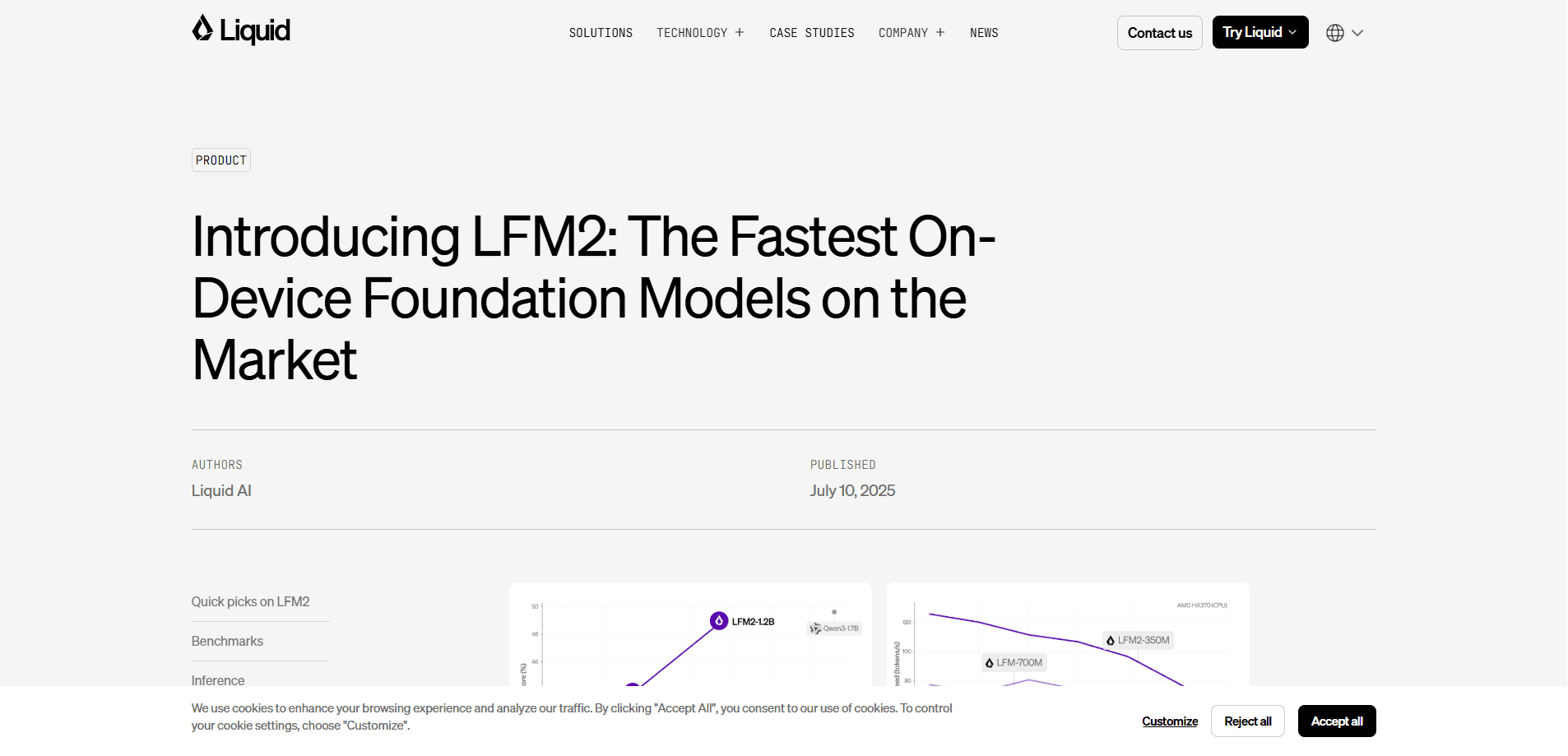
The pitch is simple. Cloud models are powerful but slow and costly to run at scale, and they send your data off the device. LFM2 aims to keep useful AI local, where responses come back in milliseconds and nothing leaves the machine. According to Liquid AI, the models decode and prefill 2x faster than Qwen3 on a CPU, and the training pipeline is 3x more efficient than the first LFM generation.
The catch is that small models have small knowledge. Liquid AI recommends fine-tuning LFM2 for narrow tasks like data extraction, RAG or multi-turn chat, and it warns against knowledge-heavy work such as deep reasoning or complex coding. Treat LFM2 as a fast, private building block, not a general assistant that knows everything.
Getting Started
- Pick a checkpoint on Hugging Face that fits your hardware, from 350M for tiny devices to 1.2B for a laptop or a single GPU
- Download the weights, or use a quantization format such as GGUF for llama.cpp if you want an even smaller footprint
- Run it locally through a supported framework, including llama.cpp, ExecuTorch or standard Transformers tooling
- Fine-tune it with a framework like TRL on your own data if a general checkpoint misses your task, then deploy the tuned build to your device
Product Information
A quick look at LFM2's pricing, supported platforms, and performance.
Best for
The users, tasks, and scenarios where this tool fits best.
Users
- App developers building on-device features
- Teams with privacy constraints
- Hobbyists and tinkerers
- Startups under $10M revenue
Tasks
- Agentic workflows
- Data extraction
- Retrieval-augmented generation
- Multi-turn chat
- Creative writing aids
Scenarios
- A phone app needs offline replies
- A laptop user wants local drafting
- A device maker ships AI on a budget
- A regulated team must keep data in house
- A developer prototypes an agent on a car system
Key features
Hybrid Convolution and Attention Architecture
LFM2 mixes short convolutions with grouped query attention instead of relying on attention alone. Each model stacks 16 blocks: 10 double-gated short-range convolution blocks and 6 blocks of grouped query attention. The design captures local patterns cheaply and leans on attention only where it pays off, which keeps latency and memory low on the hardware that actually ships in phones and laptops.
Speed on Commodity CPUs
The headline claim is throughput, not raw accuracy. According to Liquid AI, LFM2 decodes and prefills 2x faster than Qwen3 on a CPU, and the smaller 700M model stays faster than a Qwen 0.6B build in both llama.cpp and ExecuTorch despite carrying more parameters. That gap matters on a phone or a thin laptop, where the CPU is the only chip you can count on.
Four Size Classes for Different Devices
The family spans 350M, 700M, 1.2B and 2.6B parameters, so you can match the model to the device. The 350M build fits wearables and tight embedded targets, while the 1.2B checkpoint runs on a laptop or a single GPU and competes with models that carry far more parameters. As an edge language model family, one architecture across sizes means you can move a feature up or down the range without rewriting it.
Competitive LFM2 Benchmarks at Small Scale
According to Liquid AI, LFM2-1.2B performs competitively with Qwen3-1.7B, a model with 47% more parameters, and the LFM2 benchmark scores land near models many times their size. The 700M checkpoint outperforms Gemma 3 1B IT, and the 350M build trades blows with Qwen3-0.6B and Llama 3.2 1B Instruct. In the company's own multi-turn tests, judges preferred the 1.2B model over Llama 3.2 1B Instruct and Gemma 3 1B IT.
Open Weights and Flexible Licensing
Liquid AI releases the weights on Hugging Face under an open license based on Apache 2.0. Academic and research use is free, and companies under $10M in revenue can use the models commercially at no cost. Above that threshold you contact Liquid AI for a commercial license, which keeps the terms simple for smaller teams and leaves room for enterprise deals.
Broad Toolchain Support
LFM2 exports to the frameworks developers already use. It runs through llama.cpp for local inference, through PyTorch via ExecuTorch for mobile, and through standard Transformers tooling for training. Fine-tuning with TRL is a supported path, and GGUF builds make the models easy to drop into existing inference apps.
32K Context and Multilingual Training
Every checkpoint handles a 32,768-token context window, which is enough for long documents and extended chats. Training drew on 10 trillion tokens split roughly 75% English, 20% multilingual and 5% code, with extra focus on Japanese, Arabic, Korean, Spanish, French and German. That makes LFM2 a reasonable fit for apps that serve more than one language.
Pros and cons
Pros
- Runs fast on the CPUs already inside phones, laptops and cars, so you do not need a GPU or a cloud service
- Small checkpoints keep the memory footprint low, which suits wearables and other tight embedded targets
- Benchmarks match or beat larger models such as Qwen3-1.7B and Gemma 3 1B IT at a fraction of the size
- Open weights with a free commercial license for companies under $10M revenue keep the early path cheap
- Works with familiar tools like llama.cpp, ExecuTorch and TRL, so adoption does not mean a rewrite
Cons
- Small models carry less world knowledge, so knowledge-heavy tasks such as deep reasoning or complex coding fall outside their comfort zone
- Liquid AI recommends fine-tuning for narrow use cases, which adds setup work before you see your best results
- The commercial license needs a paid agreement once your company passes $10M in revenue, so scaling up carries a cost
- Newer LFM2.5 checkpoints and larger LFM2 variants now exist, so the original three sizes are no longer the newest option
Frequently asked questions
LFM2 is built for on-device AI, where a small model runs locally instead of in the cloud. Typical uses include agentic workflows, data extraction, retrieval-augmented generation, multi-turn chat and creative writing aids. Liquid AI points developers toward narrow, well-defined tasks rather than general-purpose reasoning.
Related content
Explore related tools, skills, and articles for LFM2.
LFM2 Alternatives

Odyssey 3
Odyssey · OtherOdyssey-3 is Odyssey's foundation world model. It simulates physics in real time, turns a prompt into an interactive environment, and adapts to robots, cars and games.

JarvisCore
Prescott Data · Coding · Productivity · OtherJarvisCore is an open source Python runtime where AI agents work as equal peers on an agent mesh, claim tasks from a shared ledger, and reach external services through a zero-trust broker.
Clef
Cloudflare · Business · OtherClef is Cloudflare's open-source decision model for Workers AI. It returns calibrated probabilities for typed questions, not generated text, so agents can classify, route, and act fast.