

Limestone Digital
Limestone Digital · Coding · Productivity · Business
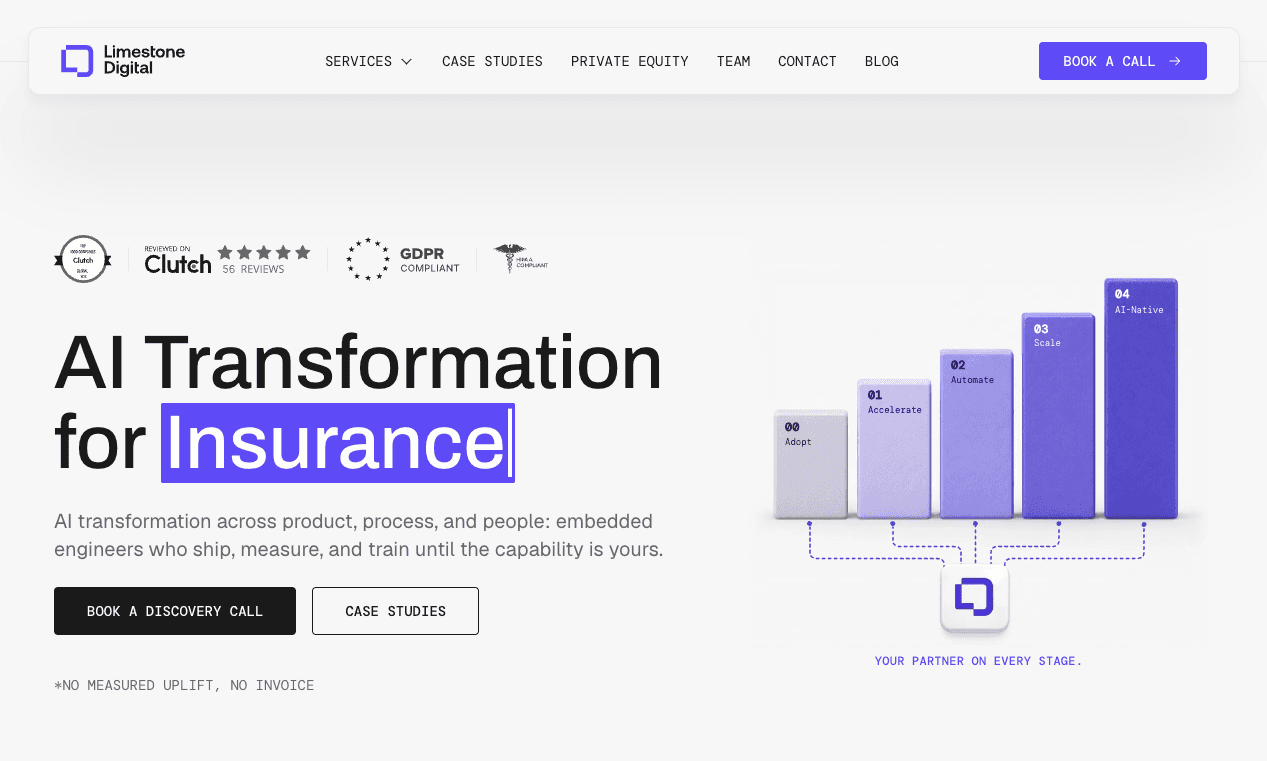
Limestone Digital is an AI transformation partner that puts embedded engineers inside existing codebases to ship custom AI agents and faster delivery, on month-to-month terms.
About Limestone Digital
What Is Limestone Digital
Limestone Digital is a software engineering company that sells AI transformation services instead of software. Its clients are enterprises and private equity portfolio companies in healthcare, insurance, mortgage and lending, financial services, logistics, and compliance. The offer is narrow on purpose: take the product a client already runs and add AI capability inside it, with no rewrite and no greenfield rebuild.
The work runs in three layers. AI training and enablement builds capability inside the client's own engineering and delivery teams. Custom AI agents cover the data foundation, a pilot, and the move to production. AI SDLC delivery places embedded AI engineers in existing squads to move the roadmap faster. A separate dashboard called DevInt measures the delivery numbers that decide whether the invoice stands.
The commercial model is the unusual part. Engagements run month to month, with no 12-month contract, and the company says it invoices only when measured uplift shows up. A starting AI Velocity Pod is one senior AI engineer plus shared specialist support at $17,000 to $20,000 per month. That price rules out solo founders and small teams, and there is no self-serve signup anywhere on the site.
Getting Started
- Book a discovery call and describe the product, the constraint that matters (compliance, a legacy stack, a small team), and the outcome you need to show.
- Run the two-week diagnostic. Limestone instruments delivery with DevInt, then hands back a baseline and an architecture decision document.
- Choose the first workstream. Weeks 3 to 6 go to shipping the first AI increment into production while planning, review, and release habits get rebuilt around AI-assisted work.
- Read the uplift dashboards in week 7, then decide whether to add pods, take the playbooks in-house, or stop.
Product Information
A quick look at Limestone Digital's pricing, supported platforms, and performance.
Best for
The users, tasks, and scenarios where this tool fits best.
Users
- Engineering leaders at regulated companies
- Private equity operating partners
- Product teams stuck on an old platform
Tasks
- Adding an AI feature to a live product
- Building a custom AI agent for a recurring workflow
- Checking whether AI tooling changed anything
Scenarios
- Your security team rejects vendors that touch production data
- You bought AI licenses and adoption flattened
- A roadmap item has slipped two quarters
Key features
Embedded engineers inside your team
Limestone places senior engineers in your standups, repositories, and Slack rather than running a separate squad behind a ticket queue. They follow your conventions and your review process, so the code lands in the product you already ship. The company says 98% of the code it delivers is not handwritten, and that all of it passes human review and testing before merge.
Custom AI agents built around one workflow
Agent work starts with a recurring task whose users, data, and expected result are clear. The team maps business rules and exceptions first, then builds a working version that your specialists test against cases they have checked themselves. Production controls, monitoring, and ownership come before any expansion of scope.
AI SDLC delivery
The AI SDLC service puts engineers who use AI across planning, development, testing, and review onto a defined workstream. In a published freight audit project, two engineers and an AI productivity lead merged 122 pull requests in the first 90 days and reached production in months five to six. The claim that follows is 50% faster development cycles on that engagement.
DevInt delivery analytics
DevInt pulls version control, issue tracking, and AI usage into one weekly read for engineering leaders. It covers GitHub, Bitbucket, Jira, ClickUp, Cursor, Anthropic, and OpenAI, and reports cycle time, review load, AI assist hours, and AI spend. Each number carries its unit and its window, which matters when you have to defend a metric in a one-on-one.
A two-week diagnostic before any build
Every engagement opens with a diagnostic sprint. Limestone instruments your delivery process, records cycle time, review load, open pull request flow, and AI assist hours, then delivers a baseline plus an architecture decision document. You can end the relationship after that document and keep the baseline.
AI training and enablement
The training layer works on engineering, technical leadership, and delivery teams at the same time. The goal is stated plainly: the capability stays with your staff after the engagement ends. That matters for companies that have been burned by contractors who shipped code nobody on staff could maintain.
Security and IP terms for regulated clients
Work happens in your repositories, your cloud, and your identity provider, with least-privilege access that you can revoke on any day. Everything built is assigned to you in writing, NDAs are standard, and client code is not used to train models. AI provider choice follows your compliance constraints rather than the vendor's preference.
Pros and cons
Pros
- The month-to-month contract with an uplift clause lowers the risk of a long AI program that produces slides instead of shipped features.
- Existing codebases are the explicit specialty, so legacy modernization conversations do not turn into a rewrite proposal.
- Pricing is published for the starting pod at $17,000 to $20,000 per month, which is rare in AI consulting and makes budgeting possible before the first call.
- DevInt gives you the same numbers the vendor uses to justify its invoice, so the uplift claim can be checked rather than trusted.
- Security and IP terms are written for healthcare, insurance, and lending buyers, which removes months of legal back and forth.
Cons
- At $17,000 a month and up, the service is built for funded enterprises. A startup with one product idea cannot use it.
- There is no self-serve trial or public demo. Everything starts with a sales call, and a diagnostic sprint is paid work.
- DevInt is the only packaged product. Its value depends on connecting your GitHub, Jira, and AI tool accounts, and gaps in that data show up in the reports.
- The model depends on the embedded engineers themselves. If a pod turns over mid-engagement, the product knowledge walks out with them.
Frequently asked questions
It embeds engineers into an existing product team to add AI features, build custom AI agents, and speed up delivery. The company also trains the client's staff and measures the delivery change with its DevInt tool.
Related content
Explore related tools, skills, and articles for Limestone Digital.
Limestone Digital Alternatives

Base Code
Base44 (Wix) · Coding · ProductivityBase Code is a shared cloud development environment from Base44. Teammates describe changes to an existing GitHub codebase in chat, preview them live and send them back as pull requests.

Google EmbeddingGemma 2
Google DeepMind · Writing · Image · CodingGoogle EmbeddingGemma 2 is a 740M-parameter open model that turns text, code, images, audio, and video frames into vectors in one 768-dimension space, running on phones and laptops.

GitGlow
GitGlow · Coding · ProductivityGitGlow is a local-first desktop Git client that lets independent developers review their own code and their AI agents' changes in one place before shipping.