

Linguamatics
Linguamatics (an IQVIA business) · Business
Linguamatics, part of IQVIA, sells healthcare NLP and translation software: I2E mines biomedical text for answers, and Translate handles clinical documents.
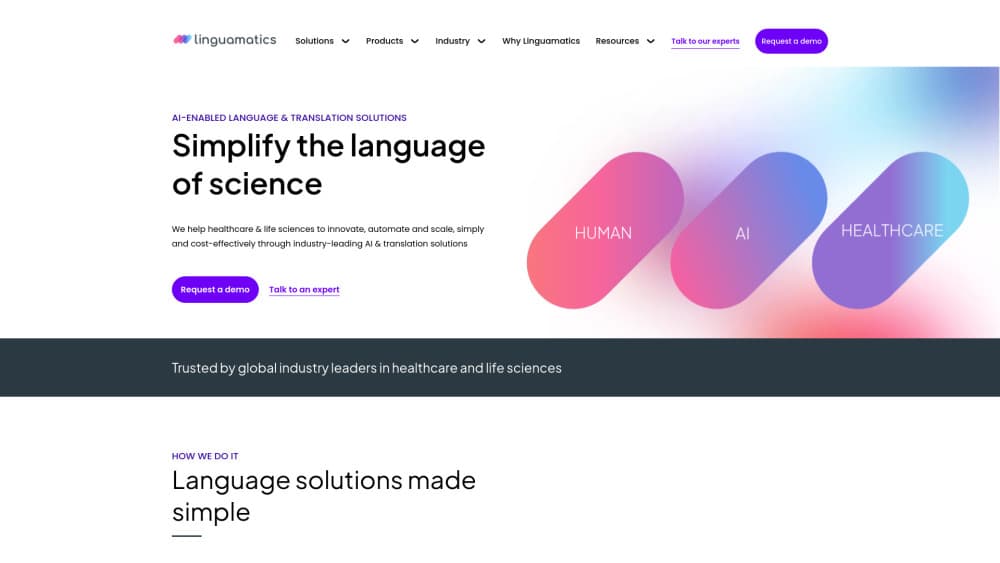
About Linguamatics
What Is Linguamatics
Linguamatics is a language technology vendor that works almost exclusively with healthcare and life science organizations. Its main product, I2E, reads scientific literature, patents, trial registries, drug labels and clinical notes, then pulls out named entities and relationships in a structured form you can analyze.
The problem it addresses is volume. A research team can read a few hundred papers. It cannot read several million, and it certainly cannot keep up with new trial records and safety reports each week. That gap is where life sciences text mining earns its budget. I2E lets a curator describe what to look for, then runs that description across large collections at machine speed.
Since 2019 the company has been part of IQVIA. Alongside I2E it now sells Linguamatics Translate, a portal for machine translation of clinical and regulatory documents, with optional review by professional linguists. Both products assume a regulated environment, paid content licenses, and a buyer who cares about audit trails more than about a monthly subscription button. That focus is also the limit: there is no self-serve tier, and nothing here is aimed at general office work.
Getting Started
- Talk to the sales team and describe the corpus, the questions your team needs answered, and whether data can leave your network.
- Pick a deployment: the vendor cloud, a private cloud, or on-premise servers inside your own environment.
- Load content sources and ontologies, then connect subscriptions such as PubMed, clinicaltrials.gov and FDA labels.
- Build a query in the I2E interface, test it against a sample, and tune precision before running it at full scale.
- Export results to a table or dashboard, or wire the run into an internal application through the web services interface.
Product Information
A quick look at Linguamatics's pricing, supported platforms, and performance.
Best for
The users, tasks, and scenarios where this tool fits best.
Users
- Medical information teams
- Translational researchers
- Regulatory and safety staff
Tasks
- Phenotype curation from clinical notes
- Target prioritization from literature
- Clinical trial translation
Scenarios
- Safety signal review before a periodic report is due
- Global study start-up
- Screening a patient population for social determinants of health
Key features
Biomedical ontology layer
I2E ships with access to roughly 6.5 million biomedical synonyms drawn from established ontologies and terminologies. That matters in biomedical text mining: a search for one drug name also catches code names, salt forms and misspellings, which is where manual literature review usually leaks.
Query building across mixed sources
You describe a pattern, such as a drug plus an adverse event within the same sentence, and run it over literature, patents, trial records, drug labels and clinical notes together. Results are normalized so the same entity from different sources lands in one column instead of five.
Rules, machine learning and LLMs in one pipeline
The platform blends rule based linguistics with machine learning models and, in current versions, large language models. Output stays explainable, meaning a curator can see which sentence produced a hit and adjust the definition rather than accept a black box score.
Deployment that fits a compliance review
The same product runs in the vendor cloud, a private cloud, or on your own servers, and the vendor states HIPAA compliant infrastructure for hosted options. For hospital and pharma buyers this is usually the first question in procurement, not an afterthought.
Throughput at production scale
Linguamatics quotes processing of more than 8 million documents per hour and out of the box F-scores above 95 for its models. Those numbers come from the vendor, so treat them as a ceiling under lab conditions rather than a promise for messy scanned records.
NLP API for internal systems
Since I2E 4.0 the platform has exposed an NLP API over HTTP, the WSAPI, with client libraries for common languages. Teams use it to push a query from a lab notebook tool or a dashboard and get structured results back without opening the web interface.
Linguamatics Translate portal
The translation side covers more than 150 languages with pre-trained engines, terminology management and a routing step that sends patient-facing or regulatory documents to certified linguists. Formatting is preserved on output, which saves the reformatting work that usually follows machine translation.
Pros and cons
Pros
- Domain-specific models for adverse events, social determinants of health and similar tasks, so teams do not train a general model from scratch.
- Explainable results with sentence-level evidence, which helps in audits and internal review.
- Flexible deployment, including on-premise for organizations that cannot send patient data outside.
- Handles very large corpora and keeps terminology consistent across languages in the translation portal.
Cons
- No published pricing and no self-serve signup, so evaluation starts with a sales conversation and a budget cycle.
- Query building takes training. Curators who understand both the biology and the query syntax get far more out of it than casual users.
- Content licenses for literature and ontologies are separate costs, and they can rival the software fee for small teams.
Frequently asked questions
It is used to extract structured facts from unstructured biomedical text, and to translate clinical documents. Typical work includes safety signal detection, phenotype curation, target research and multilingual study documentation.
Related content
Explore related tools, skills, and articles for Linguamatics.
Linguamatics Alternatives

Knocket
Knocket (Tencent RTC team) · Productivity · Business · ChatbotKnocket is a free live chat and contact page tool that lets visitors message you from your website, app, or a shareable link, with every reply handled from Telegram or one inbox.

shippedit.me
Krawlup · Marketing · Businessshippedit.me now redirects to Krawlup, a web platform that audits SEO, AEO and page speed every week, then hands the fixes to AI coding agents over MCP.

Ayven
Alknoma · Productivity · BusinessAyven is an AI control centre by Alknoma that turns a plain-language goal into a dated plan, hands the work to your people and AI agents, and asks for your approval only when the call is yours.