

Liquid Inference
Architect Financial Technologies Inc. · Coding · Productivity
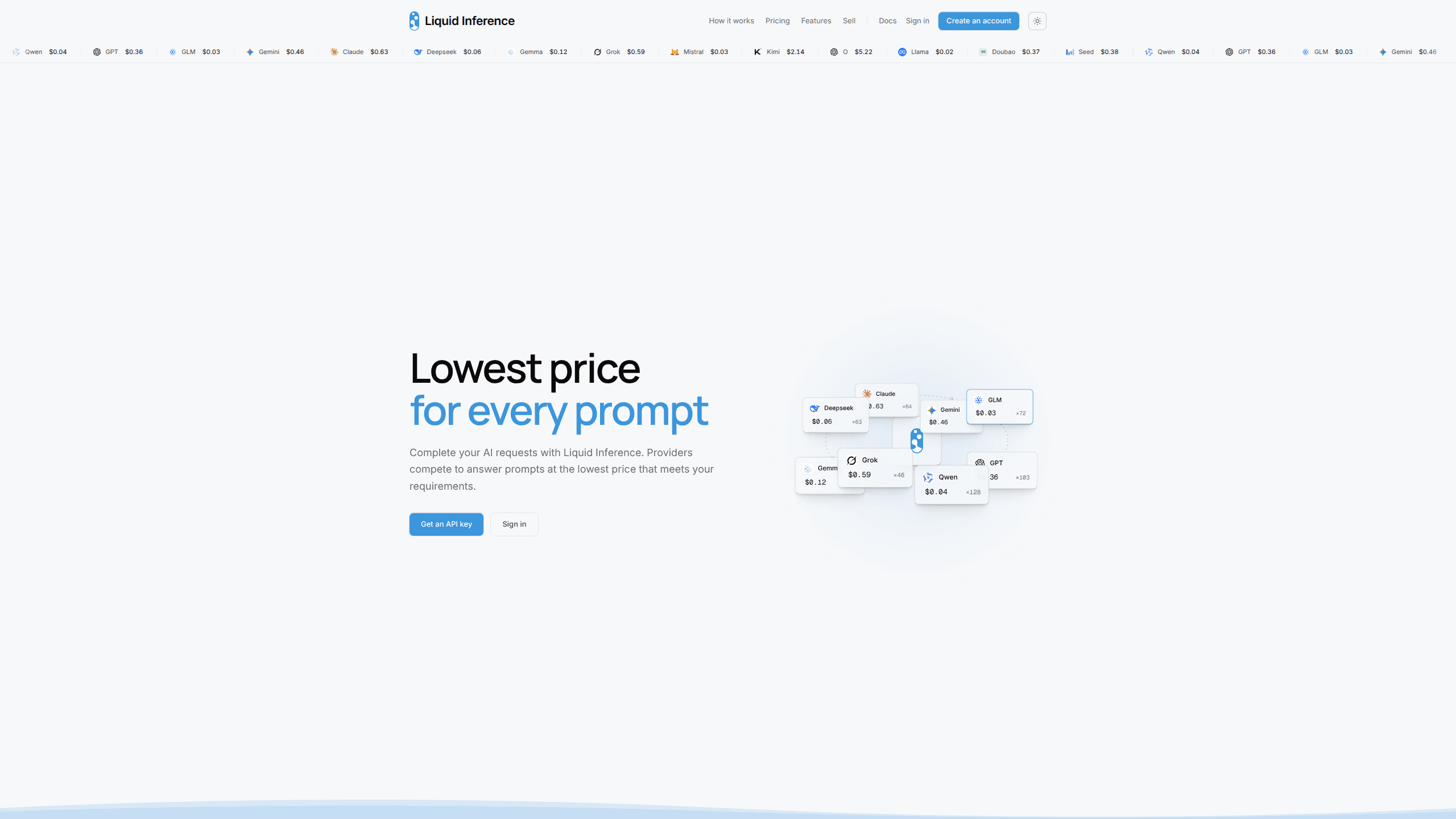
Liquid Inference is an AI inference marketplace from Architect that runs a live auction for each request and sends it to the lowest-priced provider that meets your rules.
About Liquid Inference
What Is Liquid Inference
Liquid Inference is an LLM router run as an exchange. Providers post standing offers with a price per token for each model they serve, and every request you send goes to the cheapest offer that clears your conditions. You can use it from a chat window in the browser or from the inference API, which speaks the OpenAI and Anthropic formats.
The product addresses a billing problem rather than a modeling one. Most teams pay published list prices for inference and have little room to negotiate, even when several providers serve the same open model. Architect applies trading market structure to that spend: a price cap is fixed before the first token, unused budget returns to your balance, and each job leaves a receipt that names the winning provider and the final charge.
The constraints are worth knowing before you move a workload over. The exchange launched in October 2026, so the number of sellers and the models they list is still shifting. Provider quality varies, which is why the buying rules include latency, throughput and region filters. A fee floor also applies, and on very cheap models it takes a larger share of the bill than the headline 5% suggests.
Getting Started
- Sign up at liquidinference.ai. Registration creates a workspace that holds your balance, API keys and receipts, and a starting credit lets you test without a card.
- Create an API key on the keys page. The secret appears once, so copy it before you close the panel.
- Point an existing OpenAI or Anthropic client at the exchange base URL and replace the API key. Model names have to match the ones the exchange lists.
- Add an optional
exchangeobject to the request body to set a price cap, a first-token deadline, a retention policy or a provider allow list. - Read the
exchangefield in the response, or open the receipt, to see which provider won and what the job cost.
Product Information
A quick look at Liquid Inference's pricing, supported platforms, and performance.
Best for
The users, tasks, and scenarios where this tool fits best.
Users
- Developers running coding agents
- Startups with unpredictable inference volume
- Platform engineers who need a paper trail
- GPU owners with spare capacity
Tasks
- Cost-capped batch jobs
- Comparing models on the same prompt
- RAG and search pipelines
- Buying images, speech or transcripts
Scenarios
- An agent loop starts looping and the bill climbs
- A provider has an outage during a long run
- A team wants the cheapest LLM API for a internal tool but cannot test every seller
Key features
An Auction on Every Request
Each request enters a live book of offers. The exchange drops any offer that fails your limits, ranks the rest by estimated charge plus the predicted wait, and awards the job to the best one. The winning price is capped before generation starts, so the worst case is known up front instead of after the invoice.
Buying Rules You Control
An optional exchange object carries the terms. You can set a cost cap in dollars, a maximum time to first token, a minimum throughput, approved regions, a zero-retention requirement, and allow or block lists for providers and models. Only offers that meet all of them compete, which turns policy into a request field rather than a support ticket.
Failover Before the First Token
If the winning provider fails before it writes any output, the exchange can move the job to the next offer. After the first token arrives, it does not switch, so one answer never contains two models. That split matters for streaming agents, where a mid-stream change would corrupt the tool calls already sent.
Receipts and Public Market Data
Every settled job has a receipt with the winner, the price cap, the token usage and the fee. Account holders also see the live order book, per-provider quotes and cleared transactions. You can pull the market data through the API before sending a request, which helps when you want to know whether a model is trading above its usual rate.
Auto Router and Axis Routing
Send liquid.auto and the exchange picks a model by published score and estimated charge inside your cap, with premium, balanced and economy variants. A model name suffix can rank offers by smartest, fastest or cheapest instead. Both options keep the auction underneath, so the price still comes from competing sellers.
Works With Your Existing Stack
The endpoints form an OpenAI compatible API that covers Chat Completions and Responses, plus an Anthropic Messages route. The official SDKs work after a base URL change. Connection guides exist for Claude Code, Codex, Cursor, Cline, Open WebUI, n8n, Dify, LangChain and a long list of other tools. The Liquid CLI starts a coding agent from the terminal with the same key.
A Selling Side for GPU Owners
Providers register deployments, set a price per model and quote over a session. The exchange dispatches jobs, records the usage and settles payouts. A provider with idle GPUs can monetize them without building a billing layer, and a provider already selling elsewhere can list the same deployment here as a second venue.
Pros and cons
Pros
- The price cap is fixed before generation, so a prompt with a huge output limit cannot produce a surprise bill.
- You keep your current SDK and client. In most cases the migration is a base URL and an API key, not a rewrite.
- Purchasing rules cover latency, region and data retention, which makes the marketplace usable for workloads with compliance constraints.
- Receipts and a public order book give you a record of what each job cost and who served it.
- The selling side gives GPU owners a way to fill idle capacity without a separate billing stack.
Cons
- The exchange is new. Launched in October 2026, it has a smaller set of sellers than established routers, and model coverage can change without notice.
- The fee floor of $0.01 per million tokens hits cheap and free offers hard. On a budget model the effective fee can approach half of the provider charge.
- Output quality depends on which provider wins. The auction optimizes price and declared performance, not the quality of a specific answer, and a higher published score does not guarantee a better response.
- A request cannot move to another provider once output starts. A provider that degrades mid-stream leaves you with a partial answer and a retry.
Frequently asked questions
Liquid Inference is an LLM inference exchange from Architect Financial Technologies. Providers post prices for the models they serve, and each request is awarded to the lowest-priced offer that meets the buyer's cost, speed, region and data rules. It works through a web interface, an API and a CLI.
Related content
Explore related tools, skills, and articles for Liquid Inference.
Liquid Inference Alternatives

Base Code
Base44 (Wix) · Coding · ProductivityBase Code is a shared cloud development environment from Base44. Teammates describe changes to an existing GitHub codebase in chat, preview them live and send them back as pull requests.

Google EmbeddingGemma 2
Google DeepMind · Writing · Image · CodingGoogle EmbeddingGemma 2 is a 740M-parameter open model that turns text, code, images, audio, and video frames into vectors in one 768-dimension space, running on phones and laptops.

GitGlow
GitGlow · Coding · ProductivityGitGlow is a local-first desktop Git client that lets independent developers review their own code and their AI agents' changes in one place before shipping.