

Listnr AI
Listnr AI · Voice & Language
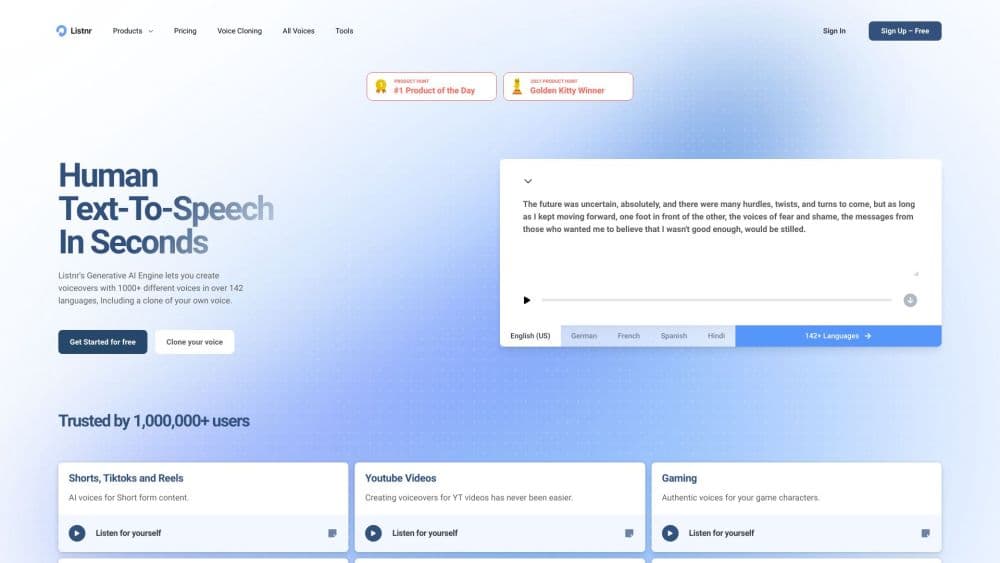
Listnr AI is an AI voice generator that turns text into natural speech in 142+ languages, with voice cloning, translation, and a studio for voiceovers, podcasts, and audiobooks.
About Listnr AI
What Is Listnr AI
Listnr AI is an AI voice generator built for turning written scripts into publishable speech. You open the browser studio, paste or import a script, pick a voice, and shape how each line is delivered before exporting the AI voiceover. The company positions it as voice generation made for real production work rather than a novelty demo, and it targets creators, marketers, educators, and agencies who need finished voiceovers without booking a recording session.
The core promise is range inside one workspace. Listnr carries more than 1,000 AI voices across 142+ languages and accents, and the same studio also handles voice cloning, an AI translator, podcast creation, and speech to text. That mix matters for teams who localize one script into several languages, since the voice, pacing, and export live in the same place instead of across four tools.
The limits are worth knowing before you commit. Voice generation runs on credits, and the free plan gives 1,000 to start with no card required, so steady output needs a paid plan. Commercial rights sit on the paid tiers rather than the free one. Some delivery controls, like emotion and style prompts, vary by voice, so the exact options you get depend on which voice you pick.
Getting Started
- Sign up for a free account in the browser studio; no credit card is needed to begin.
- Paste a script or import a draft, then pick a voice and language from the library.
- Split the script into blocks and assign a different voice to each speaker if the piece has several roles.
- Tune pace, pauses, emphasis, and style, then regenerate only the lines that changed.
- Export the finished audio as MP3 or WAV, or reuse it as a podcast, audiobook, or video voiceover.
Product Information
A quick look at Listnr AI's pricing, supported platforms, and performance.
Best for
The users, tasks, and scenarios where this tool fits best.
Users
- Video creators and YouTubers
- Podcasters and audiobook producers
- Marketers and agencies working in several languages
Tasks
- Turning a written post into audio
- Localizing a script
- Cloning a consistent brand voice
Scenarios
- Producing ad reads at volume
- Building course and training audio
- Drafting an audiobook
Key features
1,000+ Voices Across 142+ Languages
The voice library is the part most people come for. Listnr lists more than 1,000 realistic AI voices spanning 142+ languages and accents, and you can filter by language, accent, gender, and narration style before committing. For anyone localizing content, that breadth means a single script can reach a dozen markets without a new hire each time. It also opens up voices aimed at specific jobs, so an ad read and a bedtime story do not have to sound the same.
Voice Cloning From One Recording
Voice cloning lets you build a reusable voice from an approved recording of your own or a consented speaker. Once it exists, you can generate new speech in that voice and keep a channel or a brand consistent across everything you publish. The company ties cloning to consent-led workflows, so the person behind the voice has to approve its use. That makes it fit steady creators and internal teams better than one-off projects.
AI Translator for Multi-Language Audio
The built-in AI translator auto-detects the source language and can move a script into 150+ target languages. It pairs naturally with the voice library: translate the text, then read it in a matching accent so the result sounds local rather than dubbed. This is the feature that saves the most time for teams taking one campaign into many regions, since the wording and the voice swap happen in the same pass.
Studio With Block-Based and Multi-Speaker Editing
The studio works like a document editor rather than a timeline. You arrange a script into blocks, assign a different voice to each speaker, and regenerate a single line without rebuilding the rest of the audio. Multi-speaker scripts, like two-host podcasts or dialog scenes, stay organized because each section keeps its own settings. Edits land per block, which keeps long projects from turning into start-over rewrites.
Emotion, Pacing, and Pronunciation Control
You shape how a line lands, not just what it says. Style prompts push delivery toward warm, calm, confident, or narrator-style reads, and you can adjust pace, pauses, and emphasis per section. Custom pronunciations keep names, brand terms, and technical words consistent, so a product name is not read three different ways across a series. The exact emotion and style options vary by voice, which is worth checking before you build a workflow around a specific sound.
Text to Speech API for Developers
Listnr sells a public REST API for teams wiring voice into their own products. You authenticate with an API key, send a script plus a voice id, and get audio back, with reference SDK code in the company's public repository. There is a free tier of about 100 requests a day with no credit card, and higher throughput sits on enterprise and custom plans. It suits developers adding narration to an app rather than occasional one-off generation.
Pros and cons
Pros
- The voice library is unusually broad, with 1,000+ voices across 142+ languages and accents in one subscription.
- Voice cloning lets a channel or brand keep one consistent narrator across episodes, chapters, and campaigns.
- The built-in AI translator pairs with the voice library, so one script can reach many markets without extra talent.
- The block-based studio keeps multi-speaker and long-form projects editable line by line instead of forcing full re-records.
- Paid plans include commercial rights, so monetized videos, ads, and audiobooks are cleared to publish.
Cons
- Generation runs on credits, so the free plan's 1,000-credit start only covers a few previews before you need to pay.
- Emotion and style controls vary by voice, which means the delivery options you see depend on the voice you chose.
- Most strengths sit behind paid plans, since commercial rights, cloning, and full voice access are not on the free tier.
- It is not built for live conversational agents, so real-time voice bots need a streaming vendor instead.
Frequently asked questions
Listnr AI is an AI voice generator and text to speech platform that turns written scripts into spoken audio. You use it for video voiceovers, podcast and article narration, audiobook drafts, e-learning audio, and localized content in 142+ languages. It also carries voice cloning, an AI translator, and speech to text in the same studio.
Related content
Explore related tools, skills, and articles for Listnr AI.
Listnr AI Alternatives

Foley
Hanamori Labs, LLC · Voice & Language · Productivity · AI AssistantFoley is a voice to-do list that turns a spoken sentence into a filed task, complete with project, date and time, then helps you plan the day around what is already there.

HireKey
HireKey · Voice & Language · Productivity · LeaningHireKey is an AI job search copilot built by a former tech recruiter. It checks role fit, tailors resumes, runs interview practice and tracks every application.

Fluence
Yay Software (Yannick Huchard) · Writing · Voice & Language · ProductivityFluence is an Android app that reads PDFs, EPUBs, Word files and web articles aloud, follows each sentence as it speaks, and answers questions about the text on the phone itself.