

LiveX AI Agent
LiveX AI · Marketing
LiveX AI Agent is a platform for putting human-like AI agents on websites, kiosks, holograms, and voice lines, so retailers, venues, and travel hubs can answer questions and keep customers on site.
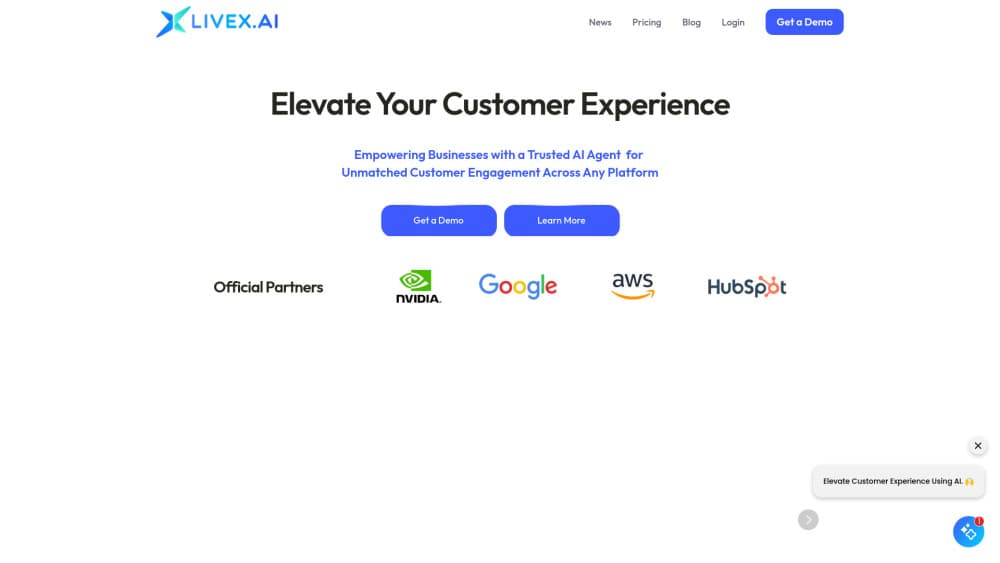
About LiveX AI Agent
What Is LiveX AI Agent
LiveX AI Agent is the agent layer of LiveX AI, a company that builds conversational AI for places where people physically stand: stores, airports, stadiums, hotels, and hospital lobbies. The same agent can answer a question in a web chat window and then handle the identical question from a shopper standing in front of a kiosk. One brain, two settings.
Most AI customer service agent tools stop at the browser tab. LiveX pushes the agent into the room. A camera and microphone feed it visual and audio context, so it can read a face, a held product, or a crowded counter and adjust what it says. The avatar on screen answers with lip-sync that matches the spoken language, which is what makes the exchange feel closer to a conversation than a search box.
The company sells to organizations, not individuals. Deployments run through a sales process, with hardware, content setup, and system integrations handled per site. LiveX says it holds SOC 2, HIPAA, and GDPR compliance, and it lists Google, Wyze, and Fotor among clients. Customer results on the site, such as Wyze reporting 90%+ self-resolution, come from the vendor's own case studies rather than independent audits.
Getting Started
- Book a demo through livex.ai. There is no self-serve signup, and the team scopes the deployment around your channels: website, mobile app, in-store kiosk, hologram, or a mix.
- Agree on the agent's job. Most projects start with one narrow task, such as product questions, onboarding help, or cancellation saves, then expand once the answers hold up.
- Load your content and connect systems. Product catalogs, help articles, CRM records, and billing tools feed the agent, and LiveX wires the integrations on its side.
- Review the agent's voice, face, and language settings. A brand can pick an avatar style, a speaking language, and a tone, then test against recorded real questions before launch.
- Run a pilot on one screen or one page, watch the transcripts, and tune answers. Rollout to more locations follows once the resolution rate looks steady.
Product Information
A quick look at LiveX AI Agent's pricing, supported platforms, and performance.
Best for
The users, tasks, and scenarios where this tool fits best.
Users
- Retail and ecommerce teams
- Airports, stadiums, and hotels
- SaaS support leaders
- Brand and experience teams
Tasks
- Answering repeat questions about hours, gates, stock, and pricing
- Rescuing customers who are about to cancel
- Guiding a purchase decision
- Onboarding new users
Scenarios
- A busy store counter at peak hours
- A trade show or sponsored event
- A multilingual service desk
Key features
One Agent Across Digital and Physical Channels
The same agent powers a web chat, a mobile app, a kiosk, and a hologram, so answers stay consistent no matter where a customer meets it. Conversations carry context between touchpoints, and a customer who starts on a phone can pick the thread back up in a store. For support teams, that removes the usual split between a website bot and a separate in-store screen.
Real-Time Voice With Visual Context
LiveX builds its agent around speech rather than text entry. It listens, answers within the flow of a conversation, and accepts visual input from a camera so it can react to what a person is holding or wearing. In a store, that means the agent can comment on the actual product instead of asking the customer to describe it. It also makes the interaction usable for people who would rather talk than type.
Life-Size Avatars and Holograms
The platform ships digital humans that can appear on a screen at human scale or as a floating hologram. Lip-sync matches the spoken language, and clients have used Japanese-language avatars for executive demos. This is the part that turns a service tool into an attraction, which is why sports venues and event sponsors are the earliest adopters.
Churn Reduction and Retention Flows
LiveX sells a churn-focused setup that sits inside a subscription product and intervenes when a customer signals intent to cancel. Akool credits it with a 26.4% cut in subscriber churn and Monica reports double the cancellation deflection across a 10 million user base. Those figures are customer statements published by LiveX, so treat them as directional. The mechanics are the useful part: catch the signal, answer the real objection, offer a concrete alternative.
Enterprise System Integrations
The agent reads from and writes to the systems a support team already runs, including CRM, billing, and knowledge bases. When a request needs a refund, an address change, or an account lookup, the agent can complete it inside the conversation instead of handing off. That is the difference between an agent that answers and one that resolves.
Summaries and Next-Best Actions for Staff
When a conversation does go to a human, the agent passes a summary and a suggested next step, so the customer does not repeat the story. Staff get the context in the same screen they already use. LiveX positions this as a way to raise output per employee without adding headcount, and the claim is plausible for high-volume service desks.
Pros and cons
Pros
- Covers web, kiosk, hologram, and voice from one agent, which cuts the cost of running separate bots per channel.
- Voice-first design with camera awareness fits real service counters better than a typed chat widget.
- Compliance posture covers SOC 2, HIPAA, and GDPR, which clears procurement in regulated industries.
- Named clients include Google, Wyze, and Fotor, so there is a reference trail to check.
- Retention and deflection flows target measurable outcomes, not just conversation quality.
Cons
- No public pricing and no self-serve trial, so you cannot test the product without a sales conversation.
- Physical deployments need hardware, installation, and content production, which pushes timelines and cost well past a software subscription.
- Published performance numbers come from vendor case studies, and independent benchmarks are hard to find.
- Small businesses with a single website will pay for channel coverage they never use.
Frequently asked questions
It is an AI agent that talks to customers on a website, in an app, or on a screen in a physical location. It listens, sees through a camera when one is attached, and answers in real time using your own content and systems.
Related content
Explore related tools, skills, and articles for LiveX AI Agent.
LiveX AI Agent Alternatives

ngram 2.0
ngram · Video · Marketingngram 2.0 is an AI video generator for teams. It turns a prompt, a screen recording, or a product URL into a narrated explainer, product demo, or AI avatar video, and every scene stays editable.

shippedit.me
Krawlup · Marketing · Businessshippedit.me now redirects to Krawlup, a web platform that audits SEO, AEO and page speed every week, then hands the fixes to AI coding agents over MCP.

MePersona
MePersona, Inc. · Writing · Productivity · MarketingMePersona is an AI unified inbox for creators. It learns your voice, drafts replies to fan messages from 12 platforms, and sends only what you approve.