

LLM Gateway
The Open Co · Other
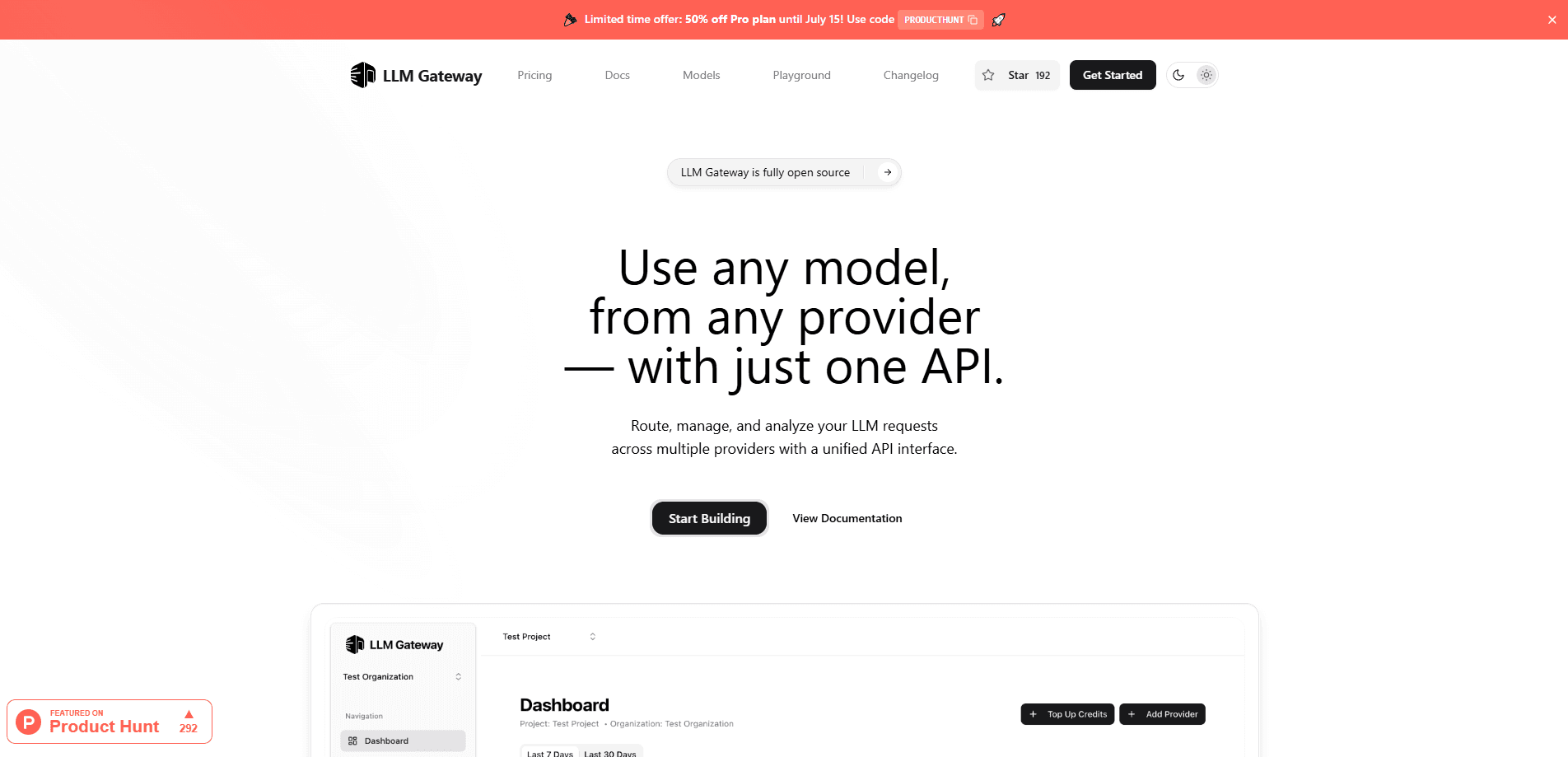
LLM Gateway is an open-source AI API gateway that routes requests to 250+ models from 40+ providers through one OpenAI-compatible endpoint, adding failover, caching, and cost tracking.
About LLM Gateway
What Is LLM Gateway
LLM Gateway is a middle layer that sits between your app and the model providers. You point your existing OpenAI SDK at one base URL, keep one API key, and call whichever model you want. The gateway forwards the request to a provider, then hands the answer back in the same format your code already expects.
The problem it solves is provider sprawl. Once a project touches OpenAI, Anthropic, Google, and an open-weight host, you end up juggling separate keys, separate SDKs, and separate bills. LLM Gateway collapses that into one interface for multi-provider LLM access, so switching models is a string change rather than a rewrite.
It's open source under AGPLv3, which matters if you'd rather keep prompts inside your own network. You can use the hosted cloud or run the same code yourself as a self-hosted LLM proxy with Docker, Compose, or Kubernetes. The trade-off is that self-hosting puts the uptime and upgrades on your team, and the free tier leans on community support.
Getting Started
- Sign in to the dashboard and create a project, then copy the API key it generates.
- Export the key as
LLM_GATEWAY_API_KEYin your shell or a.envfile. - Change your OpenAI SDK base URL to
https://api.llmgateway.io/v1and keep your existing code. - Call a model by name, such as
gpt-4o, and let the gateway pick a provider for you. - Watch latency, cost, and provider breakdown in the dashboard, then add caching or fallback as traffic grows.
Product Information
A quick look at LLM Gateway's pricing, supported platforms, and performance.
Best for
The users, tasks, and scenarios where this tool fits best.
Users
- Backend and platform developers
- AI product teams
- Privacy-conscious engineering teams
Tasks
- Swapping models without a rewrite
- Surviving provider outages
- Controlling AI spend
Scenarios
- Running a multi-provider chatbot in production
- Prototyping on free models
- Keeping data in-house
Key features
One OpenAI-Compatible Endpoint
The gateway speaks the OpenAI API format, so chat completions, embeddings, images, speech, and transcription all work through your existing SDK. You change the base URL and a model string, nothing else. For teams already on the OpenAI SDK, that's the whole migration.
Smart Routing and Automatic Fallback
Requests can be routed by price, latency, throughput, or uptime, and you can pin a specific provider with the provider/model form. A request that only names a model gets retried on another provider that serves it when the first one fails. You can block that with the X-No-Fallback: true header if you'd rather see a clean error.
Response Caching
Repeated requests can be served from a Redis-backed cache, which cuts both latency and spend on identical prompts. Provider cache controls pass through too, so you keep the provider's own caching behavior. High-volume apps notice this first on their bill.
Guardrails and PII Protection
The gateway enforces prompt-injection protection, PII detection and redaction, secrets detection, and a custom rules engine at the edge. That means policy runs in the same place every request passes through, instead of in each app. Teams handling sensitive input get a single control point.
Centralized Key Management
Provider keys are stored encrypted and paired with project-scoped API keys that carry usage and spending limits and full audit trails. You rotate keys without touching application code. It's the feature that keeps a growing team from passing raw provider keys around.
Cloud or Self-Hosted Deployment
You can use the hosted gateway or run the AGPLv3 source on your own infrastructure with Docker, Compose, or Kubernetes. Self-hosting is free, and everything from routing to analytics runs the same way. The choice comes down to who you want owning uptime.
Pros and cons
Pros
- One OpenAI-compatible endpoint covers 250+ models from 40+ providers, so model switching is a string change.
- Automatic fallback and retry keep requests alive when a single provider is rate-limited or down.
- Response caching and per-key spending limits give direct control over AI cost.
- The AGPLv3 core is self-hostable, which keeps prompts and responses inside your own network.
- Guardrails for prompt injection, PII, and secrets run at the gateway instead of in each app.
Cons
- Pay-as-you-go credits carry a flat 5% platform fee on top of provider token rates, so managed use costs more than calling providers directly.
- Self-hosting shifts uptime, upgrades, and scaling onto your own team, which means real operational work.
- The free tier is limited and leans on community support, so production teams usually end up paying or self-hosting.
Frequently asked questions
It's used to call many AI models through one API. Instead of integrating OpenAI, Anthropic, Google, and others one by one, you send requests to a single OpenAI-compatible endpoint and let the gateway handle the routing.
Related content
Explore related tools, skills, and articles for LLM Gateway.
LLM Gateway Alternatives
BinkBink
BinkBink · OtherBinkBink is a free online game platform and AI game maker that lets anyone turn a short text description into a playable browser game. You can jump into hundreds of community-made games. Or describe your own idea and play it in seconds, then share it with friends. Want to create your own game? You don't need to code. No engine setup, no download, no hassle.

Audiogen
Audiogen Inc. · OtherAudiogen is an AI music generator built by Audiogen Inc., a small research team that spent about 2.5 years training its own generative music model and designing a web interface around it. Instead of a plain text box, this AI music tool turns the timeline into a beginner-friendly Generative Audio Workstation, or GAW, where inpainting, extending, remixing and stem editing work more like painting on a canvas. The product is still in beta, so access runs through a waitlist or an invite. Paid plans aren't published yet.

Aiml API
AIMLAPI OÜ · OtherAiml API is a unified AI model API that puts more than 1000 models from OpenAI, Google, Anthropic, and others behind one endpoint and one bill. You write code against a single OpenAI-compatible schema, then switch between chat, image, video, and audio models by changing a model string. It suits developers and small teams who want multi-model access without juggling a dozen separate provider accounts, and it removes the usual billing headache that comes with testing several vendors. One key covers it all.