

LLM SEO EEAT
findable · Marketing · Other
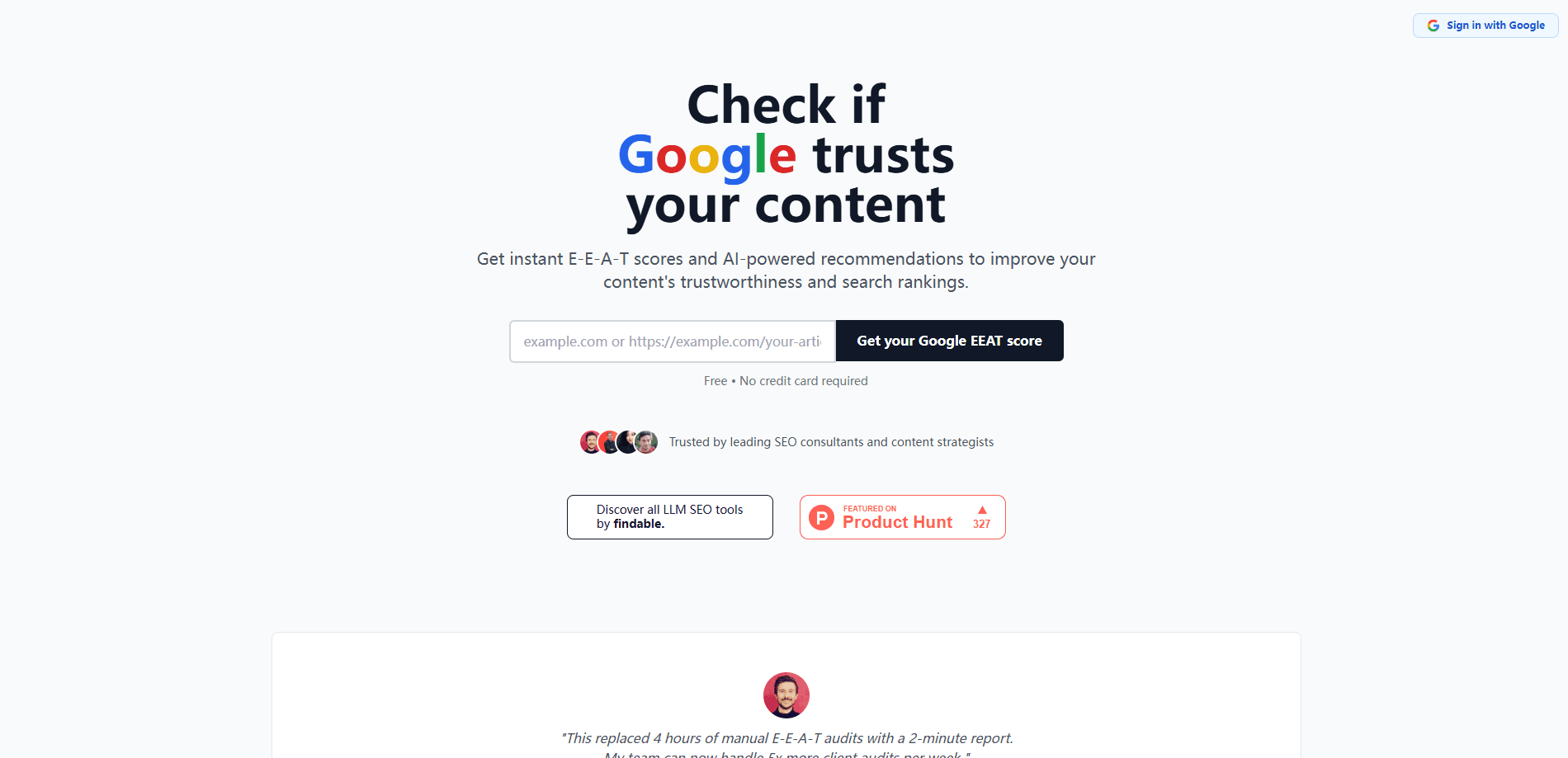
LLM SEO EEAT is a free web tool that scores how much Google and AI assistants trust a page, then lists the E-E-A-T fixes that improve visibility.
About LLM SEO EEAT
What Is LLM SEO EEAT
LLM SEO EEAT is a browser tool from the team behind findable, a marketing platform for AI search. You paste in a public page, and it grades how well that page signals Experience, Expertise, Authoritativeness, and Trustworthiness, the four quality signals Google and AI answer engines weigh when they decide what to cite.
The problem it solves is a blind spot. A page can rank on Google and still never get quoted by ChatGPT, Claude, or Google AI Mode, because those systems pick sources on trust rather than position alone. You can't see that gap from your usual ranking report. This tool puts a number on it and breaks the number into the four signals, so you know which part of the page to rewrite.
It stays narrow on purpose. There is no site crawl here and no long-term tracking on the free scorer. Treat it as a fast check on one URL at a time, useful before and after you edit a page, not a standing dashboard.
Getting Started
- Open llmseoeeat.com in any browser.
- Paste the URL of a public article, landing page, or product page.
- Let the scorer read the page and return your EEAT score.
- Read the four signal scores for Experience, Expertise, Authority, and Trust.
- Fix the weakest signal first, then rerun the page to check the change.
Product Information
A quick look at LLM SEO EEAT's pricing, supported platforms, and performance.
Best for
The users, tasks, and scenarios where this tool fits best.
Users
- SEO managers
- Content marketers
- Agency teams running client audits
Tasks
- Scoring a landing page before launch
- Comparing two versions of a rewrite
- Auditing competitor pages
- Preparing AI search content
Scenarios
- Before a content refresh
- After adding author bios and citations
- Pitching a client on AI search work
Key features
Single-page EEAT score
The core of the tool is one number for one URL. You paste a public article, landing page, or product page, and it returns an overall EEAT score out of 100, built from how clearly the page shows real experience, named expertise, recognized authority, and verifiable trust signals. One number sounds crude, but it forces a decision: is this page worth pushing into AI answers right now, or does it need work first.
Four-signal breakdown
Under the total, the EEAT checker splits the score into Experience, Expertise, Authority, and Trust, the same four pillars Google describes in its quality guidelines. Experience looks at first-hand proof such as case studies and specific results. Expertise looks at author credentials and depth. Authority looks at recognition and how often the brand gets mentioned. Trust looks at transparency, sourcing, and accuracy. Seeing them apart tells you whether to add a real author, add sources, or add proof you actually did the thing.
Built for AI answer engines
The scorer exists because citations and rankings no longer move together. Google's own guidance says that making a page work for AI overviews still counts as SEO, and yet a page that ranks can stay invisible in a generated answer. The tool targets that second job, the answer engine optimization layer, so you can check if a page is quotable, not just findable. For teams doing AI content optimization, it turns that abstract goal into four numbers you can act on.
Works on public pages, no setup
There's nothing to install and no account to configure for the basic score. You paste a URL that already exists on the open web, and the tool reads it. That keeps the first check fast, which matters when you're scouting a competitor or testing a draft before you commit an editor's time to it.
Part of a wider findable stack
The scorer is the free front door to findable, the paid platform behind it. That platform adds answer engine monitoring across ChatGPT, Google, Claude, Perplexity, and more, plus competitor tracking, content gap reports, and crawler checks. If the single score leaves you wanting trend lines and prompt tracking, the paid tools are the next step.
Pros and cons
Pros
- Free score with no signup, so you can check a page before spending anything.
- Splits the result into the four E-E-A-T signals, which points straight at what to fix.
- Handles public articles, landing pages, and product pages alike, so it fits most content types.
- Ties into the wider findable platform if you later want monitoring and competitor tracking.
Cons
- A single score is a snapshot, so you can't measure progress from one run alone.
- It grades one URL at a time, which is slow for auditing a whole site.
- Paid plans are quoted by sales rather than listed with fixed prices, which slows budget planning.
- There's no advertised public API, so you can't pull the score into your own dashboard.
Frequently asked questions
It scores how strongly a single page signals the four E-E-A-T pillars: Experience, Expertise, Authoritativeness, and Trustworthiness. You get an overall figure plus a score for each pillar, based on signals like author credentials, cited sources, first-hand proof, and how recognizable the brand is. Think of it as a content trust score built from an E-E-A-T analysis of the page, not a ranking check.
Related content
Explore related tools, skills, and articles for LLM SEO EEAT.
LLM SEO EEAT Alternatives

ngram 2.0
ngram · Video · Marketingngram 2.0 is an AI video generator for teams. It turns a prompt, a screen recording, or a product URL into a narrated explainer, product demo, or AI avatar video, and every scene stays editable.

shippedit.me
Krawlup · Marketing · Businessshippedit.me now redirects to Krawlup, a web platform that audits SEO, AEO and page speed every week, then hands the fixes to AI coding agents over MCP.

MePersona
MePersona, Inc. · Writing · Productivity · MarketingMePersona is an AI unified inbox for creators. It learns your voice, drafts replies to fan messages from 12 platforms, and sends only what you approve.