

LLM Stats
LLM Stats · Business · Other
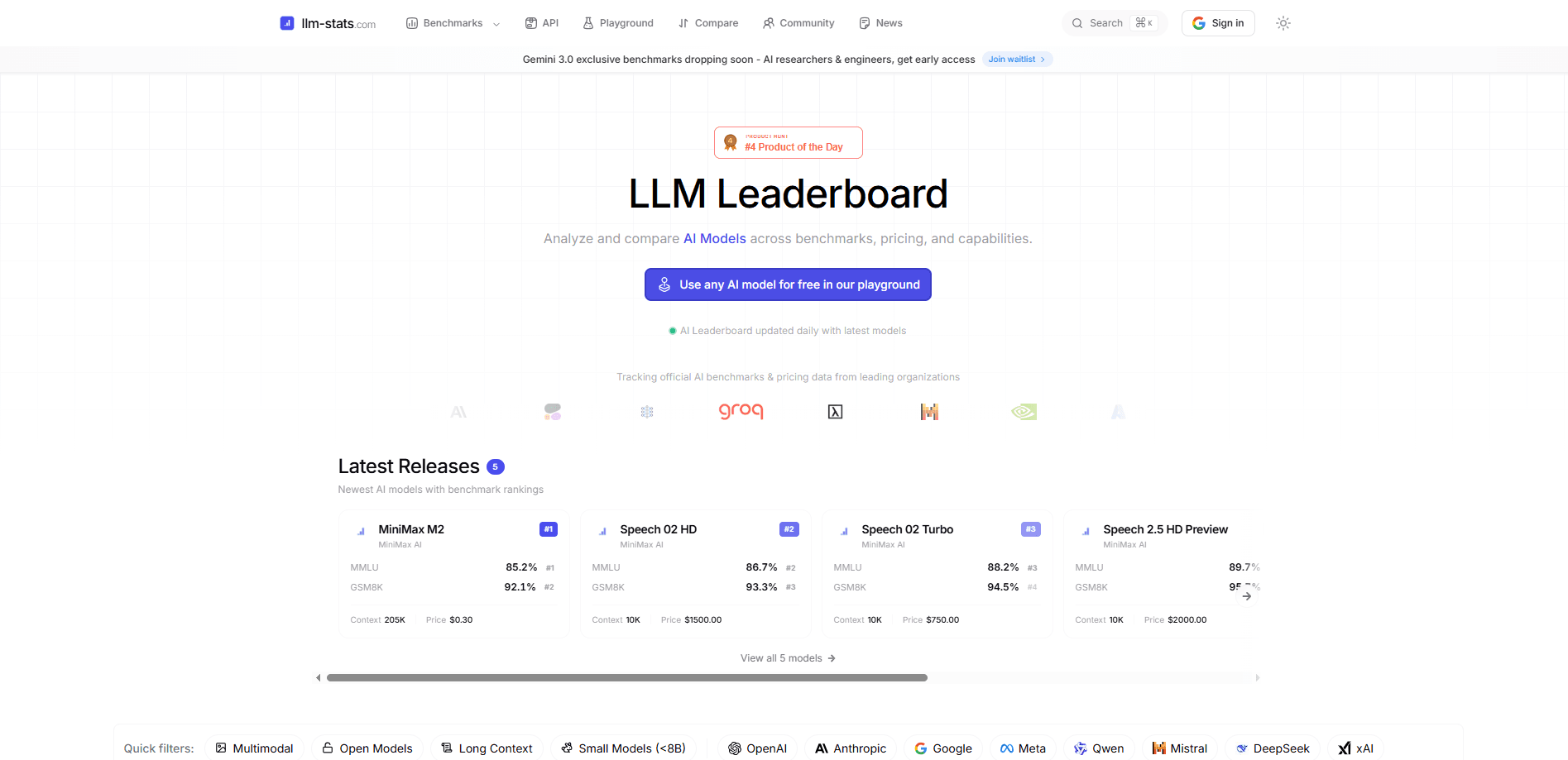
LLM Stats is a free AI model comparison platform that ranks more than 300 language models by benchmark scores, speed, and price on a single dashboard. It pulls public benchmarks and live API metrics into one LLM leaderboard, so you can compare GPT, Claude, Gemini, and DeepSeek side by side without juggling a dozen vendor pages.
About LLM Stats
What Is LLM Stats
LLM Stats is a benchmarking hub for anyone trying to make sense of the AI model market. Instead of reading each lab's marketing page, you get one place that lines up reasoning, coding, math, and long-context scores across mainstream models. The site updates continuously and tracks both closed and open-weight releases.
The core value is comparison. Why does that matter? Because no single lab publishes honest, side-by-side numbers for rival models. The platform runs every model through a composite LLM Stats Score, a conservative, uncertainty-aware number that mixes benchmark evidence into a single ranking. According to LLM Stats, missing results stay missing rather than counting as failures. That keeps half-tested models from looking worse than they're actually performing. Small detail. Big difference when you're picking a model for a real project.
The catch is scope. The rankings reflect whatever public evidence exists today. A model with thin benchmark coverage may sit lower than it deserves. The platform says outright that its score isn't a task-specific deployment recommendation. Treat it as a research shortcut, not a final answer.
Getting Started
- Open llm-stats.com and browse the main AI leaderboard, which lists ranked models with scores, speed, and per-million-token pricing.
- Narrow the list using the leaderboards for a specific job, like best AI for coding, writing, math, or long context.
- Filter by license, speed, or price to match your budget and latency needs.
- Open a model page to see its benchmark breakdown, context window, and provider pricing.
- If you're building software, connect through the Data API or MCP integration to pull the same numbers into your own app.
Product Information
A quick look at LLM Stats's pricing, supported platforms, and performance.
Best for
The users, tasks, and scenarios where this tool fits best.
Users
- AI developers choosing a model for a build
- Product managers and founders sizing up the market
- Researchers and students
Tasks
- Comparing AI model pricing
- Picking a coding or writing model
- Tracking new releases
Scenarios
- Deciding which model to pay for this quarter
- Evaluating an open-weight model against a closed one
- Wiring live model data into an internal tool
Key features
Composite LLM Stats Score
Every model gets a single score that combines benchmark results into one comparable number. The score is built to stay cautious: models with less evidence keep more uncertainty instead of being penalized. The ranking rewards broad, well-tested performance over one lucky benchmark win.
Live LLM Leaderboard
The main leaderboard ranks 300+ models and refreshes continuously from public benchmarks and API metrics. Columns cover reasoning, coding, agent, context window, output speed, and pricing. Scan it all at once. Sort on whatever matters to you.
Category Leaderboards
Beyond the overall ranking, the site runs focused boards for coding, writing, research, math, long context, tool calling, reasoning, image generation, and video creation. Each board applies the same scoring rules to a narrower benchmark set, which helps when your need has nothing to do with general intelligence.
AI Model Pricing Comparison
A dedicated pricing page lists input, cached input, and output cost per million tokens for hundreds of models, plus an observed cost-per-turn figure based on real traffic. It notes when each price was last checked and refreshes every 30 minutes, so the numbers don't drift out of date.
Open LLM Leaderboard
Open-weight models get their own ranking, separate from closed labs. That separation matters when you want to self-host or fine-tune. Open and closed models rarely compete on the same terms.
Open Arena and Playground
The platform hosts chat, coding, image, and video arenas where you can pit models against each other on real prompts. A playground lets you try models directly. Useful sanity check before you trust any leaderboard number.
Data API and MCP Server
For developers, a Data API and an MCP server expose the same leaderboard and pricing data programmatically. The platform also offers custom benchmarking and data labeling services for teams that need evaluation beyond public benchmarks.
Pros and cons
Pros
- Free to browse, with no paywall between you and the rankings or pricing tables.
- Pulls hundreds of models into one AI model comparison view. No more hopping across dozens of vendor pages.
- Pricing page shows when data was checked and refreshes every 30 minutes, so cost figures stay current.
- Separate open and closed leaderboards keep comparisons fair for people who self-host.
- The Data API and MCP server make it easy to reuse the data in your own tools.
Cons
- The score depends on public benchmarks, so a new or lightly tested model can rank lower than its real ability suggests.
- Deep benchmark coverage skews toward popular models, meaning niche or regional models get thinner data.
- Custom benchmarking and data labeling are paid services, and pricing isn't published on the site, so you have to contact the team for a quote.
- Leaderboard standings shift often as new models drop, which can make a saved screenshot go stale in weeks.
Frequently asked questions
Yes. The public leaderboards, model pages, and pricing comparison cost nothing to browse. The company does sell custom benchmarking and data labeling services for businesses. The core data stays open regardless.
Related content
Explore related tools, skills, and articles for LLM Stats.
LLM Stats Alternatives
Liveplan
Palo Alto Software · BusinessLivePlan is business plan software that helps founders and small business owners turn an idea into a funder-ready plan. It combines AI-assisted writing, market research with cited sources, and connected financial forecasting so your income statement, cash flow, and balance sheet move together when you change one number. Over 1.5 million businesses have used it to plan, forecast, and track performance against real accounting data. That's a lot of founders. It's also a signal the tooling survived contact with real lenders.

Swms
Swms AI · Writing · Productivity · BusinessSwms is an AI safety compliance tool that turns a plain description of a job into ready-to-use safety documents. Describe your project, trade, and known hazards, and it writes a safe work method statement, job hazard analysis, safe work procedure, RAMS, or safety data sheet in seconds. It also ships with Oscar, a chat assistant that answers workplace safety questions in any language. Teams in construction, mining, transport, and warehousing use it to cut the paperwork that usually eats into a workday.

Rows
Rows (Superhuman) · Productivity · BusinessRows is an AI spreadsheet and data analysis tool that imports live data from more than 50 sources, then lets you work with it using plain language instead of SQL queries or nested formulas. You can pull numbers out of PDFs, connect ad platforms, databases, and bank accounts, and ask the AI to build reports, merge datasets, or set up models that recalculate themselves. It runs in the browser, works like a spreadsheet, and now sits under the Superhuman umbrella.