

Logic, Inc.
Logic, Inc. · Coding · Productivity
Logic, Inc. is a spec-driven AI agent builder, and it centers on a simple idea: you write the agent in plain English, and the platform turns that spec into a working, callable product. Instead of wiring prompts, schemas, and glue code by hand, teams describe what an agent should do and let Logic handle orchestration, typed I/O, testing, and deployment. It suits developers and operations teams that need reliable agents rather than one-off chat demos.
About Logic, Inc.
What Is Logic, Inc.
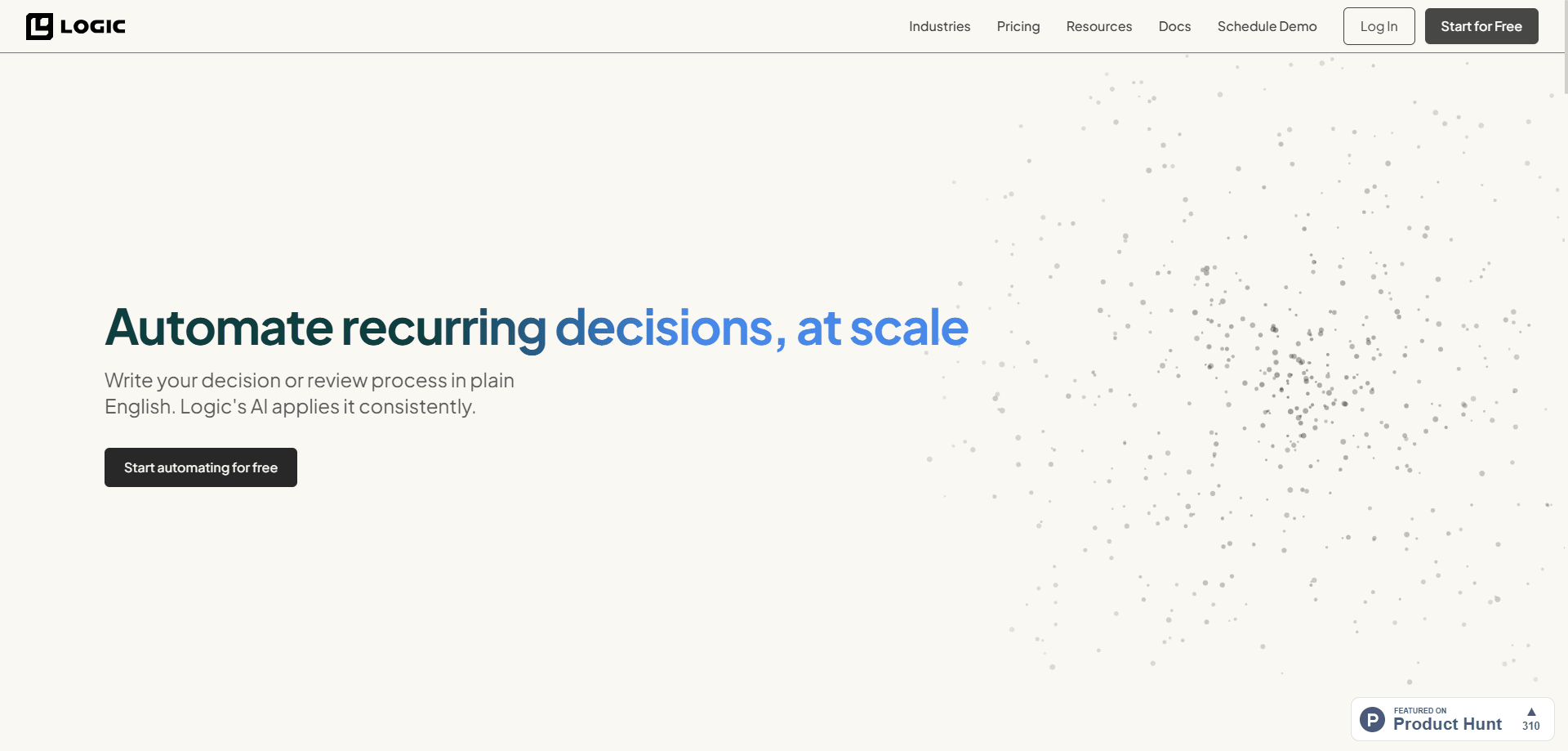
Logic, Inc. is a web platform for building AI agents from natural language specifications. You write a spec or standard operating procedure in everyday English, and the system infers the schemas, the orchestration logic, and the API that runs underneath. The pitch is that most of what you would normally build yourself, testing, versioning, approvals, a REST endpoint, a shareable web form, is already there. That alone saves weeks.
The main problem it solves is the gap between a prompt that works in a demo and an agent a team can depend on. Prompts break quietly. Outputs drift. Nobody can tell which version shipped what. Logic freezes every published version, generates tests on save, and enforces typed input and output so downstream code doesn't have to guess.
The most important limit is that it's a builder, not a finished assistant. You still have to write a clear spec and know your own workflow. Vague instructions produce vague agents, and the platform won't invent business logic for you.
Getting Started
- Create a free account on logic.inc and open the authoring workspace.
- Write a plain-English spec for the agent, then let the platform infer schemas and orchestration logic.
- Review the inline warnings and suggestions, and refine the spec until the generated tests pass.
- Connect any needed integrations, then publish the agent to get its REST API and shareable web UI.
- Run the agent against real inputs, and use execution history to compare versions before promoting it to production.
Product Information
A quick look at Logic, Inc.'s pricing, supported platforms, and performance.
Best for
The users, tasks, and scenarios where this tool fits best.
Users
- Developers building AI agents
- Operations and support teams
- Small product teams without a platform squad
Tasks
- Turning documents into APIs
- Automating repetitive review work
- Handling inbound requests by email
- Validating output quality
Scenarios
- Launching an internal tool without a frontend
- Handling regulated data
- Prototyping a first agent on a budget
Key features
Natural Language Specs
Put simply: you write the agent in plain English, and Logic Inc. infers the schemas and orchestration logic behind it. No flowchart editor required. the spec works from an SOP, a ticket, or a rough description, so you're not locked into a flowchart editor. An IDE-like authoring view flags warnings and suggests fixes as you refine the text.
Auto-Generated REST API
Every agent becomes callable the moment you save it, through a POST endpoint with bearer token authentication. No extra step. Integration docs are generated alongside, so a developer can wire the agent into an app without asking the platform team for a spec. This is the feature that turns a spec into something shipping code can actually call.
Built-In Testing and Synthetic Cases
The platform analyzes your spec on each save and writes test cases that probe edge cases, conflicting inputs, and boundaries. Results carry pass, fail, or uncertain statuses with field-level detail. Worth checking before every release. Tests can also be built from manual cases or promoted from real production traffic.
Immutable Versioning and Rollback
Published versions are frozen and can't be overwritten, so you always know what is running. That sounds small. It matters a lot. You can compare versions side by side, pin integrations to a specific version, and roll back with one click if a release misbehaves. No redeployment needed.
Multimodal Input and PDF Handling
Agents work with text, documents, images, and audio, including PDFs, PNGs, JPGs, CSV, and JSON. That range matters. They can read, fill, write, and edit any PDF, and there is built-in web browsing for research tasks. That range matters when real workflows mix scanned forms with structured data.
MCP Server Support
Logic agents can be exposed as MCP servers, which makes them usable inside tools like Claude, Cursor, and ChatGPT. It's the fastest way to reach teams that already live inside an AI assistant. You choose whether to expose every agent or a selected few, and set the server name and description. It's a shortcut for teams already working inside AI assistants.
Approval Workflows
Teams can require review before any new version goes live, with domain experts proposing changes and engineers approving them. Every change is version-controlled automatically, and enforcement can be turned on per agent. Good for regulated teams that can't let anyone publish unchecked.
Batch Processing and Email Triggers
An agent can run across an entire CSV dataset in parallel, with inline editing and export to CSV, JSON, or Markdown. Each agent also gets a unique email address, so an incoming message can start a run without any API work.
Pros and cons
Pros
- Specs in plain English lower the barrier, so people who aren't engineers can describe a workflow and get a working agent.
- Testing, versioning, rollback, and an API come built in, replacing a stack most teams would otherwise build themselves.
- The auto-generated REST API and MCP server make agents easy to plug into existing apps and AI assistants.
- Free tier supports up to five agents and unlimited users, which is generous for prototyping.
- Compliance options include SOC 2 Type II and HIPAA, which matters for regulated industries.
Cons
- Pricing is token-based on paid plans, so heavy usage costs are hard to predict up front from the sticker price alone.
- Output quality depends on how well you write the spec, and a vague description leads to an unreliable agent.
- The free plan caps storage at 10 MB and log retention at 7 days, so it isn't meant for long-term production use.
- It's a building platform, not a ready-made solution, so teams still need someone to define and maintain the workflows.
Frequently asked questions
It's used to build AI agents that automate document-heavy and repetitive workflows, such as turning a written process into a callable API. Teams describe the task in plain English and get an agent with typed input and output, testing, and versioning.
Related content
Explore related tools, skills, and articles for Logic, Inc..
Logic, Inc. Alternatives
Forefront
Forefront · CodingForefront is a web platform for building with open-source AI. It lets you fine-tune leading open-source language models on your own data, evaluate how they perform, and run them through an API or export them to host yourself. Developers who want the convenience of a closed-source platform but insist on owning their models and data are the target audience here.

Startkit
StartKit.AI · CodingStartkit is a boilerplate for building AI SaaS and AI wrapper products. Think of it as an AI startup boilerplate with the boring parts already wired up: authentication, Stripe and Lemon Squeezy payments, usage limits, transactional email, and an AI API starter that talks to OpenAI, Anthropic, Groq, or Llama. You clone the repo, set your price, and start on the part of your product that people actually pay for. It's Next.js under React and Tailwind, so most of the boilerplate code already feels familiar.
Testim
Tricentis · CodingTestim is an AI-powered test automation platform for building and running end-to-end tests across web, mobile, and Salesforce applications. It leans on machine learning to keep tests stable when an interface changes, so teams spend less time fixing broken selectors. Not bad for an automated testing tool you can start using today. You create tests by recording actions in a browser, then optionally add JavaScript when you need more control. It's a solid pick for busy QA teams.