

Lovable-prompts.com
Lovable-prompts.com · Coding · Prompts
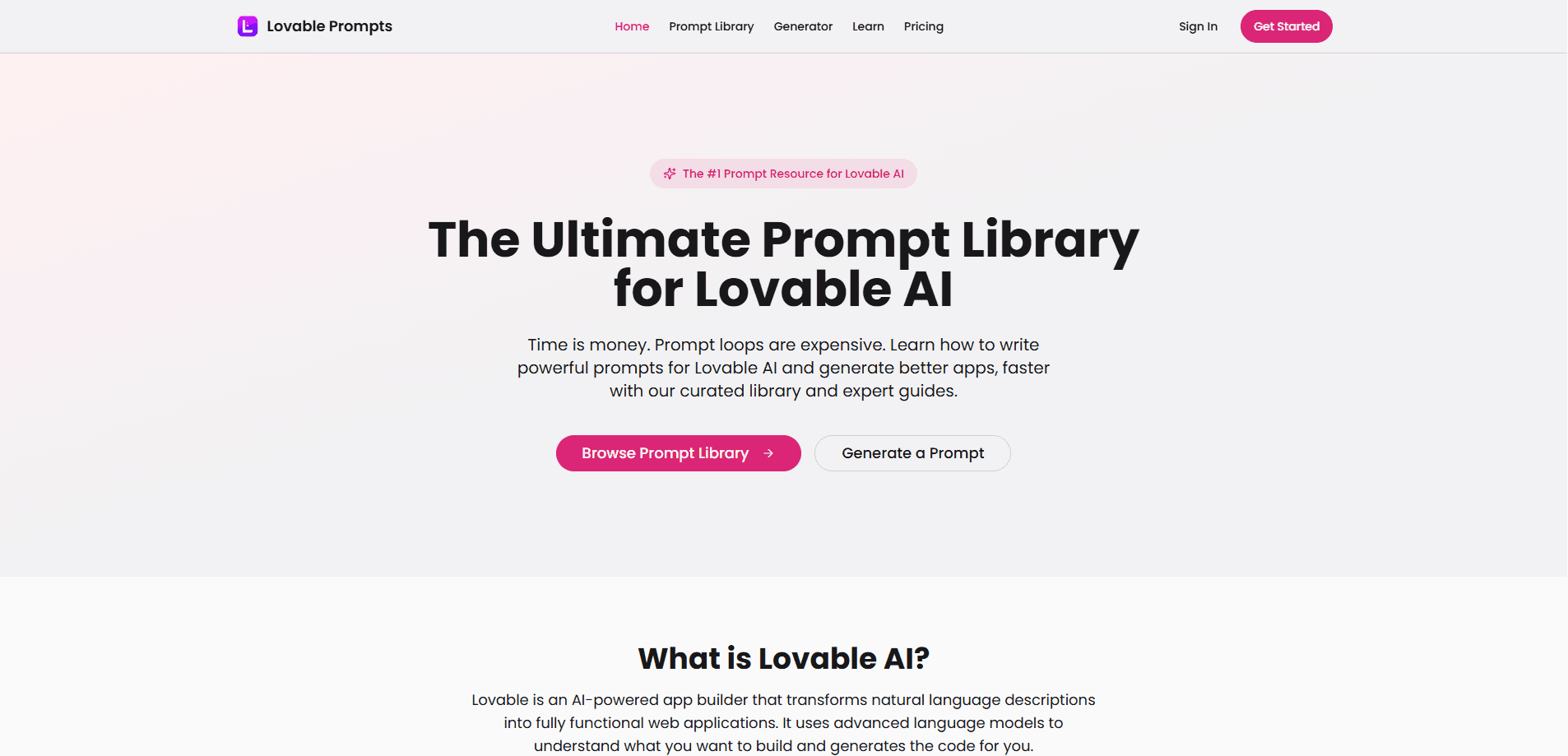
Lovable-prompts.com is a prompt library and generator built for people who use Lovable AI to turn ideas into working web apps. It ships a browsable collection of curated prompts plus a generator that turns your own app idea into a distribution-ready prompt. Building features is the easy part. Getting people to find what you built is the hard part.
About Lovable-prompts.com
What Is Lovable-prompts.com
Lovable-prompts.com is a website that helps you write better prompts for Lovable, the AI app builder. Instead of staring at an empty box and hoping, you pick a prompt from the library or describe your idea to the generator and get back a structured, copy-paste-ready prompt.
The core pitch is distribution. Most prompt tools stop once the app is built. This one adds a growth section to every generated prompt, so the product you build is designed around a channel you pick before you start. If you've ever shipped no-code web apps and then wondered why nobody showed up, that's the problem it's aimed at.
The main limit is scope. Everything here is tuned for Lovable specifically. If you build with Cursor, Bolt, or v0, the prompts still travel fine as plain text, but the site's own structure and generator are built around Lovable's prompting guidance.
Getting Started
- Sign up free on the site to generate your first prompt.
- Describe your app idea and pick the job it needs to do.
- Choose a growth channel, like Organic SEO, Product-led Growth, or Short-Form Video.
- Copy the generated prompt and paste it into Lovable to build.
- Browse the library for ready-made prompts if you'd rather start from an example.
Product Information
A quick look at Lovable-prompts.com's pricing, supported platforms, and performance.
Best for
The users, tasks, and scenarios where this tool fits best.
Users
- Solo founders
- Non-coders
- Indie makers learning growth
Tasks
- Writing a first Lovable prompt
- Planning distribution early
- Building a Supabase-backed app
Scenarios
- Weekend side project you want strangers to actually use
- Learning how prompt structure changes output quality
- Launching a small SaaS MVP
Key features
Curated Prompt Library
The library holds 101 prompts across six categories, browsable and free to copy. It includes 93 Pro channel variants that aren't published on the site itself and come only with the paid bundle. If you're learning what a good Lovable prompt looks like, the free tier is enough to study the shape.
Structured Prompt Generator
The generator rewrites your idea into a fixed seven-section format: Context, Core Features, Visual Style, Technical Requirements, Implementation Strategy, Safe-Guard Instructions, and Growth Features. The order isn't decoration, because Lovable builds the load-bearing feature first instead of spreading its effort evenly across every single thing you happened to mention.
Channel-Aware Distribution Section
You pick a growth channel before generating, and it changes the prompt itself, not just the marketing copy around it. Options include Organic SEO, Paid Search, Organic Socials, Short-Form Video, Product-led Growth, Community-led Growth, B2B Sales, X, and Email Marketing. Each channel implies different product mechanics, so the choice decides what gets built. Pick wrong and you build the wrong thing.
Build Kits With Reviewed Security
The four build kits add a Supabase schema with row-level security already written, plus verification queries that prove the policies deny what they should. The site states these were executed against real Postgres rather than merely asserted. For anyone shipping user data, that's the part that saves the most time.
Files You Keep Offline
The paid bundle delivers everything as a zip: each prompt as its own markdown file, the kits as runnable SQL, and a JSON export for pasting into an LLM. There's no tool to sign into and no subscription to maintain. It lives in your own repo.
Pros and cons
Pros
- Free tier lets you generate three prompts and browse the whole library, so you can judge quality before paying.
- One-time $199 price with no subscription or renewal, which suits people who hate recurring charges.
- Every prompt carries a distribution section, a step most prompt tools skip entirely.
- Build kits ship with row-level security and verification queries written out, saving real setup time.
Cons
- Everything is tuned for Lovable, so the extra value shrinks if you build with a different tool.
- The generator caps free users at three prompts, which runs out fast if you're iterating on one idea.
- Pro channel variants stay behind the paywall, so free users can't see the full library.
- There's no public API, so you can't wire prompt generation into your own workflow.
Frequently asked questions
It helps you write prompts for Lovable AI that produce working web apps. You either copy a prompt from the library or describe your idea to the generator and get a structured prompt back, with a distribution section included.
Related content
Explore related tools, skills, and articles for Lovable-prompts.com.
Lovable-prompts.com Alternatives
Forefront
Forefront · CodingForefront is a web platform for building with open-source AI. It lets you fine-tune leading open-source language models on your own data, evaluate how they perform, and run them through an API or export them to host yourself. Developers who want the convenience of a closed-source platform but insist on owning their models and data are the target audience here.

Startkit
StartKit.AI · CodingStartkit is a boilerplate for building AI SaaS and AI wrapper products. Think of it as an AI startup boilerplate with the boring parts already wired up: authentication, Stripe and Lemon Squeezy payments, usage limits, transactional email, and an AI API starter that talks to OpenAI, Anthropic, Groq, or Llama. You clone the repo, set your price, and start on the part of your product that people actually pay for. It's Next.js under React and Tailwind, so most of the boilerplate code already feels familiar.
Testim
Tricentis · CodingTestim is an AI-powered test automation platform for building and running end-to-end tests across web, mobile, and Salesforce applications. It leans on machine learning to keep tests stable when an interface changes, so teams spend less time fixing broken selectors. Not bad for an automated testing tool you can start using today. You create tests by recording actions in a browser, then optionally add JavaScript when you need more control. It's a solid pick for busy QA teams.