

Luma Agents
Luma AI · Other
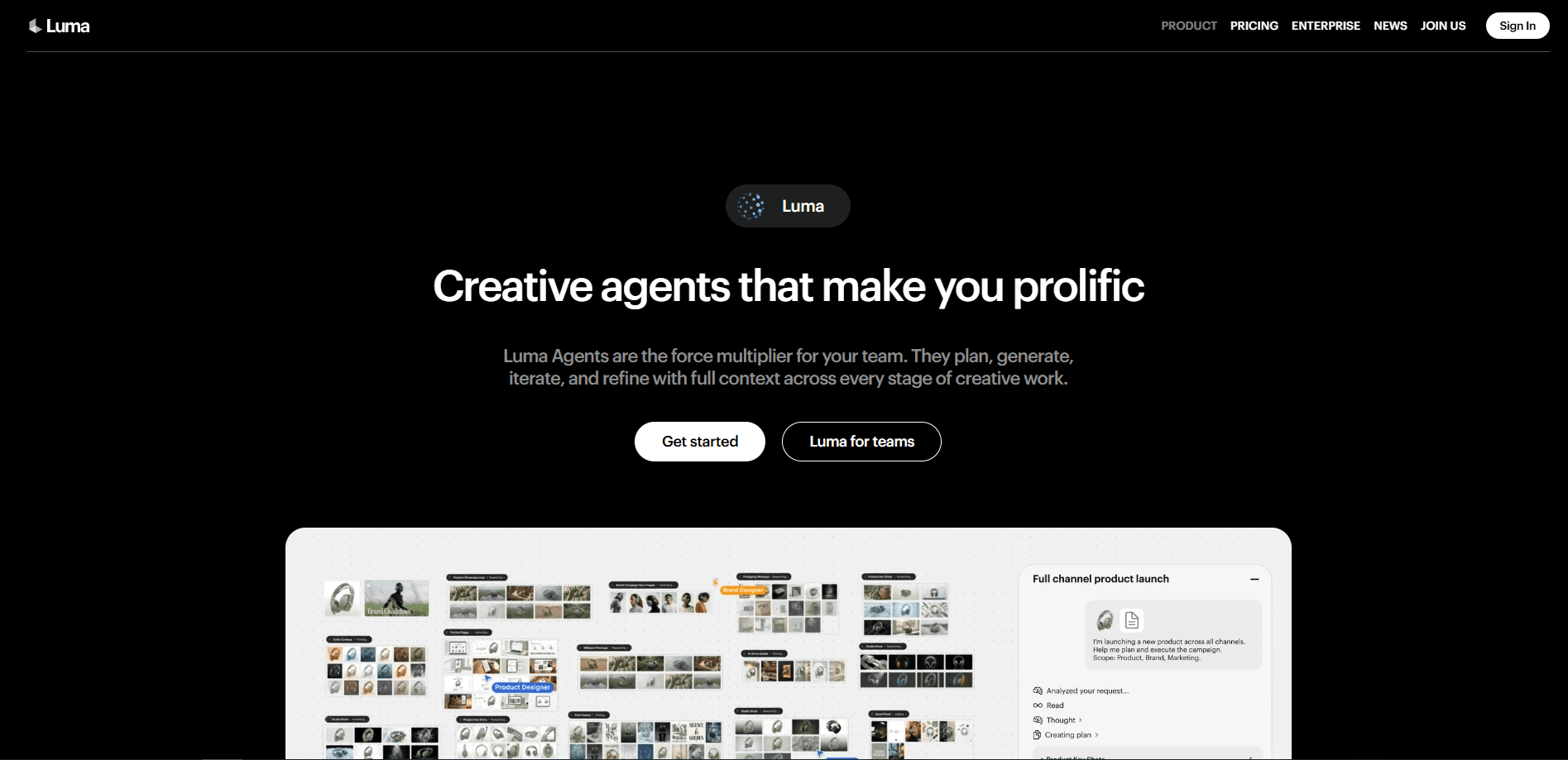
Luma Agents are AI creative collaborators built by Luma AI. They take a brief and carry it through research, generation, and refinement across video, image, audio, and text, holding one shared context from the first draft to the final cut. Teams use them to move from idea to finished asset without stitching together separate tools.
About Luma Agents
What Is Luma Agents
Luma Agents are the creative agent layer inside Luma's platform, reachable at lumalabs.ai/app. Instead of one model that answers a single prompt, you get agents that work on a project. They research references, generate options, and iterate on the output while keeping track of what your brand wants across every format.
The appeal is speed with consistency. Luma's own marketing frames the pitch as ten directions before a morning standup and fifty variants by the end of the day, with brand style holding steady the whole way. For a team that normally ships one or two concepts a week, that changes what's realistic.
The limitation is scope. Luma Agents are aimed at creative and marketing teams in a browser workflow, not at casual users who want a quick one-off clip. There's no public standalone mobile app for the agent layer, and pricing for the heavier plans isn't published as a simple number. You'll likely need to talk to sales or check the app itself for exact credits.
Getting Started
- Go to lumalabs.ai/app and sign in, typically with your Google account.
- Pick the starting point for your project, such as video, image, or a mixed brief.
- Describe the work you want, then let the agent research references and draft initial options.
- Review the outputs, give feedback, and let the agent refine across formats while the context stays intact.
- Export the finished assets or share them with your team workspace.
Product Information
A quick look at Luma Agents's pricing, supported platforms, and performance.
Best for
The users, tasks, and scenarios where this tool fits best.
Users
- Creative teams
- Marketing and brand managers
- Solo creators with steady output
Tasks
- Multi-format campaigns
- Rapid concept exploration
- Localization variants
- Video production support
Scenarios
- Agency pitches
- Brand content pipelines
- Early project research
Key features
Shared Context Across Formats
Context stays synced as work moves from video to image to audio to text. Set the direction once. The agents keep referring back to it. That matters most on long projects. A single dropped detail means redoing work.
Multimodal Generation
These are multimodal AI agents, which means they generate across video, image, audio, and text rather than one narrow output type. The underlying models include the Ray family for video and Uni-1 for image, both built in-house by Luma. Models built under the agents mean frontier research lands in the product directly.
Brand Intelligence
Uni-1, Luma's image model, handles brand understanding at the model level. It doubles as a capable AI image generator that carries style references, character references, and visual grounding into each asset. Output looks like it belongs to your brand even across a large batch. Luma describes it as understanding your brand as deeply as it generates for it.
End-to-End Project Handling
Agents don't stop at a single generation. They research, generate, and refine toward a finished deliverable. That's the difference between an assistant and a one-shot tool. For a team, it means fewer handoffs. Big win.
Team Collaboration and Workspaces
Workspaces let teams share credits and manage usage in one place. Agents and people can work in parallel under the same shared intelligence, and Luma Skills let you turn recurring workflows into reusable steps.
Ray Video Model Controls
The Ray video models support directable frames, multi-keyframe control, and native HDR with 16-bit EXR export. That last part matters for real production: HDR output can go straight into a color or compositing pipeline alongside shot footage.
Pros and cons
Pros
- One shared context across video, image, audio, and text removes the usual copy-paste between tools.
- Brand-aware image generation keeps large batches visually consistent.
- Team workspaces with shared credits make it practical for groups, not just individuals.
- Native HDR and 16-bit EXR export let AI output fit into professional post-production.
Cons
- Heavy plans don't publish simple pricing, so you have to contact sales or dig for exact credit costs, which slows budgeting.
- The agent layer is browser-based with no standalone mobile app, so you can't run it from a phone.
- It targets teams and professional pipelines, which makes it more than most casual users need.
Frequently asked questions
They're AI helpers on Luma's platform that take a creative brief and carry it through research, generation, and refinement across video, image, audio, and text. Think of a collaborator that remembers the whole project, not a tool that resets every prompt.
Related content
Explore related tools, skills, and articles for Luma Agents.
Luma Agents Alternatives
BinkBink
BinkBink · OtherBinkBink is a free online game platform and AI game maker that lets anyone turn a short text description into a playable browser game. You can jump into hundreds of community-made games. Or describe your own idea and play it in seconds, then share it with friends. Want to create your own game? You don't need to code. No engine setup, no download, no hassle.

Audiogen
Audiogen Inc. · OtherAudiogen is an AI music generator built by Audiogen Inc., a small research team that spent about 2.5 years training its own generative music model and designing a web interface around it. Instead of a plain text box, this AI music tool turns the timeline into a beginner-friendly Generative Audio Workstation, or GAW, where inpainting, extending, remixing and stem editing work more like painting on a canvas. The product is still in beta, so access runs through a waitlist or an invite. Paid plans aren't published yet.

Aiml API
AIMLAPI OÜ · OtherAiml API is a unified AI model API that puts more than 1000 models from OpenAI, Google, Anthropic, and others behind one endpoint and one bill. You write code against a single OpenAI-compatible schema, then switch between chat, image, video, and audio models by changing a model string. It suits developers and small teams who want multi-model access without juggling a dozen separate provider accounts, and it removes the usual billing headache that comes with testing several vendors. One key covers it all.