

LumozAI
Kites.Dev LLC · Other
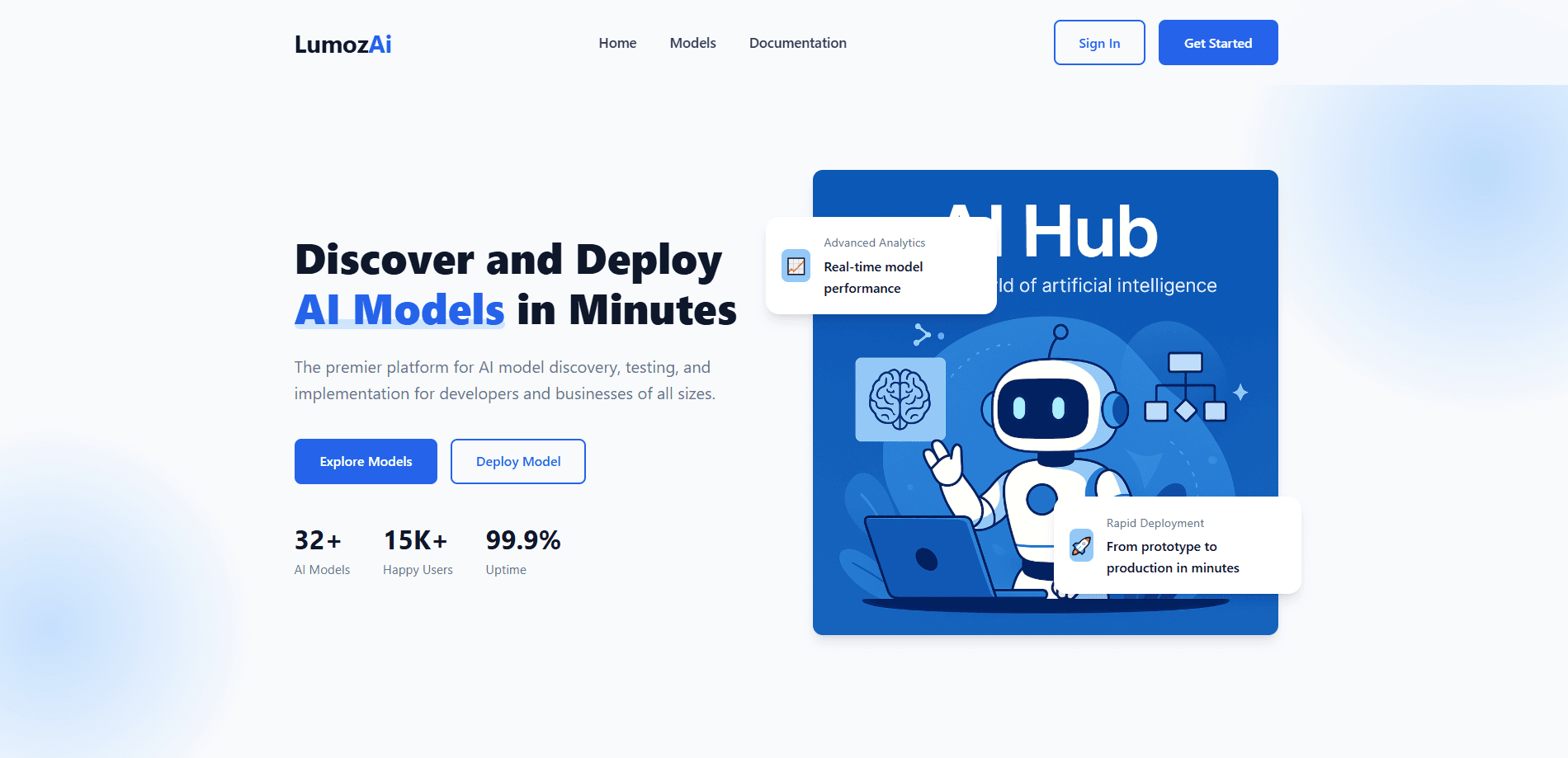
LumozAI is a platform that runs 60+ image, video and audio AI models and ready-made micro-services behind one API key, billed pay-as-you-go with no subscription.
About LumozAI
What Is LumozAI
LumozAI is a model hosting and inference platform from Kites.Dev LLC. It puts frontier and open-source models from different providers behind a single REST endpoint, so you send one JSON payload and get a result without configuring a GPU or signing up with each model maker separately.
The problem it targets is fragmentation. Running FLUX for images, an LLM for text and an upscaler for cleanup normally means three accounts, three billing systems and three sets of keys. LumozAI collapses that into one balance and one key, and it adds pre-tuned micro-services like background removal and room redesign that you can call the same way.
Two things are worth knowing up front. It is a developer-first product: the web studio is there for testing, but the product is built around the API, so non-technical users will find it less immediate. And it runs as a newer service on newer infrastructure, so the enterprise solutions page still lists several offerings as pilot or coming soon rather than generally available.
Getting Started
- Create an account with an email address and top up your balance, starting at $5 with no card needed to register
- Generate an API key and test any model in the browser playground before you send real traffic
- Send a POST request to the run endpoint with your model name, prompt and options, then read the result from the JSON response
- Track spend in one place, since failed runs are refunded automatically and unused balance never expires
Product Information
A quick look at LumozAI's pricing, supported platforms, and performance.
Best for
The users, tasks, and scenarios where this tool fits best.
Users
- Indie developers and small teams
- Product teams prototyping image or video features
- Agencies and studios
- Backend and platform engineers
Tasks
- Text-to-image generation
- Batch image editing and cleanup
- Image-to-image and reference editing
- Multimodal queries
- Prototyping and playground testing
Scenarios
- An e-commerce team turns raw product shots into lifestyle images with shadow mapping and batch rendering
- A rendering or interior studio converts a 2D floorplan into a photorealistic 3D staging image in seconds
- A solo developer builds a side project and pays only for the generations that actually succeed
- A team evaluating a new model
- A startup without GPU hardware
Key features
One API Key for Many Models
LumozAI routes more than 60 models through a single endpoint, with a standardized JSON payload. You send a model name, a prompt and options, and the platform handles the rest. Swapping models is a one-line change rather than a new integration, which matters when you're still deciding which model fits your use case.
Frontier Image, Video and Audio Models
The catalog spans text-to-image, image editing, upscaling and vision models from several providers. It lists Black Forest Labs' FLUX family, HiDream-I1, Google's Imagen3, ByteDance's SDXL Lightning and seedream-4, plus a Llama 4 Maverick instruction model. Each model page shows a per-generation or per-second price before you run anything, so you can compare cost against quality up front.
Ready-Made Micro-Services
Beyond raw models, LumozAI ships pre-tuned micro-services you call the same way. Background removal, 4K image upscaling, face swap, room redesign and document parsing are packaged as single calls rather than workflows you assemble yourself. For teams that need a fixed function instead of a blank model, this cuts setup time to almost nothing.
Pay-As-You-Go Billing
There are no plans, no monthly fee and no minimum commitment. You add balance in any amount starting at $5 and spend it per generation or per compute second. Credits never expire, the same balance covers web and API use, and failed runs are refunded automatically, so the bill reflects only output you kept.
Browser Studio and Playground
Every model can be tested in the web studio before you write code. The studio presents the inputs a given model accepts and returns real output, so you can judge quality and tune a prompt before spending on API calls. For teams comparing candidates, this is where a shortlist gets narrowed to one.
Enterprise Options and Private Deployment
The enterprise track covers dedicated Nvidia H100 capacity inside an isolated VPC, zero data retention and custom SLAs. Teams can also fine-tune proprietary models or train LoRA weights on private data, with checkpoints reachable only through their own API keys. These options sit on top of the same API surface, so production code doesn't change when you move up.
Pros and cons
Pros
- One key and one balance replace separate accounts for each model provider
- Pay-as-you-go with no subscription, so cost tracks usage instead of a fixed seat fee
- Failed runs are refunded and unused credits never expire, which lowers the cost of experimenting
- Per-generation pricing is shown before you run a model, so comparisons are straightforward
- Micro-services like background removal and upscaling ship ready to call, cutting setup for common tasks
Cons
- Developer-first design, so users without coding skills will find the API the real product
- No free tier, so you pay from the first generation even to try the platform
- Several enterprise solutions are still marked pilot or coming soon, which limits production commitments today
- Model availability depends on upstream providers, so a given model or its exact version can change
Frequently asked questions
LumozAI is a platform from Kites.Dev LLC that hosts more than 60 image, video and audio AI models and a set of ready-made micro-services behind one API. You call a single REST endpoint with a model name and prompt, and it returns the result without any GPU setup on your side.
Related content
Explore related tools, skills, and articles for LumozAI.
LumozAI Alternatives

Odyssey 3
Odyssey · OtherOdyssey-3 is Odyssey's foundation world model. It simulates physics in real time, turns a prompt into an interactive environment, and adapts to robots, cars and games.

JarvisCore
Prescott Data · Coding · Productivity · OtherJarvisCore is an open source Python runtime where AI agents work as equal peers on an agent mesh, claim tasks from a shared ledger, and reach external services through a zero-trust broker.
Clef
Cloudflare · Business · OtherClef is Cloudflare's open-source decision model for Workers AI. It returns calibrated probabilities for typed questions, not generated text, so agents can classify, route, and act fast.