

Lunen.ai
REDspace · Coding
Lunen.ai is an AI agent control plane for the enterprise. It lets anyone on your team describe an agent in plain language, then turns that description into a structured execution plan with named tools, scoped data, and a schedule IT can approve. The pitch is simple: the same flow that builds an agent also sets its permissions and logs its actions, so enterprise AI adoption survives a security review instead of dying in one.
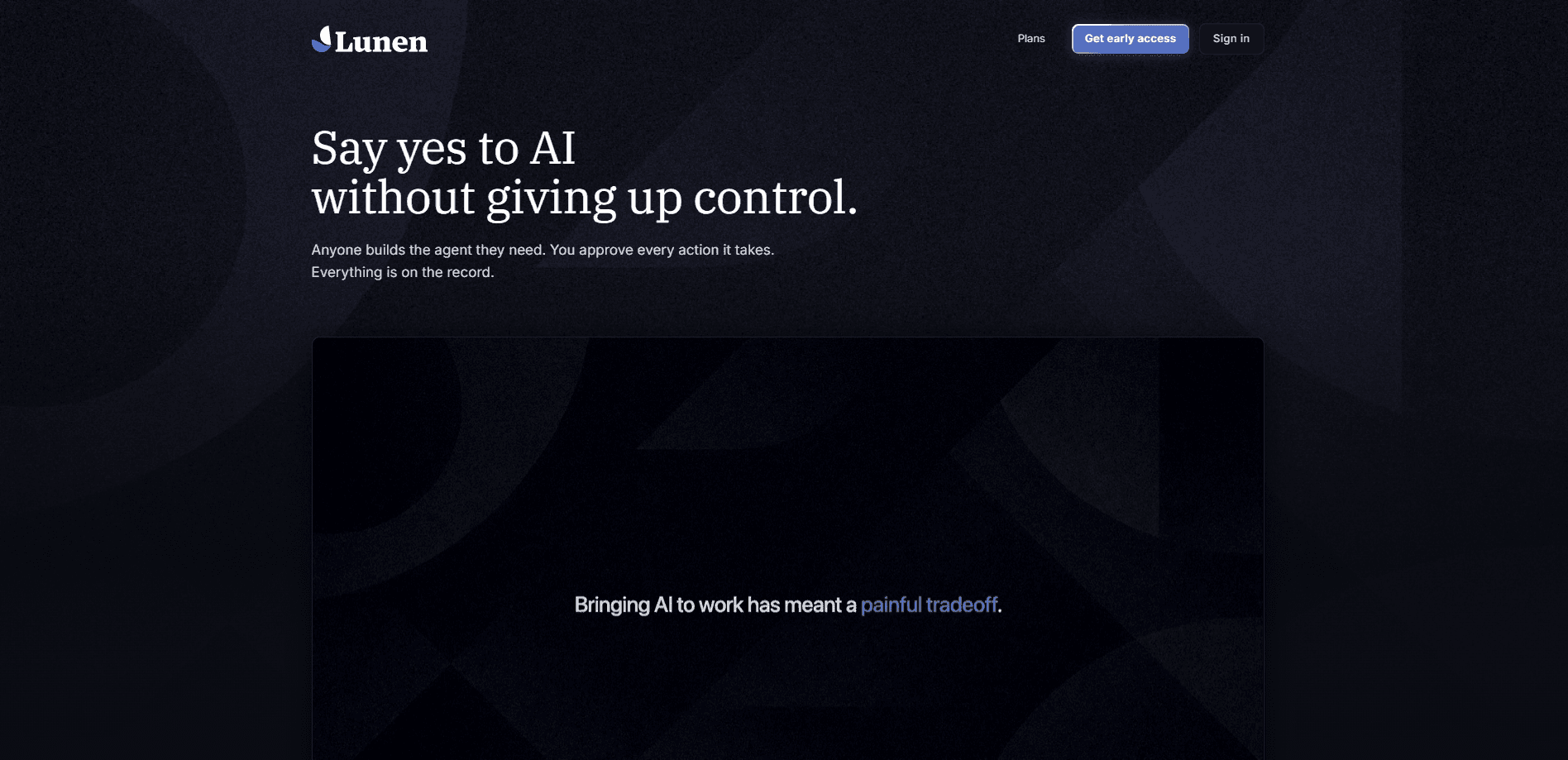
About Lunen.ai
What Is Lunen.ai
Lunen.ai is an enterprise AI agent governance platform built by REDspace, a company with 25+ years of enterprise platform engineering behind it. Most AI pilots fail for the same reason: the tool either never clears a security review, or it clears and nobody wants to use it. Which one is worse? Hard to say. Lunen treats agent building and agent governance as one motion rather than two separate systems.
The product centers on a governed control plane. A subject-matter expert types what they want the agent to do in plain language, and Lunen drafts a structured execution plan with named tools, scoped data, and a clear schedule. That's the whole idea. MCP tool governance sits at the center of the design: every MCP tool call becomes a policy decision, so you allow reads to run unattended and require human approval before every write.
The main limitation is reach. Lunen is still working with a small group of design partners, so pricing isn't public and general availability is limited. If you need a self-serve tool today, this isn't it yet. That's a real constraint.
Getting Started
- Sign up on the Lunen.ai site and schedule a call, since onboarding runs through the design partner program.
- Describe the agent you want in plain language, naming the task, the tools it should reach, and how often it runs.
- Review the execution plan Lunen drafts, then confirm which data the agent can read and which actions need human approval.
- Set the policy toggles for every MCP tool, allowing reads to run unattended and gating writes behind approval.
- Turn the agent on and watch its runs roll into the shared audit log alongside user actions.
Product Information
A quick look at Lunen.ai's pricing, supported platforms, and performance.
Best for
The users, tasks, and scenarios where this tool fits best.
Users
- IT and security teams
- Subject-matter experts in finance, marketing, or operations
- AI platform owners at mid-size and large companies
Tasks
- Governed lead scoring
- Controlled data lookups
- Audit preparation
- Cross-team rollout
Scenarios
- A pilot that stalled in security review
- Shadow AI creeping in on personal accounts
- Overnight automation you can't babysit
- A first enterprise agent rollout
Key features
Plain-language agent building
There's no drag-and-drop builder and no YAML to learn. A subject-matter expert types what they want in plain language, and Lunen drafts a structured execution plan with named tools, scoped data, and a schedule. You review the plan, save it, and run it. Simple.
Allow reads, approve writes
Every MCP tool call turns into a policy decision. You can let a tool run unattended or require a human approval before each call. Pick one. The same toggles apply to every agent and every ad-hoc run, so nothing reaches production data without the rule you set. No surprises. That's the point.
One audit log for people and agents
User actions and agent actions roll up in the same log. Open any event to see who acted, what was approved, what model ran, and which data it touched. It's the record a security review asks for, and you can export it on demand. That matters.
Governed execution plans
The plan Lunen writes is the artifact your team approves. It names the tools the agent uses, the data it can reach, and the schedule it runs on, so reviewers see exactly what they're signing off on before anything goes live.
Approval that doesn't stall delivery
Lunen's core idea is that "easy" and "governed" aren't opposites. The same flow that lets someone describe an agent also scopes its data, sets its permissions, and logs its actions, which closes the gap where enterprise AI usually dies.
Built by an enterprise platform shop
Lunen comes out of REDspace, which has spent 25+ years building and running enterprise platforms for large media and technology companies. The team's stated reason for building it: watching AI projects work in a demo and then die in a security review.
Pros and cons
Pros
- Building and governance live in one flow, so you don't bolt a policy layer onto a tool IT never approved.
- Plain-language agent creation opens the work to non-developers instead of keeping it with engineers.
- Per-tool policy toggles give fine control, letting reads run free while writes wait for a human.
- A single audit log covering both user and agent actions makes review and compliance export straightforward.
- Backed by REDspace's 25+ years of enterprise platform work, not a brand-new startup.
Cons
- Pricing isn't public and onboarding runs through a design partner program, so you can't try it self-serve today.
- It focuses on governing MCP-based agent tool calls, so teams outside that model may find limited fit.
- No public API details yet, which makes it hard to plan custom integrations before a call.
- General availability is still limited, so rollout timelines depend on the design partner arrangement.
Frequently asked questions
It's a governed control plane for enterprise AI agents. You build an agent in plain language, and the platform scopes its data, sets its permissions, and logs every action so the whole thing can pass a security review.
Related content
Explore related tools, skills, and articles for Lunen.ai.
Lunen.ai Alternatives
Forefront
Forefront · CodingForefront is a web platform for building with open-source AI. It lets you fine-tune leading open-source language models on your own data, evaluate how they perform, and run them through an API or export them to host yourself. Developers who want the convenience of a closed-source platform but insist on owning their models and data are the target audience here.

Startkit
StartKit.AI · CodingStartkit is a boilerplate for building AI SaaS and AI wrapper products. Think of it as an AI startup boilerplate with the boring parts already wired up: authentication, Stripe and Lemon Squeezy payments, usage limits, transactional email, and an AI API starter that talks to OpenAI, Anthropic, Groq, or Llama. You clone the repo, set your price, and start on the part of your product that people actually pay for. It's Next.js under React and Tailwind, so most of the boilerplate code already feels familiar.
Testim
Tricentis · CodingTestim is an AI-powered test automation platform for building and running end-to-end tests across web, mobile, and Salesforce applications. It leans on machine learning to keep tests stable when an interface changes, so teams spend less time fixing broken selectors. Not bad for an automated testing tool you can start using today. You create tests by recording actions in a browser, then optionally add JavaScript when you need more control. It's a solid pick for busy QA teams.