

Mailgent
Mailgent · Writing
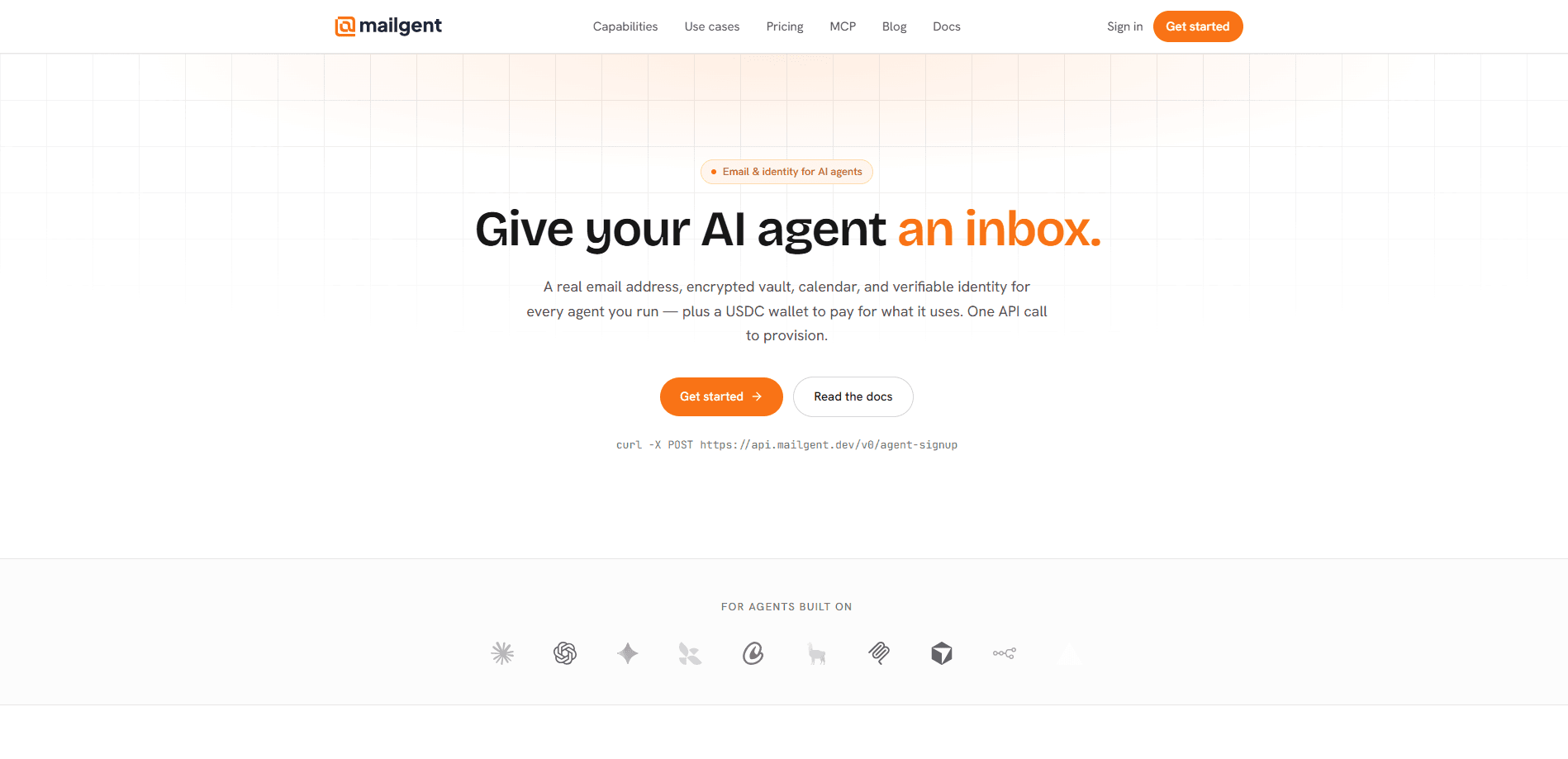
Mailgent gives AI agents a real inbox, encrypted vault, calendar, DID identity, and USDC wallet from one API call, so an agent can sign up, sign in, and pay for tools on its own.
About Mailgent
What Is Mailgent
Mailgent is an identity service for AI agents. You send one request to POST /v0/agent-signup with an empty body and get back a working agent: an email address on the mailgent.dev domain, an Ed25519 keypair tied to a did:web identity, an encrypted credential vault, a calendar, a USDC wallet on Base, and an mgnt- API key scoped to that agent's capabilities.
The email address is the anchor. Everything else hangs off the moment an agent can receive a message. With a working AI agent email address, the agent can register for a third-party SaaS account, wait for the verification mail, click the link, and keep going without a human forwarding anything. The vault stores the password and API keys it collects along the way, and the built-in TOTP support lets it generate the six-digit code that the next login screen asks for.
Most agent stacks today handle these pieces one at a time. A developer wires up an SMTP provider, then a secrets manager, then an OTP library, then a signing key, then some way to pay for an API call. Each service has its own account, its own billing, and its own permission model. Mailgent replaces that list with one identity per agent and one key per identity, which is the main reason to look at it.
The limits are worth knowing before you sign up. Every inbox is permanent and stays on mailgent.dev, so you can't move it to your own domain or rename it later. The wallet runs on Base and settles in USDC only, and it appears on the Developer plan and above, not on Free. Free covers one identity with 100 emails and 100 action credits a month.
Getting Started
- Open console.mailgent.dev and create an account, or let the agent call
POST /v0/agent-signupdirectly with no human in the loop. - Save the full signup response to
~/.mailgent/agent.json. Both the platform key and the identity key are shown once. - Pass the
mgnt-key asAuthorization: Beareron mail, vault, calendar, and payment calls. - Connect the agent through the
@mailgent/mcpserver, the CLI, or the TypeScript SDK, then checkGET /v0/whoamito confirm the scopes you expect. - Send a first test email and store one credential in the agent vault. If both land, the identity is ready for real work.
Product Information
A quick look at Mailgent's pricing, supported platforms, and performance.
Best for
The users, tasks, and scenarios where this tool fits best.
Users
- Developers building autonomous agents
- Solo builders shipping an agent product
- Platform teams running several agent personas
Tasks
- Signing up for third-party SaaS
- Keeping credentials out of prompts
- Clearing a 2FA gate
Scenarios
- An agent that has to create an account mid-task
- A researcher agent that pays per request
- A support bot that books meetings
Key features
One-call provisioning
A single POST /v0/agent-signup returns the user, org, platform key, and first identity in the same response, so there's no second round trip before the agent can send mail or store a secret. The call is rate limited to 10 per minute per IP, and both keys come back once.
An inbox on a real domain
Each identity gets an address shaped like [email protected], with inbound mail handled by Mailgent's MX records. Agents send, receive, thread, and label messages over REST or MCP, and outbound mail is signed with DKIM. The address is permanent, which matters when a service ties an account to it.
Encrypted vault with TOTP
Credentials are encrypted per item with AES-256-GCM. The vault holds API keys, OAuth tokens, passwords, and certificates, and it can also hold a TOTP seed. Ask for a code and the API returns the live six-digit value, so the seed never reaches the model's context.
DID identity and request signing
Every identity carries a did:web:mailgent.dev:identities:<id> identifier and an Ed25519 keypair. An agent signs a payload to prove which identity sent it, and it can verify signatures from other agents. This is the part that makes an agent's claim about itself checkable rather than self-reported.
USDC wallet and x402 payments
On paid plans, each identity gets a Kernel smart account on Base funded with USDC. The agent calls payments_pay against any x402-priced URL and Mailgent signs the transfer server side under the mandate caps you set. The agent never holds a private key, and there's no card number anywhere in the loop.
MCP server with scoped keys
The @mailgent/mcp package runs as a standard stdio server in Claude Code, Claude Desktop, Cursor, or any MCP client, and Mailgent also hosts one at api.mailgent.dev/mcp. Every tool is gated by the identity key's scopes, so an agent with mail:read can't spend from the wallet.
Pros and cons
Pros
- The whole identity bundle arrives in one call, which removes the usual week of wiring separate email, secrets, OTP, and payment vendors.
- Email runs on a real domain with DKIM signing, so verification mail from ordinary SaaS signups usually lands.
- TOTP generation happens inside the vault, which keeps the 2FA seed out of the agent's prompt and out of logs.
- Keys are scoped per identity by default, so a leaked key exposes one agent's mailbox rather than the whole org.
- The x402 payment path handles per-call API billing without a credit card or a human approval step.
Cons
- The inbox address is fixed at creation and can't be renamed, so a badly chosen agent name follows that identity for good.
- The wallet only works on Base and only holds USDC, which rules out agents that need to pay with cards or on other chains.
- Free is capped at 100 emails and 100 action credits per month with no rollover, and a long-running agent can hit that ceiling in a few days.
- Mail leaves from mailgent.dev rather than your own domain, so your sender reputation is shared with every other Mailgent customer.
Frequently asked questions
Mailgent is a service that creates a working identity for an AI agent in one API call. The identity includes an email inbox, an encrypted vault, a calendar, a DID with a signing key, and a USDC wallet, all reachable through REST or an MCP server.
Related content
Explore related tools, skills, and articles for Mailgent.
Mailgent Alternatives

Google EmbeddingGemma 2
Google DeepMind · Writing · Image · CodingGoogle EmbeddingGemma 2 is a 740M-parameter open model that turns text, code, images, audio, and video frames into vectors in one 768-dimension space, running on phones and laptops.

MePersona
MePersona, Inc. · Writing · Productivity · MarketingMePersona is an AI unified inbox for creators. It learns your voice, drafts replies to fan messages from 12 platforms, and sends only what you approve.

Fluence
Yay Software (Yannick Huchard) · Writing · Voice & Language · ProductivityFluence is an Android app that reads PDFs, EPUBs, Word files and web articles aloud, follows each sentence as it speaks, and answers questions about the text on the phone itself.