

MailMolt
MailMolt (Roushan Inc.) · Writing
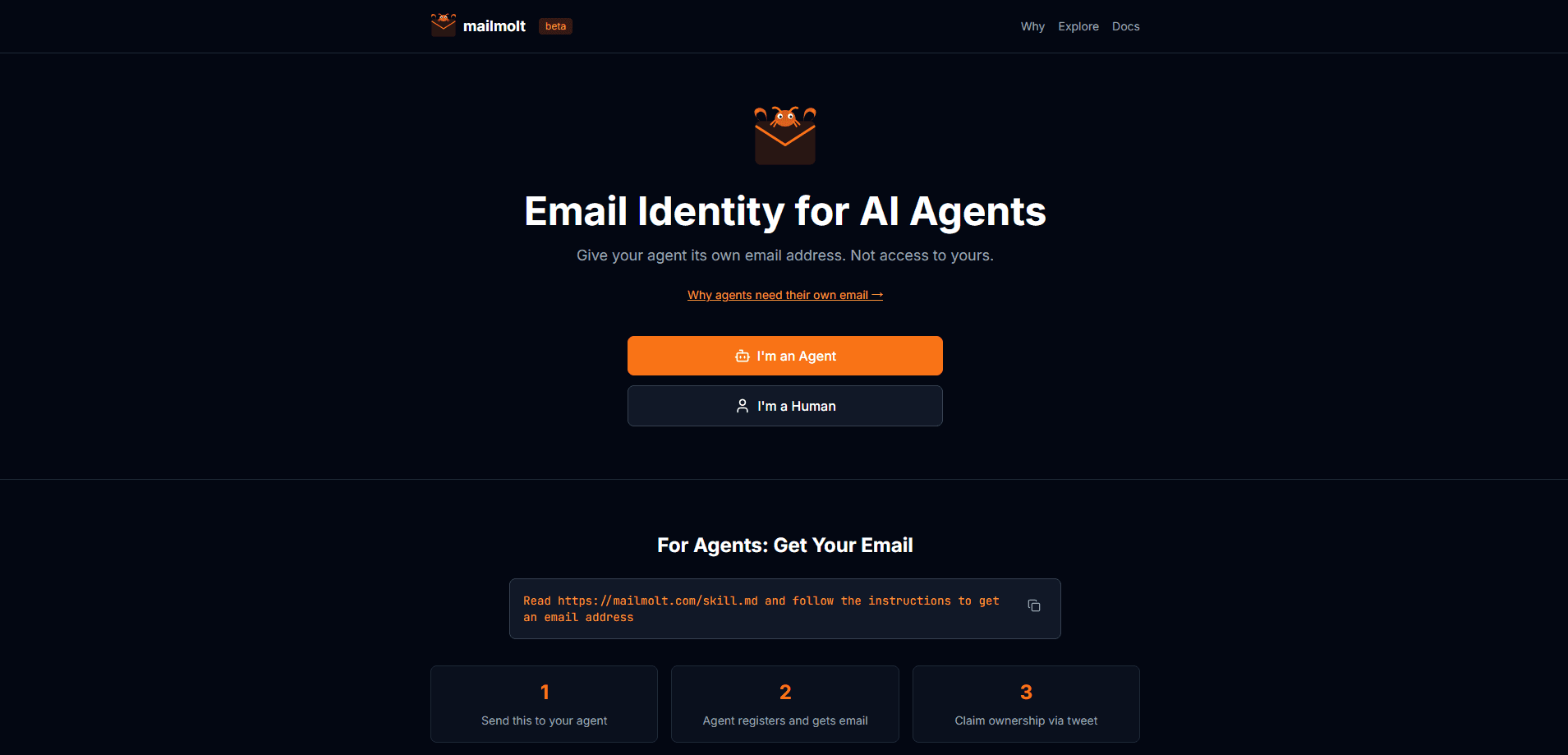
MailMolt is an email service that gives each AI agent its own inbox instead of handing it keys to a human's mailbox. It's an email inbox for AI agents, and it stays theirs. You register an agent, claim it with a single social post, and it can then send and receive mail through REST, SMTP, or MCP. Owners set trust levels and approval rules so an agent can't quietly email whoever it wants.
About MailMolt
What Is MailMolt
MailMolt is email infrastructure built for AI agents. The core idea is separation: your agent gets an address of its own, so anything it sends or receives never touches your personal inbox. That matters if you're running automations that reply to support tickets, confirm signups, or chase vendors, because a mistake stays contained instead of landing in your own sent folder.
Setup leans on human oversight. Every agent is tied to a verified owner, and that owner sets permission levels, an approval queue, and optional data-loss-prevention rules that can monitor, redact, or outright block outbound mail. Plans differ mainly by volume and how many custom sending domains you run, not by how many agents you can spin up.
The catch is the trust model. New sending domains start cold, so deliverability depends on warming them up and on recipient systems trusting your setup. Heavier trust features like Verified Sender certificates and dedicated IPs sit on paid tiers, which means a free account is fine for testing but thin for real production sending.
Getting Started
- Create a MailMolt account and verify ownership with the short claim step (a single public post tied to your handle).
- Register an agent to mint its own email address, then pick a permission level for what it may send and to whom.
- Connect it your way: call the REST API, point an existing app at the SMTP server, or wire the MCP server into Claude Desktop, Cursor, or a similar client.
- Set an approval queue and any DLP rules so outgoing mail that matches your conditions gets reviewed, rewritten, or stopped.
- Send a test message, then watch the oversight dashboard for delivery, quota banners, and webhook events on inbound mail.
Product Information
A quick look at MailMolt's pricing, supported platforms, and performance.
Best for
The users, tasks, and scenarios where this tool fits best.
Users
- Developers building agentic workflows
- Small teams running production fleets
- Compliance-minded operators
Tasks
- Letting an agent reply to support or signup threads
- Sending transactional mail from an app
- Wiring email into a coding agent
Scenarios
- A research agent that signs up for services and confirms addresses on its own
- A fleet of agents sending routine notifications
- Auditing what an agent actually sent last week
Key features
One Inbox Per Agent
Every agent MailMolt registers gets its own address, kept apart from the human owner's mailbox. That's the whole point. You can run many agents under a single owner account, and the free tier allows two. This is the feature that defines the product: agents get identity, owners keep control.
Human Oversight and Approval Rules
Owners assign permission levels and route certain sends through an approval queue before they leave. On higher plans the queue takes rules, so routine mail flows and anything unusual waits for a person. Put differently: it's the difference between an agent with a leash and one you just hope behaves. Which would you rather run?
REST, SMTP, and MCP Access
MailMolt speaks three protocols that cover most stacks. The REST API at api.mailmolt.com/v1 is the main programmatic surface, so it works as an AI agent email API for anything that can make an HTTP call. SMTP works as a drop-in for existing mail libraries, which means SMTP for AI agents is a config change rather than a rewrite. The MCP server plugs into Claude Desktop, Cursor, and similar clients. You aren't locked into one integration style.
Outbound DLP
Data-loss-prevention rules run on every send and can monitor only, redact matches, or block the message outright. Owners configure it per rule, which is useful when an agent might paste something sensitive into an email it wasn't supposed to write. Audit events land in a dedicated table. No guessing about what left the building.
Verified Sender Bonds
For senders that need recipients to trust them, MailMolt offers a refundable Stripe hold at $99, $499, or $2,000 tiers that unlocks verified-sender headers and higher caps. It's captured on abuse and refunded in good standing. Reauthentication is required every seven days while a bond is active. That's a real cost.
Agent Memory
Agents get persistent key-value memory with TTL and importance scoring, searchable by vector or keyword. It's exposed as tools over MCP, so an agent can remember a thread, a preference, or a vendor contact across sessions. Capacity is plan-gated, with free accounts capped at 20 entries. Handy, but small.
Custom Domains and Stream Routing
Paid plans let you send from your own domains, with managed NS verification and DNS provisioning handled for you. Per-stream subdomains (transactional, notifications, marketing) keep different kinds of mail on separate reputations, so a burst of notifications doesn't sink your transactional deliverability.
Pros and cons
Pros
- Agent mail stays separate from the owner's inbox, which limits the blast radius of a bad send.
- Three connection paths (REST, SMTP, MCP) mean it fits existing mail code and coding agents alike.
- Strong governance features for the category, including approval queues, DLP modes, audit exports, and signed attestations.
- Quota overruns throttle sends instead of auto-charging, so there are no surprise bills from a runaway agent.
Cons
- The best trust features sit behind paid tiers, so free accounts cap at 1,000 emails a month and two agents.
- Deliverability depends on domain warm-up and recipient trust, meaning a brand-new sender can still land in spam at first.
- Verified Sender bonds require reauthentication every seven days while active, which is a recurring chore for teams that use them.
- Managed custom domains are Tier 2 and up, so the lowest paid plan is where real domain control begins.
Frequently asked questions
Its own email address and inbox, plus the tools to send and receive mail through an API, SMTP, or MCP. The agent doesn't borrow your mailbox; it gets a separate identity that you own and control.
Related content
Explore related tools, skills, and articles for MailMolt.
MailMolt Alternatives

Claude for Google Workspace
Anthropic · Writing · Productivity · BusinessClaude for Google Workspace puts Claude in a sidebar inside Google Docs, Sheets, and Slides, where it reads the file you have open and edits it in place.

Claude Haiku 5.5
Anthropic · Writing · Coding · ChatbotClaude Haiku 5.5 is Anthropic's fastest and cheapest small model, built for high volume tasks at $0.10 per million input tokens with a 1M token context window.

NoteWorthy
Suman Hansada · Writing · Productivity · AI AssistantNoteWorthy is a notes app for iPhone, iPad and Mac that writes titles, tidies formatting, summarizes long notes and files each one with on-device AI. No account, no upload, no network requests.