

MappingSpace ALM
Suzhou Yunti Technology (YT DevOps) · Coding
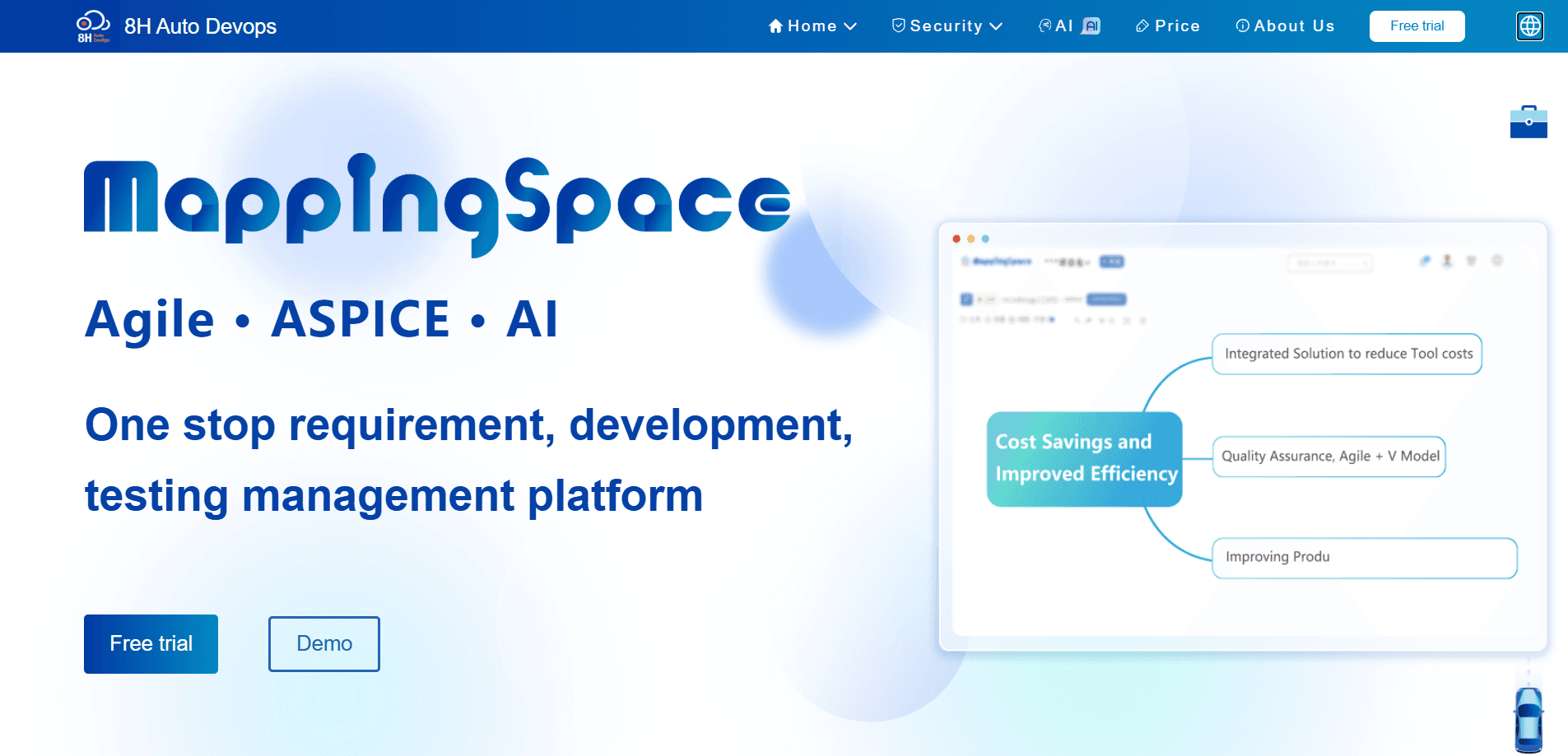
MappingSpace ALM is an AI-driven application lifecycle platform for automotive software teams. It ties requirements, development, tests, baselines and releases into one traceable chain while meeting ASPICE.
About MappingSpace ALM
What Is MappingSpace ALM
MappingSpace ALM is a lifecycle management platform from Suzhou Yunti Technology (YT DevOps), built for automotive software research and development. It handles the full chain from requirements and test planning to baseline control and product release, and it's designed around the ASPICE process model that automotive OEMs and suppliers have to follow.
The system is modular. Requirements management links product definition to development, work items track progress, test management covers plan creation, execution and reporting, and baseline management freezes each version so changes stay under control. Code repositories connect through GitLab, and API tests run inside the platform.
The AI layer is what separates MappingSpace from older tools like IBM Doors or Polarion. Large language models generate research process documents, such as requirements, architecture and test cases, and convert them into tracked tasks. Teams write these documents in a mind-map style instead of flat lists, and the vendor's users call that out as their favorite part of the workflow.
Getting Started
- Request a demo or trial on ytdevops.com to get access to the cloud or private deployment edition
- Model your ASPICE process by trimming or adding stages to match how your projects actually run
- Import or author requirements, then use the AI features to generate architecture and test cases where they fit
- Baseline a version and push changes through review when requirements shift
Product Information
A quick look at MappingSpace ALM's pricing, supported platforms, and performance.
Best for
The users, tasks, and scenarios where this tool fits best.
Users
- Automotive software teams that have to meet ASPICE
- Teams replacing legacy ALM tools
- Functional safety and compliance leads
- Small and mid-size automotive suppliers
Tasks
- Requirements management
- Test management
- Baseline and change control
- AI document generation
- Release management
Scenarios
- A supplier prepares for an ASPICE audit
- An architect sketches a system
- A project changes scope mid-cycle
- A team has documents but gaps in them
- An engineer needs a head start on code
Key features
AI Agent Driven ALM
The platform applies large language models across the research process. Engineers generate requirements, architecture and test cases inside MappingSpace and push them straight into tracked tasks. The AI supplement feature completes existing documents, AI drawing turns architecture descriptions into editable static and dynamic diagrams, and AI code generates a code framework from the detailed design. The point is to cut the document hours that ASPICE normally costs.
Requirements Management With Mind-Map Documents
Requirements connect product definition to the development flow. Work item tracking and version control sit alongside them, so each requirement keeps its links to design and tests. Documents are organized as mind maps rather than flat hierarchies, which makes large requirement trees easier to read and keeps traceability intact as the tree grows.
Test Management From Plan to Report
Test management covers the whole cycle: create a test plan, execute cases, and generate reports. Each test ties back to the requirement it covers, so coverage gaps surface before a release gate rather than during an audit. Test cases can be generated by AI and then edited like any other document.
Baseline and Change Control
Baseline management brings order to version iteration. When a requirement changes, the system pulls a copy and triggers a review flow, so the change is controlled rather than silent. The full change history is recorded, from the reason it was raised to the final decision, which is what ASPICE traceability asks for.
Release Management on a Standardized Path
The chain ends in a standardized release process. A verified baseline moves through defined gates, and the platform keeps the record of what shipped and what it was built on. Teams that do not follow ASPICE end to end can trim the flow and still keep the parts they need.
Private Deployment and Private Models
Private deployment is supported, and the vendor offers a lifetime free private deployment edition. AI features can run against models the customer hosts, so sensitive research documents stay on internal infrastructure. This matters for automotive work, where documents often cannot leave the company network.
Toolchain and Industry Reach
GitLab connects for code repositories, and API testing runs inside the platform. The toolchain is built for automotive specifically, with add-on solutions for avionics and medical devices. Reference customers include parts and systems suppliers like Tuopu and Fulda, and the vendor publishes white papers on automotive basic software and research process management.
Pros and cons
Pros
- The AI layer generates requirements, architecture, test cases and code, which cuts the document hours ASPICE usually costs
- Private deployment comes with a lifetime free edition, and it keeps sensitive documents on your own infrastructure
- Mind-map style documents make large requirement trees readable while keeping traceability intact
- Change control clones the affected requirement and records the full history, which matches ASPICE traceability demands
- The process can be trimmed, so projects that do not follow all of ASPICE can still use the tool
Cons
- Pricing is quote-based, so there is no public number to compare before you talk to sales
- The product and roadmap are documented mainly in Chinese, which raises the bar for teams outside that market
- It targets automotive and industrial manufacturing, so general software teams get less value from the compliance features
- Public tool certification against ISO 26262 or IEC 61508 is not clearly stated, which matters for safety-critical projects
- The private-deployment focus means setup and model hosting carry more overhead than a plain cloud sign-up
Frequently asked questions
MappingSpace ALM is an application lifecycle management platform from Suzhou Yunti Technology (YT DevOps), built for automotive software research and development. It covers requirements management, test management, baseline and change control, and release management, with AI features that generate research documents like requirements, architecture and test cases.
Related content
Explore related tools, skills, and articles for MappingSpace ALM.
MappingSpace ALM Alternatives

Base Code
Base44 (Wix) · Coding · ProductivityBase Code is a shared cloud development environment from Base44. Teammates describe changes to an existing GitHub codebase in chat, preview them live and send them back as pull requests.

Google EmbeddingGemma 2
Google DeepMind · Writing · Image · CodingGoogle EmbeddingGemma 2 is a 740M-parameter open model that turns text, code, images, audio, and video frames into vectors in one 768-dimension space, running on phones and laptops.

GitGlow
GitGlow · Coding · ProductivityGitGlow is a local-first desktop Git client that lets independent developers review their own code and their AI agents' changes in one place before shipping.