
MapZot.AI
MapZot Inc. · Coding · Business
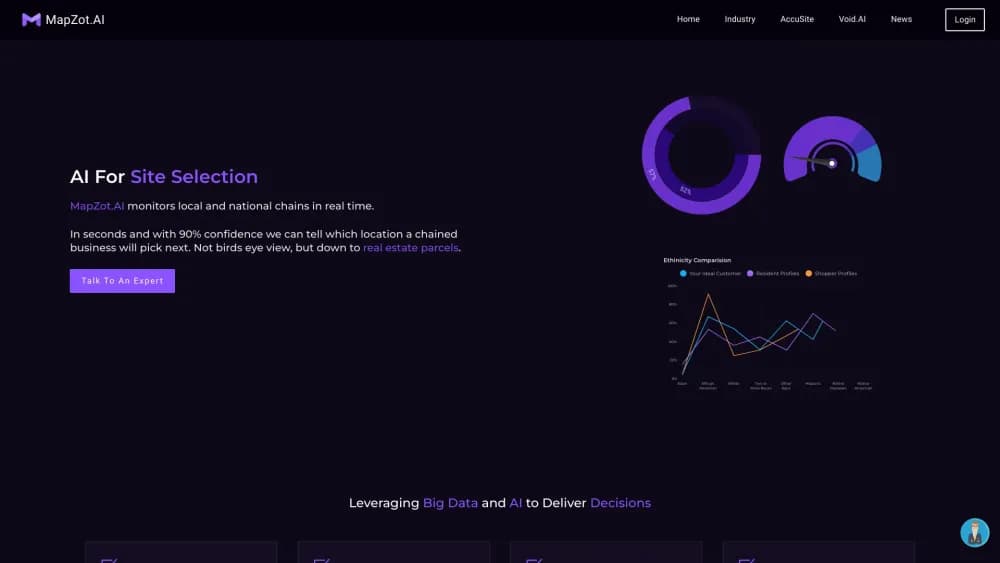
MapZot.AI is a location intelligence platform that ranks expansion sites, forecasts store revenue, and tracks competitor openings for retail, healthcare, and civic teams.
About MapZot.AI
What Is MapZot.AI
MapZot.AI is AI site selection software from MapZot Inc., a company founded in Atlanta in 2018. Chains use it to answer three questions before they spend money: where to open, which existing stores to close or relocate, and how much revenue a candidate site will produce. The company says it serves more than 1,000 businesses across 36 industries, plus state and municipal economic development offices.
The product pulls foot traffic analytics, demographics, competitor store lists, planned construction, flood zones, and climate layers into one map built on GIS mapping software. AccuSite.AI, its main site selection module, scores locations against a store prototype and projects sales for each one. Its sales forecasting software weighs more than 10,000 signals across 20,000 U.S. cities, according to MapZot.AI. Version 3.0, released in February 2026, reports an internal R² of about 0.91 when predicted revenue is plotted against actual revenue.
The limits matter as much as the features. There's no published price list and no self-serve signup, so every evaluation runs through a sales call. Coverage is built around U.S. markets. Forecast quality also depends on what you feed the model: a chain that uploads its own sales and store data gets sharper projections than a first-time operator working from public data alone.
Getting Started
- Book a demo through the MapZot.AI site and describe your expansion question, whether that's one new site or a twenty-store rollout.
- Set up your store prototype, trade area rules, and the competitor set you want to track.
- Connect first-party sales, membership, or patient data if you have it, then pick the markets you want ranked.
- Review the ranked sites, revenue forecasts, and cannibalization estimates, then export the report your finance or real estate team needs.
Product Information
A quick look at MapZot.AI's pricing, supported platforms, and performance.
Best for
The users, tasks, and scenarios where this tool fits best.
Users
- Franchise and multi-unit operators
- Commercial real estate and leasing teams
- Civic and economic development offices
- Healthcare and dental groups
Tasks
- Forecasting revenue before signing a lease
- Ranking markets for expansion
- Checking cannibalization
- Filling retail vacancies
Scenarios
- A single high-stakes opening
- Diagnosing a sales decline
- Portfolio review before a capital raise
Key features
AccuSite.AI Site Ranking and Revenue Forecasts
This is the core module for retail site selection. You define a store prototype, and the platform scores candidate addresses on demand, access, competition, and trade area fit, then attaches a revenue projection to each one. MapZot.AI says the model weighs over 10,000 parameters, including drive-thru lanes, facility size, and chair counts for service businesses. The output is a ranked list a real estate committee can argue over, not a single mystery score. Cannibalization analysis sits in the same view, so a new store gets scored against your own nearby locations.
TrafficRX Live Traffic Patterns
TrafficRX shows how vehicle and foot traffic moves through a trade area by hour and by day, plus where shoppers come from. That matters for formats where a morning commute and a weekend errand crowd behave nothing alike. You can compare a candidate site against a performing store and see whether the traffic curve actually matches your peak hours.
Mobilytics Demographics and Cross-Visits
Mobilytics breaks down who visits an area by age, income, household type, and other demographic cuts, then tracks cross-visits between your category and nearby businesses. A coffee chain can see how often its customers also stop at a gym or a grocery store. These patterns are the raw material for co-tenancy arguments and local marketing plans.
Void.AI Retail Void Analysis
Void.AI looks at what a trade area is missing. It tracks more than 6,500 retailers across 35 categories and over a million store locations, then identifies retail categories with demand but no supply. The co-tenancy match goes further: it studies which brands open near each other across 450,000 plus brands, which helps a landlord or broker build a tenant shortlist that fits the center.
PlannedDev Pipeline Intelligence
PlannedDev surfaces approved developments before construction starts. The feed covers projects that will add rooftops, offices, or competing retail nearby. For a site decision with a ten-year lease attached, a permitted mixed-use project two blocks away changes the forecast. The layer is most useful in fast-growing suburbs where today's traffic counts lag tomorrow's population.
Globe.AI Portfolio Tracking
Globe.AI tracks performance across an existing portfolio in one view, so an operator can compare stores, spot markets where sales are sliding, and see competitive openings as they land. It turns the platform from a one-time site study into a monitoring tool. Chains that already have twenty locations tend to use this layer more than the opening-day forecast.
Pros and cons
Pros
- Revenue forecasts come with a stated accuracy figure, and MapZot.AI reports an internal R² near 0.91 for version 3.0.
- Six modules cover the whole cycle: site ranking, traffic, demographics, vacancies, planned development, and portfolio tracking.
- Case studies name real operators, and a dental group reports model accuracy above 0.90.
- The data set is broad for U.S. retail, with more than a million store locations tracked across 6,500 retailers.
- Reports are built for non-analysts, so a real estate or finance lead can present them without a data team.
Cons
- No public pricing and no self-serve trial, so you can't test the platform without talking to sales first.
- Coverage centers on U.S. markets, which rules it out for teams expanding in Canada, Europe, or Asia.
- Forecast quality depends on first-party data, so a single-site operator gets less value than a multi-unit chain.
- There's no documented public API, which limits automated feeds into an existing BI stack.
Frequently asked questions
MapZot.AI helps chains and public agencies decide where to open, close, or relocate physical locations. It ranks candidate sites, forecasts revenue, estimates cannibalization, and maps competitors and planned developments.
Related content
Explore related tools, skills, and articles for MapZot.AI.
MapZot.AI Alternatives

Base Code
Base44 (Wix) · Coding · ProductivityBase Code is a shared cloud development environment from Base44. Teammates describe changes to an existing GitHub codebase in chat, preview them live and send them back as pull requests.

Google EmbeddingGemma 2
Google DeepMind · Writing · Image · CodingGoogle EmbeddingGemma 2 is a 740M-parameter open model that turns text, code, images, audio, and video frames into vectors in one 768-dimension space, running on phones and laptops.

GitGlow
GitGlow · Coding · ProductivityGitGlow is a local-first desktop Git client that lets independent developers review their own code and their AI agents' changes in one place before shipping.