

Marpipe
Marpipe Inc. · Coding · Productivity · Marketing
Marpipe is a catalog ad platform for online stores. It turns a product feed into styled dynamic product ads for Meta, Google, TikTok and Pinterest, then adds feed tools and SKU filtering.
About Marpipe
What Is Marpipe
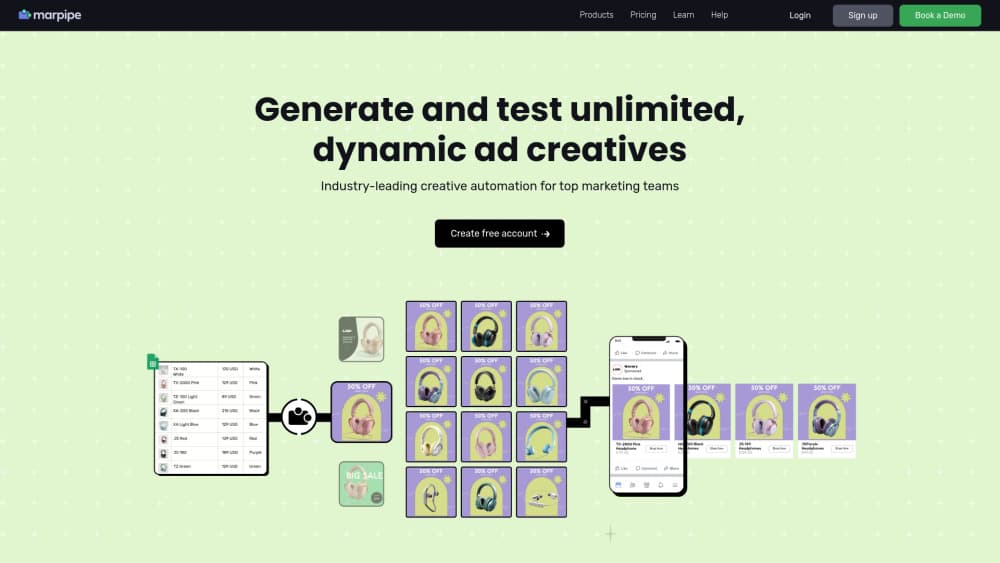
Marpipe is a New York software company, founded in 2018, that builds catalog ads. A catalog ad, also called a dynamic product ad, pulls the photo, title and price of each item from a product feed and assembles the ad by itself. The machinery works. The output often looks like a spreadsheet inside an ad frame.
Marpipe keeps the automation and hands back the design. You map feed fields onto a template once, add rules for the SKUs that need special treatment, and the platform renders an ad for every product in the catalog. Think of it as an ecommerce ad platform with a narrow remit: the catalog and the feed. The same feed then feeds Google Shopping, TikTok catalog ads, Pinterest and Meta catalog ads.
Much of the daily pain in catalog ads starts in the feed itself. Missing identifiers, vague titles and wrong category mapping get products rejected or quietly ignored by the channel. Marpipe's product feed management side handles that: you edit fields, group products into sets, and see a feed score for each destination. That part is free.
The limits are worth knowing up front. Marpipe doesn't run your campaigns, set bids or report on spend, so you still launch and adjust inside each ad platform. The enterprise plan is where unlimited channels and unlimited live designs sit, and white glove feed work is billed per SKU on top.
Getting Started
- Create a free account. Signup takes about five minutes, and the Shopify app is the shortest path if your store runs there.
- Connect a source feed. Import from Shopify, Salesforce Commerce Cloud, BigCommerce, WooCommerce or Magento, or drop in a CSV or feed URL.
- Check the feed score for your first channel and fix what it flags: titles, categories, missing product identifiers.
- Build one design in the canvas, mapping feed fields to image slots and text layers, then add per SKU rules where a product needs its own treatment.
- Publish an output feed and connect it inside Meta, Google, TikTok or Pinterest as the catalog source.
- Launch the campaign in the ad platform, then come back to filter out the SKUs that never earn their spend.
Product Information
A quick look at Marpipe's pricing, supported platforms, and performance.
Best for
The users, tasks, and scenarios where this tool fits best.
Users
- Ecommerce marketers already running catalog ads
- Small DTC teams without a designer on staff
- Agencies handling several stores
Tasks
- Making dynamic product ads look like real ad creative
- Cleaning a feed a channel keeps rejecting
- Producing video for every SKU
- Cutting spend on dead products
Scenarios
- A catalog of hundreds or thousands of SKUs where hand-designing each product is impossible
- Expanding into new markets
- Testing a channel before committing budget
Key features
Catalog Creative Canvas
The canvas is where Marpipe earns its place. Feed fields get mapped to image and text layers, so the product photo, price and title change per SKU while the layout stays fixed. You add typography, badges and backgrounds once, and the design system applies to thousands of products. Brands that hated their default catalog template usually come here for exactly this.
Product Level Video
Every product in the feed can get its own short video, built from the stills and clips you already shot. It removes the usual bottleneck of briefing an editor for a 40 SKU refresh. Output is sized for the channel you publish to, and you can keep the same design logic you use for static DPA creative.
Generative Catalogs
Generative catalogs apply image models to the product photos in your feed, so a plain white background shot can come out looking like a styled scene. The point isn't novelty, it's giving a catalog of near identical items some visual variety. Quality varies by category, and product accuracy still needs a human check before launch.
SKU Optimization
Most catalogs carry products that will never sell through paid social. This feature ranks items and lets you filter the weakest ones out of the ad set. Fewer SKUs means each product gets more budget and more data, which usually shows up in reported return on ad spend. You choose the cutoff.
Channel Ready Output Feeds
A feed built in Marpipe can be published out to Meta, Google Shopping, TikTok and Pinterest with the field names and formats each one expects. That beats maintaining four exports of the same catalog. Paid plans set how many channels and live designs run at once, and extra markets are an add on.
Free Feed Auditor
The auditor checks a product feed and reports what each channel will complain about: missing identifiers, thin titles, category mismatches. It's a free product feed tool, and it's the fastest way to see whether feed quality is the reason your catalog ads stalled. You can run it without an account.
Pros and cons
Pros
- Design control is the real difference. Dynamic product ads stop looking like feed dumps and start looking like campaigns someone designed.
- Feed management is free, which removes the usual "buy first, find out later" step.
- One feed pushes to Meta, Google Shopping, TikTok and Pinterest without four separate exports.
- Signup to first design takes about five minutes, and the Shopify app skips feed setup entirely.
- The free tier includes design previews and generative options, so you can judge the output before paying.
Cons
- It doesn't manage campaigns, bids or spend reporting, so it sits beside your ad platform rather than replacing part of it.
- The $199 Startup plan caps you at one channel, one market and three live designs, which is tight for a store selling in several countries.
- Enterprise pricing starts at $999 a month plus $0.5 per SKU, with unlimited markets sold separately, and that jump from $199 is steep for a mid sized catalog.
- There's no documented public API, so feed pipelines that need programmatic control have to work through the app or the exported feed URL.
Frequently asked questions
It builds and manages catalog ads. You connect a product feed, design how products appear, and Marpipe publishes an output feed that Meta, Google, TikTok or Pinterest uses to serve dynamic product ads.
Related content
Explore related tools, skills, and articles for Marpipe.
Marpipe Alternatives

Base Code
Base44 (Wix) · Coding · ProductivityBase Code is a shared cloud development environment from Base44. Teammates describe changes to an existing GitHub codebase in chat, preview them live and send them back as pull requests.

Google EmbeddingGemma 2
Google DeepMind · Writing · Image · CodingGoogle EmbeddingGemma 2 is a 740M-parameter open model that turns text, code, images, audio, and video frames into vectors in one 768-dimension space, running on phones and laptops.

GitGlow
GitGlow · Coding · ProductivityGitGlow is a local-first desktop Git client that lets independent developers review their own code and their AI agents' changes in one place before shipping.