
Mavenoid
Mavenoid AB · Marketing
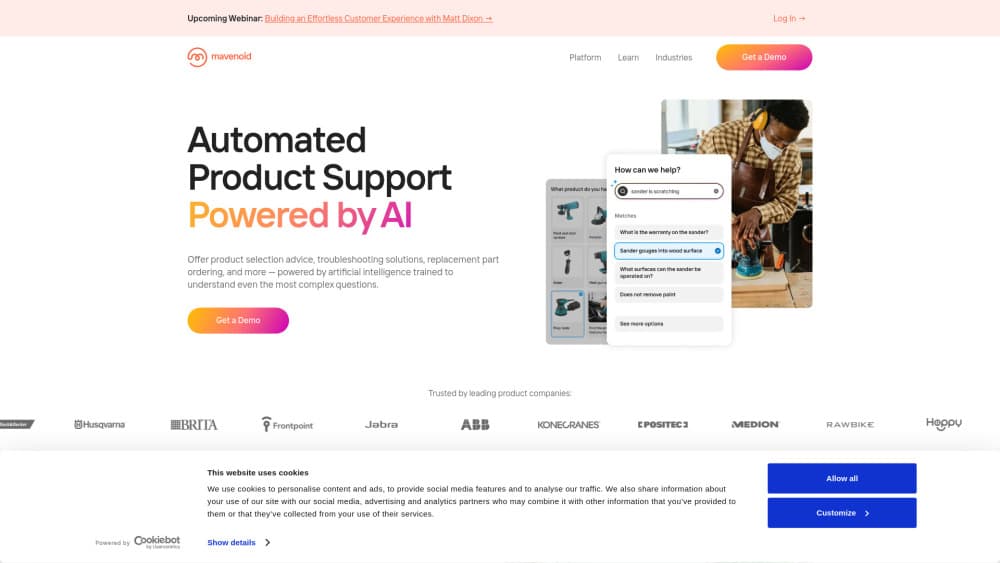
Mavenoid is an AI support platform for product brands. It combines a virtual assistant, a voice agent, and a help center so customers can solve product issues without waiting for a person.
About Mavenoid
What Is Mavenoid
Mavenoid is an AI customer support platform for companies that sell physical products. Founded in Stockholm in 2017, it goes after a narrow gap: problems too technical for a generic chatbot, yet too small to justify a 20 minute call with a live agent. Think washing machine error codes, treadmill belt tension, or a router that won't pair with its app.
Three products share one knowledge base. The Virtual Assistant handles chat on your site and in your app, Voice Assist takes phone calls, and the Dynamic Help Center catches people who arrive from Google. Mavenoid reports self-service resolution rates around 58 percent for chat and 47 percent for voice. Those numbers come from the vendor and depend on how complete your product documentation is.
The limit is the method itself. Mavenoid works when you already have structured knowledge: manuals, part lists, step-by-step repair guides. Teams with thin docs spend their first weeks writing content, and the AI won't invent a fix it has never seen.
Getting Started
- Request a demo and get a workspace. There's no self-serve signup and no public price list, so onboarding starts with a call to sales.
- Load what you already have. You can import existing FAQs and manuals, or write troubleshooting flows in the editor with branching steps and photos.
- Connect the assistant to your site, mobile app, and ticketing tool. Prebuilt actions create and update tickets without code.
- Watch the Insights dashboard for a week, then write guides for the questions customers keep abandoning.
Product Information
A quick look at Mavenoid's pricing, supported platforms, and performance.
Best for
The users, tasks, and scenarios where this tool fits best.
Users
- Support teams at hardware and device brands
- CX leads at telecom and medical device companies
- Warranty and field service managers
Tasks
- Troubleshooting a device fault
- Warranty registration and claims
- Choosing the right product or spare part
- Publishing support content in many languages
Scenarios
- Seasonal call spikes
- Thin documentation after a launch
- Multi-language support without local hires
Key features
Virtual Assistant Trained on Products
The chat assistant is built to understand how devices work, not just how help articles are worded. A customer can type "my robot vacuum keeps stopping on the rug" and get a branching diagnostic instead of a list of links. Mavenoid reports 58 percent and higher self-service resolution rates for this product. Human-written step guides sit next to AI-generated answers, so routine questions stay cheap while tricky repairs get a careful script.
Voice Assist for Phone Calls
Voice Assist answers calls in the customer's language and adapts mid-conversation. When a problem needs more than words, it sends an SMS link that opens a visual walkthrough, a form, or a spare part page. Call memory carries context across calls so nobody repeats their serial number three times. The product is in early access, which means terms and availability come from sales, not a pricing page.
Dynamic Help Center
This is the public facing side: a searchable help site that personalizes results by the product a visitor owns. Content gets created and translated inside the same editor, and pages are structured for search engines so FAQs and guides can show up directly in results. That matters for brands whose best troubleshooting answers currently live on forums they don't control.
Vision Assist Label Scanning
Customers point a phone at a product label and the assistant fills in model, serial number, and variant. It removes the most common reason support calls stall: nobody knows which version they bought. The same scan feeds warranty registration and part ordering.
Insights Dashboard and Data Feed
One dashboard tracks self-service resolution rate, live agent resolution rate, content performance, and where people abandon a troubleshooting flow. An API feed pushes the raw conversation data to your warehouse so analysts can join it with product and returns data. Gap analysis flags topics where documentation is missing.
Integrations Without Code
Mavenoid connects to any tool with an API, and prebuilt actions cover the usual jobs: create a ticket, update a ticket, look up an order, talk to your CRM. Support engineers set these up in the flow editor rather than in a separate integration project. For teams already running Zendesk, Salesforce, or a custom stack, this shortens the pilot considerably.
Pros and cons
Pros
- Product-aware answers beat generic chatbots on technical troubleshooting, because the assistant reasons about models and parts.
- Chat, phone, and the help center read from one knowledge base, so a guide written once shows up everywhere.
- Human-written step guides keep quality high on complex repairs while AI covers the routine volume.
- Translation inside the editor covers 50+ languages, which is real product support automation for small teams.
- API access for conversation data means support metrics can live next to product and returns data.
Cons
- No public pricing and no free tier. You have to talk to sales before you can test anything, which slows down small teams.
- Voice Assist is still early access, so phone coverage isn't a settled product yet.
- The AI is only as good as your documentation. Sparse manuals mean weeks of content work before the numbers look good.
- Setup pays off at volume. A team handling 200 tickets a month will struggle to justify the contract.
Frequently asked questions
It automates technical customer support for product companies, and self-service support is the default path. Customers get guided troubleshooting through chat, phone, or a help center, and only the cases that need a person reach your agents.
Related content
Explore related tools, skills, and articles for Mavenoid.
Mavenoid Alternatives

ngram 2.0
ngram · Video · Marketingngram 2.0 is an AI video generator for teams. It turns a prompt, a screen recording, or a product URL into a narrated explainer, product demo, or AI avatar video, and every scene stays editable.

shippedit.me
Krawlup · Marketing · Businessshippedit.me now redirects to Krawlup, a web platform that audits SEO, AEO and page speed every week, then hands the fixes to AI coding agents over MCP.

MePersona
MePersona, Inc. · Writing · Productivity · MarketingMePersona is an AI unified inbox for creators. It learns your voice, drafts replies to fan messages from 12 platforms, and sends only what you approve.