

Maximem Synap
Maximem · Coding · Productivity · Other
Maximem Synap is a managed memory layer for AI agents that keeps structured long-term memory across sessions and compacts context to cut token costs.
About Maximem Synap
What Is Maximem Synap
Maximem Synap is a hosted memory layer that sits between your application and its language model. It takes in conversations and documents, pulls out facts, preferences, episodes and dated events, then returns the slice of memory that fits the request in front of it. Your agent stops opening every session as a blank slate.
The company behind it, Maximem, published Synap as the reference implementation in an arXiv paper on Agentic Context Management. It reports 95.6% on LongMemEval and 93.2% on LoCoMo, with the answer model and judge model listed beside each figure. Read those as vendor results with stated conditions, not as an independent verdict.
Two limits shape the buying decision. Memory quality depends on which retrieval mode you call and which model answers, so the fast path with a small model won't reproduce the benchmark run. Billing runs on credits per operation, so cost tracks how you retrieve and how much you ingest rather than how many seats you buy.
Getting Started
- Create an account at synap.maximem.ai, then copy an API key from the dashboard.
- Install the Python SDK with
pip install maximem-synap, add the JavaScript or TypeScript package, or skip code and point an MCP client at the hosted server with a URL and a token. - Write a short use-case file. Synap builds the instance's memory architecture from it, so the schema follows your domain instead of a generic template.
- Ingest past conversations and documents in bulk, or stream new turns as they happen.
- Retrieve context on each turn, then compact long threads once the history outgrows your token budget.
Product Information
A quick look at Maximem Synap's pricing, supported platforms, and performance.
Best for
The users, tasks, and scenarios where this tool fits best.
Users
- AI product teams building assistants for returning users
- SaaS and support platform engineers
- Indie developers wiring memory into a coding agent
Tasks
- Keeping customer preferences across sessions
- Backfilling history before go-live
- Cutting context tokens on long threads
- Splitting memory by tenant
Scenarios
- A support copilot that remembers a customer's plan, past escalations and tone preferences across months of tickets.
- A coding agent that keeps project conventions, rejected approaches and review comments between sessions.
- A B2B product where each client organization needs its own memory island inside one deployment.
Key features
Structured memory instead of a transcript
Most AI agent memory tools store transcripts and search them later. Synap extracts facts, preferences, episodes, emotions and temporal events, then keeps those as typed records. Retrieval works on the records, so an answer can use a preference from March without replaying three months of chat. You describe the memory architecture for your domain instead of accepting one fixed schema.
Three retrieval modes at different prices
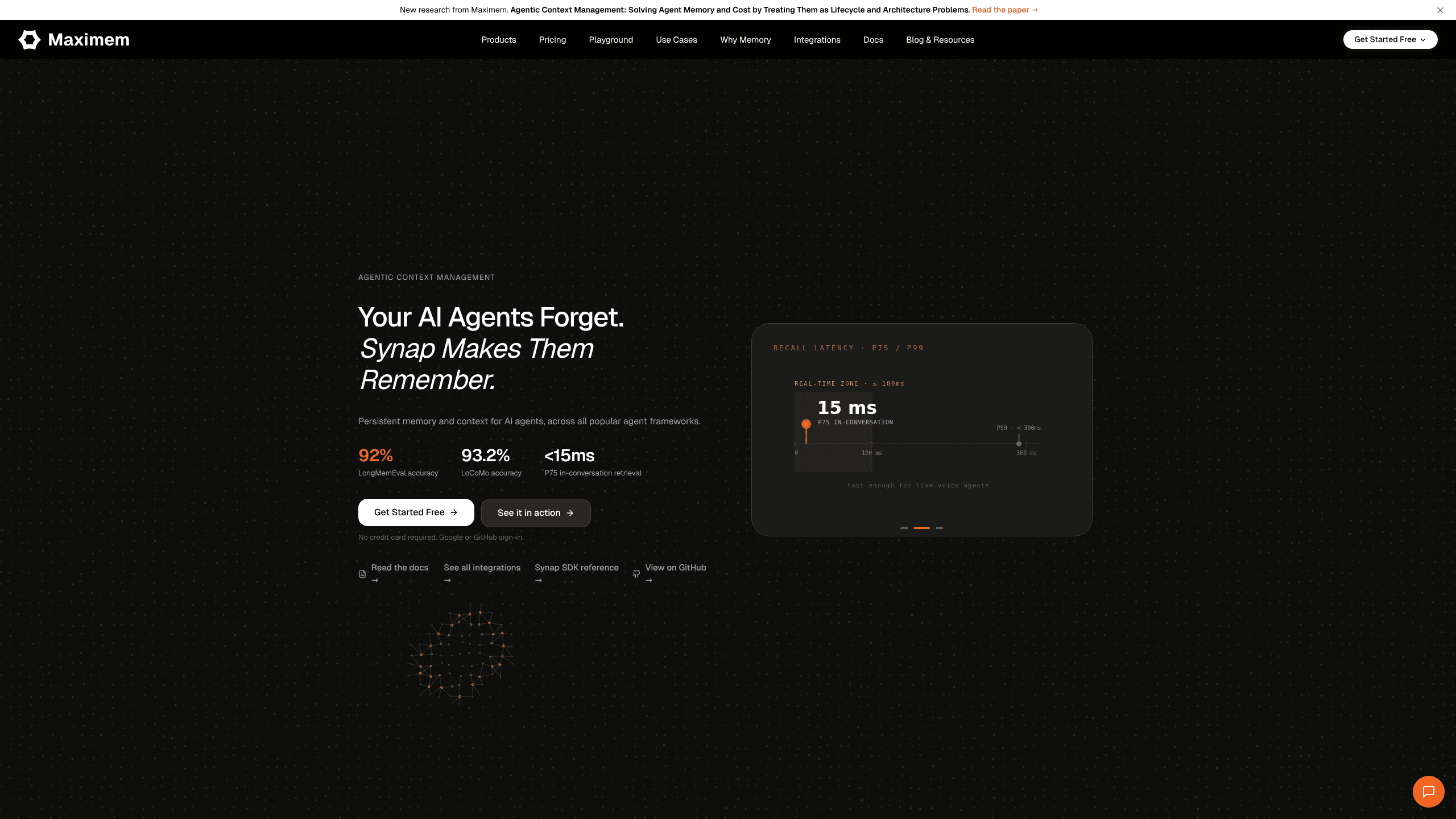
The fast path costs one credit per query and serves most reads inside a live turn. Hybrid costs two and adds a second pass. The accurate path costs three and adds query decomposition plus reranking. Maximem reports P75 latency under 15ms for in-conversation retrieval, which is the number that decides whether memory feels instant or laggy.
Agentic context compaction
Long histories get compressed into a summary you can fetch later, with calls to check whether a compaction is stale or still running. The point isn't shorter text for its own sake. Compaction holds a token budget while keeping the details that change an answer, and Maximem says compaction plus anticipation roughly halves context tokens per turn.
Anticipatory retrieval
A listen stream watches a conversation and surfaces memories likely to matter before the agent asks for them, which removes a round trip on every turn. It's also the hardest feature to judge from a demo, so test it on your own traffic before you build a workflow around it.
Multi-tenant memory scopes
Every record sits on a scope ladder that defaults to User, Customer and Client. Reads travel up the chain by priority, writes stay where you put them, and one instance can serve many tenants. Deletion runs per user through the SDK and the API, which is the question security reviews ask about first.
SDKs, an MCP server and framework hooks
Native SDKs cover Python 3.11+ and Node.js 20+, and the JavaScript build runs on Vercel Edge, Cloudflare Workers and in the browser for memory and context calls. Connectors exist for Claude Agent SDK, CrewAI, AutoGen, Microsoft Agent Framework and Vercel eve. The MCP server covers no-code platforms such as n8n, Gumloop and Claude.
Security and audit basics
Traffic runs over TLS 1.3, application data is encrypted at rest with AES-256, and API keys are hashed with SHA-256 before storage. Audit trails run from 7 days on the Trial to 180 days on Scale, with custom retention on Enterprise.
Pros and cons
Pros
- Benchmark figures come with answer model, judge model and dataset version attached, and the harness plus run outputs are public.
- Every plan carries the full feature set, so the entry price buys the same retrieval modes and compaction as the top tier.
- The scope ladder handles multi-tenant memory without you building an isolation layer.
- SDKs cover Python, Node and edge runtimes, and the MCP server skips code entirely.
- Per-operation credit pricing is published, so you can estimate a bill before committing.
Cons
- Credits make forecasting awkward: one document costs 2 to 25 credits depending on length, and heavy ingestion can burn a Starter allowance fast.
- The free trial caps you at 12,500 credits and a single instance, which is enough for a prototype and not much more.
- There's no self-hosted option. BYOK covers model keys, not where memory lives.
- Most evidence comes from the vendor's own runs. Independent third-party comparisons are thin.
Frequently asked questions
It gives an AI agent a memory that outlives a single conversation. You send conversations or documents in, Synap extracts structured memory, and later calls return ranked, scoped context for the current turn.
Related content
Explore related tools, skills, and articles for Maximem Synap.
Maximem Synap Alternatives

Base Code
Base44 (Wix) · Coding · ProductivityBase Code is a shared cloud development environment from Base44. Teammates describe changes to an existing GitHub codebase in chat, preview them live and send them back as pull requests.

Google EmbeddingGemma 2
Google DeepMind · Writing · Image · CodingGoogle EmbeddingGemma 2 is a 740M-parameter open model that turns text, code, images, audio, and video frames into vectors in one 768-dimension space, running on phones and laptops.

GitGlow
GitGlow · Coding · ProductivityGitGlow is a local-first desktop Git client that lets independent developers review their own code and their AI agents' changes in one place before shipping.