

mdhub
mdhub · Writing · Productivity
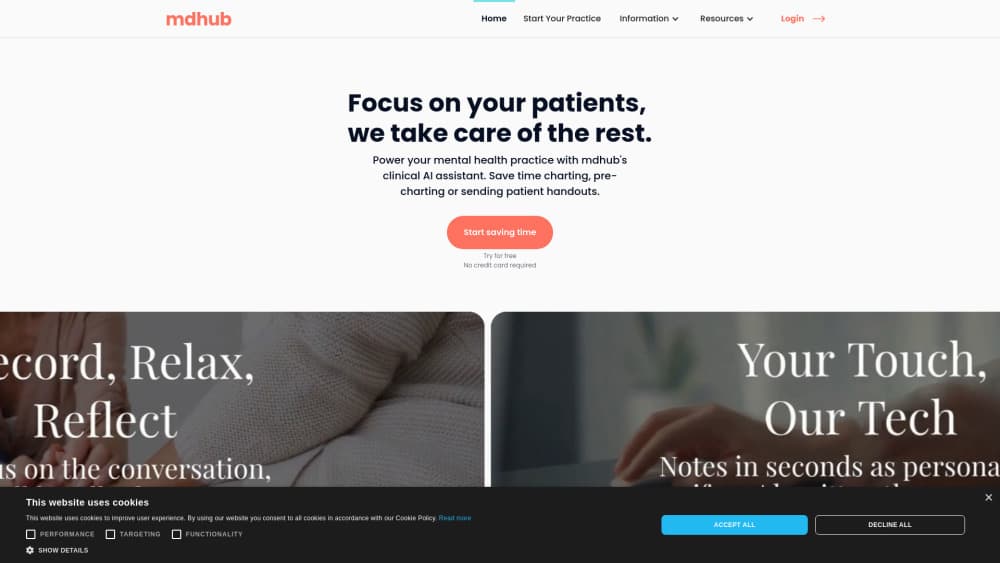
mdhub is an AI clinical assistant for behavioral health clinicians that drafts session notes, pre-charts visits, and applies CPT codes automatically.
About mdhub
What Is mdhub
mdhub is a clinical AI assistant built for behavioral health practices. It listens to therapy and psychiatry sessions, then turns the conversation into a structured note your team can actually bill from. The company pitches it as part of a wider "AI-first clinic operating system," but the piece most clinicians touch first is Emma, the assistant that handles documentation.
The problem it solves is mundane and expensive. Behavioral health clinicians spend hours after their last patient typing notes, chasing codes, and prepping the next chart. mdhub markets itself on saving up to 2 hours per clinician per day, which for a full-time therapist is the difference between finishing at 6 and finishing at 8.
The main limits are worth stating plainly. mdhub isn't a general-purpose note tool. It's tuned for mental health and psychiatry workflows, so a surgical practice or a primary care clinic will find it a poor fit. It also plugs into your EHR rather than replacing it, and the lower Lite tier caps you at 50 sessions a month. High-volume panel? You'll be looking at Pro or Enterprise pricing fast.
Getting Started
- Sign up on the mdhub website and start the free trial.
- Connect the assistant to your existing EHR so patient charts and history flow in.
- Set your note templates to match how your clinic documents sessions and specialties.
- Run your first session with mdhub capturing notes in the background.
- Review the generated note, adjust anything you want, and push it to the chart.
Product Information
A quick look at mdhub's pricing, supported platforms, and performance.
Best for
The users, tasks, and scenarios where this tool fits best.
Users
- Therapists and counselors
- Psychiatrists (MD/PMHNP)
- Group practices and CCBHCs
- Clinic ops and billing staff
Tasks
- Writing session notes
- Applying CPT codes
- Pre-charting
- Patient follow-up summaries
Scenarios
- Back-to-back appointment days
- Telehealth visits
- Intake-heavy clinics
Key features
Automatic clinical notes
mdhub listens during the session and produces a structured note rather than a transcript you have to reshape. The company builds it for clinical-grade accuracy. Think the level of detail needed for real documentation, not a loose summary. You review and edit before anything hits the chart.
Pre-charting and session prep
Before each appointment, mdhub fills the chart with relevant history, context, and open items from prior visits. That means you walk into the room already knowing what happened last time and what still needs attention, instead of skimming notes in the two minutes between patients.
CPT coding from clinical context
Rather than coding after the fact from memory, mdhub assigns CPT codes from what was actually discussed and documented. The company links this to a 55% reduction in insurance denials, a claim worth verifying against your own payer mix but a sensible direction if your denials often trace back to coding.
Chart-aware assistant for follow-up
After a session you can ask questions or draft summaries and follow-up within an assistant that reads the patient's chart. It's HIPAA-compliant, so the back-and-forth happens in a secure environment rather than a generic chatbot. This is where the tool shifts from scribe to something closer to a clinical sidekick.
Custom documentation templates
mdhub builds notes around templates shaped to your clinic's workflows, specialties, and compliance requirements. A DBT-focused practice and a medication-management clinic document differently, and the templates reflect that instead of forcing one format on everyone.
EHR integration
The assistant connects to your existing EHR, so you keep the system your staff already knows and layer documentation on top. You're not migrating records or retraining the front desk. Setup is quick, and mdhub says it takes about a minute to get started.
Pros and cons
Pros
- Notes are generated during the session, which directly attacks the after-hours documentation backlog clinicians complain about most.
- CPT coding runs off clinical context, which cuts a task that quietly drives claim denials.
- Tuned for behavioral health specifically, so it handles therapy and psychiatry workflows better than generic scribes.
- HIPAA-compliant and SOC 2-certified, which matters when patient data flows through any AI tool.
- Connects to your current EHR instead of demanding a full platform switch.
Cons
- Lite caps you at 50 sessions a month, so anyone with a fuller caseload pays Pro prices.
- No free tier, only a trial, which makes it harder to test at length before committing.
- Built for mental health, so it's the wrong tool outside behavioral health and psychiatry settings.
- The chart-aware assistant and custom templates sit on higher tiers, so the cheapest plan is fairly basic.
Frequently asked questions
mdhub is an AI clinical assistant for behavioral health. It captures sessions and generates structured clinical notes, pre-charts appointments, applies CPT codes, and helps with follow-up documentation, all inside a HIPAA-compliant environment.
Related content
Explore related tools, skills, and articles for mdhub.
mdhub Alternatives

Claude for Google Workspace
Anthropic · Writing · Productivity · BusinessClaude for Google Workspace puts Claude in a sidebar inside Google Docs, Sheets, and Slides, where it reads the file you have open and edits it in place.

Claude Haiku 5.5
Anthropic · Writing · Coding · ChatbotClaude Haiku 5.5 is Anthropic's fastest and cheapest small model, built for high volume tasks at $0.10 per million input tokens with a 1M token context window.
NoteWorthy
Suman Hansada · Writing · Productivity · AI AssistantNoteWorthy is a notes app for iPhone, iPad and Mac that writes titles, tidies formatting, summarizes long notes and files each one with on-device AI. No account, no upload, no network requests.