
Medical Realities
Medical Realities Ltd · Other
Medical Realities is a London VR platform that puts medical students and surgical trainees inside real operations through 360-degree video modules, in-scene notes, and assessments.
About Medical Realities
What Is Medical Realities
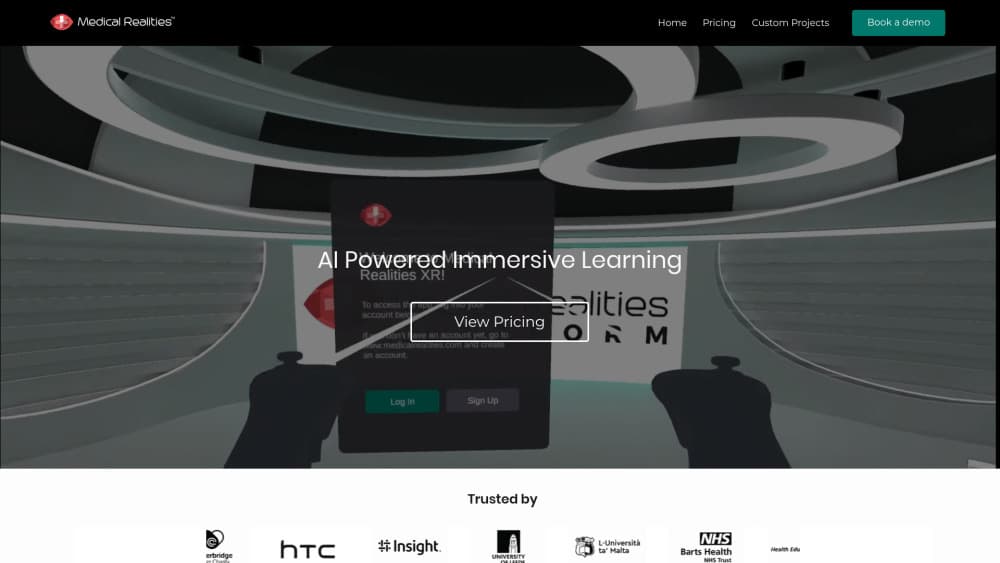
Medical Realities is a virtual reality education platform for medical students, surgical trainees, surgeons, and other health care professionals. The company is based in London and was built around one idea: let people watch real surgery from the surgeon's point of view instead of reading about it in a textbook.
Steve Dann co-founded the company with Dr Shafi Ahmed, a colorectal surgeon who became known for operating while broadcasting live in VR. Their target user is not a VR hobbyist. It's a student who has read the chapter, memorized the steps, and still has no mental picture of what a theatre looks like when something goes wrong.
The platform ships as a set of VR surgical training modules. Each module drops you into an operating theatre in VR, shows the procedure from several angles, and layers notes on top of the footage: who is standing where, what each instrument does, why the team pauses. There are assessment questions afterward, which matters for anyone using it inside a formal course.
The limits are worth knowing early. This is filmed content, not a haptic simulator. You won't feel tissue resistance or practice hand movements, so it supplements bench and cadaver work rather than replacing it. You also need a headset or a desktop viewer, and the company doesn't publish prices on its site.
Getting Started
- Create an account on the Medical Realities website. Registration unlocks the learning portal and the module library tied to your course or your own study plan.
- Pick a procedure that matches your rotation or syllabus, then check the runtime and the hardware it needs. Modules vary in length and camera setup.
- Watch in a headset for the full effect, or on desktop if you only need the footage. Use the in-scene labels to follow staff roles and instruments as the operation moves.
- Work through the assessment at the end of the module, then revisit the sections you missed. Most learners repeat a module two or three times before the sequence sticks.
Product Information
A quick look at Medical Realities's pricing, supported platforms, and performance.
Best for
The users, tasks, and scenarios where this tool fits best.
Users
- Medical students in pre-clinical or early clinical years
- Surgical trainees and junior doctors
- Clinical educators and teaching hospitals
Tasks
- Prepping for a theatre session
- Learning anatomy in context
- Revising for exams
- Training across sites
Scenarios
- A cancelled theatre list
- A specialty with rare cases
- Induction week for new trainees
Key features
360-Degree Operation Footage
The core of the product is recorded surgery you can look around inside. Instead of a fixed camera angle chosen by an editor, you turn your head and follow the surgeon, the assistant, or the anaesthetist. That freedom is the difference between watching a procedure and understanding the room it happens in.
Multi-Camera Operating Theatre Views
Modules combine several feeds, including laparoscopic views and 3D close-ups, so you can switch between the wide shot of the team and the inside view of the operative field. Seeing both at once is how you learn which movement produces which result on screen.
Syllabus-Mapped Training Modules
The library is organized around surgical curriculum topics rather than a random pile of videos. Each surgical training module covers a procedure or a theme that shows up in exams and rotations, and the company says the collection maps to key syllabus material. That structure saves you from guessing which recording is worth your evening.
In-Scene Notes and Staff Role Callouts
Labels sit inside the footage and explain what you're looking at: the role of each person around the table, the name of an instrument, the reason for a pause. Small detail, big difference. Most surgical video online assumes you already know, and this one doesn't.
Assessment and Progress Checks
Each module ends with questions, which turns passive viewing into something you can measure. For a student, that's a quick way to find out whether you actually followed the steps. For a course director, it's a reason to assign the module rather than suggest it.
Headset and Desktop Access
The platform runs on PC VR headsets including the Oculus Rift, with builds listed on Viveport, and offers a desktop viewer for people without hardware. Quality of experience differs a lot between the two. The desktop version is fine for content, the headset version is why you bother.
Pros and cons
Pros
- Real operations, filmed in 360 degrees, with the whole theatre visible instead of a cropped surgical field.
- Notes and staff role labels sit on the footage, so a first-year viewer isn't lost in the first thirty seconds.
- Modules follow surgical syllabus topics and end with assessment, which makes the library usable in a formal course.
- No haptics means no consumables and no per-attempt cost, so a department can let students repeat a procedure as often as they like.
Cons
- No touch feedback. You can't rehearse hand pressure, suturing tension, or instrument angles, so this can't stand in for a skills lab.
- Prices and licensing aren't published, and there's no self-serve checkout. A single learner has to ask, and an institution has to negotiate.
- Content depth depends on what's been filmed. If your specialty or a rare procedure isn't in the library, the platform won't help you that week.
- Hardware matters. A laptop viewer flattens the experience, and a shared departmental headset brings hygiene and scheduling problems.
Frequently asked questions
Medical Realities is a VR education platform for surgical and medical training. It films real operations in 360 degrees, wraps them in explanatory notes, and adds assessment questions. The company is based in London.
Related content
Explore related tools, skills, and articles for Medical Realities.
Medical Realities Alternatives

Odyssey 3
Odyssey · OtherOdyssey-3 is Odyssey's foundation world model. It simulates physics in real time, turns a prompt into an interactive environment, and adapts to robots, cars and games.

JarvisCore
Prescott Data · Coding · Productivity · OtherJarvisCore is an open source Python runtime where AI agents work as equal peers on an agent mesh, claim tasks from a shared ledger, and reach external services through a zero-trust broker.
Clef
Cloudflare · Business · OtherClef is Cloudflare's open-source decision model for Workers AI. It returns calibrated probabilities for typed questions, not generated text, so agents can classify, route, and act fast.