

MemSync
Vanna Laboratories Inc. · Other · Chatbot
MemSync is a Chrome extension and developer API that builds a portable memory layer for AI apps, so ChatGPT, Claude, and Grok remember your context instead of starting from zero.
About MemSync
What Is MemSync
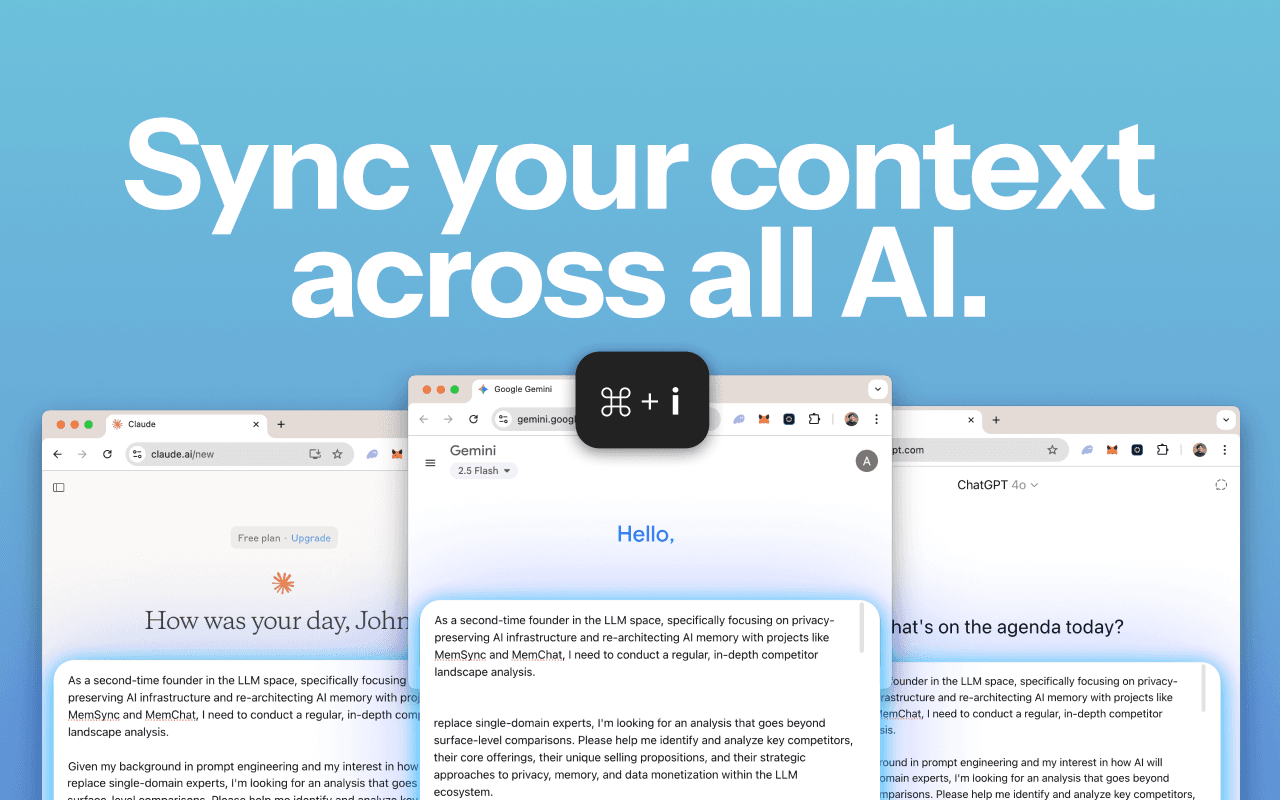
MemSync is a memory layer for AI apps, built by Vanna Laboratories and tied to the OpenGradient team. The Chrome extension sits quietly in your browser, watches the AI conversations you already have, and turns them into a personal knowledge base that any connected AI app can draw on.
The problem it targets is familiar to anyone who juggles more than one assistant. Tell ChatGPT about your project on Monday, and Claude has no idea who you are on Tuesday. Every new chat means retyping the same background, preferences, and constraints. MemSync captures those details once and hands them back wherever you're working.
The limit is that MemSync doesn't make the underlying models smarter or give them a bigger context window. It feeds them better input. You also have to trust a third party with a running record of your interactions, which is why the company leans hard on encryption and a user-owned data dashboard.
Getting Started
- Install the MemSync extension from the Chrome Web Store and sign in with an account.
- Use your AI apps the way you normally do. MemSync works in the background and starts extracting facts from your conversations.
- Open the dashboard to review what it captured, then edit or delete anything that's wrong.
- Turn on one-click prompt tuning on any supported platform to fold your stored context into the prompt you're about to send.
- For your own product, grab an API key and call the REST endpoints at api.memchat.io to store and search memories programmatically.
Product Information
A quick look at MemSync's pricing, supported platforms, and performance.
Best for
The users, tasks, and scenarios where this tool fits best.
Users
- Heavy AI users
- Developers building AI products
- Privacy-minded users
Tasks
- Keeping preferences consistent
- Importing existing context
- Prompt optimization
Scenarios
- Switching between ChatGPT, Claude, and Grok on the same project
- Onboarding a new AI tool
- Building a personalized chatbot
Key features
Unified memory across AI apps
The core promise is one memory that follows you between ChatGPT, Claude, Grok, and other platforms. MemSync captures interactions where they happen and stores them in a shared vault, so the facts you established in one app are available in the next. This is the feature that separates it from the built-in memory each platform ships on its own.
One-click prompt tuning
On any supported AI platform, MemSync can personalize and sharpen your prompt before you send it. The tuner folds in what it knows about you, so a request that would normally return a generic answer comes back tuned to your history. It's the fastest way to feel the difference without changing how you work.
Personal AI database and user profiles
MemSync sorts everything it learns into memories and builds an auto-generated profile with a bio, category breakdowns, and insights. The profile updates as new memories land, which means the picture of you gets sharper over time rather than going stale.
Cross-app import
You can bring existing context in from social media, documents, and chat history. According to Vanna Laboratories, MemSync connects LinkedIn, Twitter, and Reddit alongside PDF and Word files and imported ChatGPT conversations, so a new account doesn't start empty.
Semantic search
Memories are stored with embeddings, so you can query them in plain language instead of scrolling a list. The API exposes a search endpoint that returns the most relevant memories for a query, which is what makes the retrieval feel instant rather than keyword-bound.
Privacy and encryption by design
MemSync says it uses end-to-end encryption, decentralized multi-party computation for key management, and trusted execution environments for processing. Keys aren't stored, and the dashboard lets you browse, edit, or delete your memories, so the data stays under your control in principle.
Developer API and SDK
Beyond the extension, MemSync ships a REST API at api.memchat.io with endpoints for storing, searching, updating, and deleting memories, plus profile and integration calls. Python and JavaScript examples and SDK docs get a developer to a first working call quickly.
Pros and cons
Pros
- One memory layer covers ChatGPT, Claude, Grok, and more, so you stop re-explaining yourself in every tab.
- The prompt-tuning feature improves answers without you rewriting anything by hand.
- A real REST API and SDK docs mean you can build on the same memory outside the extension.
- The dashboard lets you review, edit, and delete what's stored, which is more control than most AI memory tools offer.
- Encryption and a user-owned data model are built into the pitch, not bolted on later.
Cons
- Everything runs through a third-party service, so you're trusting MemSync with a running log of your AI interactions.
- The extension is Chrome-only, so Firefox, Safari, and mobile browsers are left out.
- Deep personalization only kicks in after enough conversations, and a fresh install feels close to no memory at all.
- Pricing runs on in-app purchases and credits, which is less transparent than a flat posted plan.
Frequently asked questions
MemSync gives your AI apps a shared memory. It captures your interactions, builds a personal knowledge base, and feeds the right context back into ChatGPT, Claude, Grok, and other tools so they stop starting from scratch.
Related content
Explore related tools, skills, and articles for MemSync.
MemSync Alternatives

JarvisCore
Prescott Data · Coding · Productivity · OtherJarvisCore is an open source Python runtime where AI agents work as equal peers on an agent mesh, claim tasks from a shared ledger, and reach external services through a zero-trust broker.
Clef
Cloudflare · Business · OtherClef is Cloudflare's open-source decision model for Workers AI. It returns calibrated probabilities for typed questions, not generated text, so agents can classify, route, and act fast.

iFixAi
iFixAi · Business · OtheriFixAi is an open-source auditor for AI agents. It runs your agent through a simulation of your business, grades every reply, and returns an A to F scorecard backed by evidence.