

Mengram
Mengram · Other
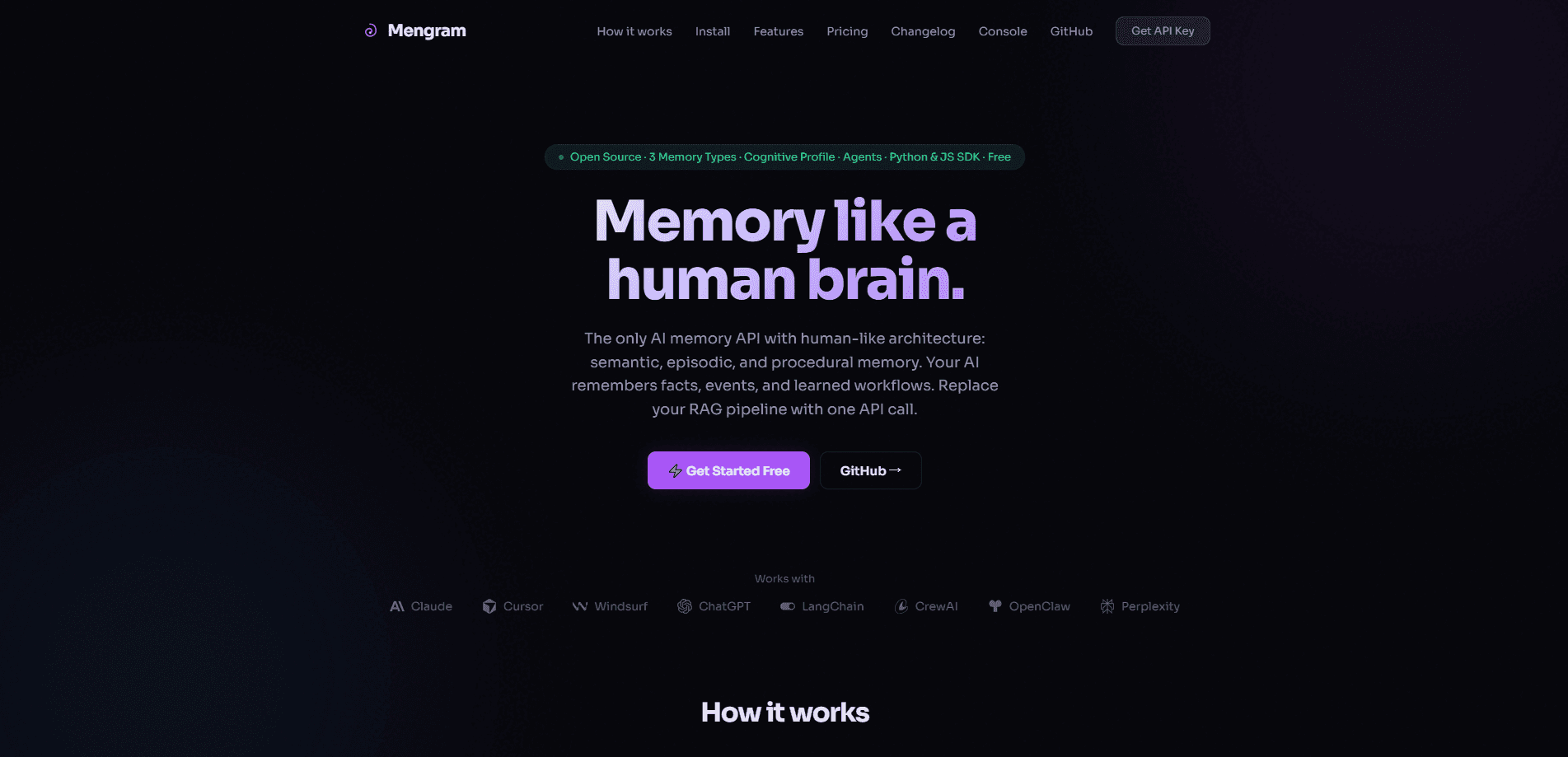
Mengram is an open-source AI memory API that gives applications and agents persistent, human-like recall. It stores three memory types, semantic facts, episodic events, and procedural workflows, then pulls them back through a single call. Developers building agent products use it to keep context across sessions, while everyday users can add it to Claude or Cursor as a memory connector.
About Mengram
What Is Mengram
Mengram is an AI memory API built for developers who want their agents to remember users instead of starting every session from zero. It works as both a persistent memory for AI agents and a library you search on demand. Where a chatbot forgets a conversation the moment the window closes, Mengram runs an extraction layer that turns raw chat turns into structured memory you can search later.
The core idea is that human memory isn't one thing. Mengram splits recall into semantic memory (facts and preferences), episodic memory (events and outcomes), and procedural memory (step-by-step workflows). All three get extracted automatically when you send messages to the API, so it's not just another vector store bolted onto a chatbot.
It's open source under Apache 2.0, so teams with compliance needs can self-host the core and keep the same API surface. The main limitation is scope: Mengram is a memory backend, not a chat framework. You still bring your own LLM, your own prompts, and your own agent loop. Nothing here writes replies for you.
Mengram pricing scales with volume. The free tier covers demos. Paid tiers step up from there.
Getting Started
- Sign up at mengram.io to get a free API key (it starts with
om-), or runmengram signup --email [email protected]from the terminal. - Install the SDK with
pip install mengram-aifor Python, or add the JavaScript package for Node. - Send your first memory by calling
m.add(messages, user_id="customer-4812"). Mengram extracts facts, events, and workflows server-side. - Search it back later with
m.search("how should I contact this customer?", user_id="customer-4812"). - For tool-native agents, paste the one-click connector URL into Claude, Cursor, or any MCP client.
Product Information
A quick look at Mengram's pricing, supported platforms, and performance.
Best for
The users, tasks, and scenarios where this tool fits best.
Users
- Developers building agent products
- Solo builders and indie devs
- Claude and Cursor power users
Tasks
- Remembering user preferences across sessions
- Tracking what happened and how it turned out
- Learning workflows from failures
Scenarios
- Customer support agents handling thousands of users
- Coding assistants that span tools
- Multilingual products
Key features
Three Memory Types in One API
Mengram doesn't ask you to pick a memory model. A single m.add() call extracts semantic facts, episodic events, and procedural workflows at once, and each type is searchable on its own. You get a knowledge graph for entities, a timeline for episodes, and versioned procedures for how-to knowledge. That split maps closer to how people actually remember than a flat vector index does.
Procedural Memory That Evolves
Most memory tools store what happened. Mengram also stores how to do things, then updates those procedures when they fail. Report a failure with m.procedure_feedback(proc_id, success=False, context="Step 3 failed: OOM"), and Mengram revises the steps and derives preconditions your agent can check before trusting the workflow. The version history keeps every revision, so you can see what changed and why.
Multi-User Isolation
Pass a user_id and every end user gets a separate memory store with their own facts, events, workflows, and a cognitive profile. You keep one API key and serve thousands of users. For anyone shipping a support bot or a personal assistant, this is the feature that makes the API usable in production rather than just a prototype.
Graph RAG Recall
Search isn't limited to direct matches. Mengram traverses relationships in the knowledge graph, so a query for "Python" can surface Django, which links to the platform you deployed it on. Two-hop traversal pulls in context that simple vector search would miss. It's the difference between finding a keyword and finding the thing that actually relates to it.
Works Across Claude, Cursor, and Codex
The memory survives /clear, auto-compaction, and machine switches. Mengram ships a one-click Claude connector, an MCP memory server with around 30 tools, and integrations for LangChain, CrewAI, n8n, and OpenClaw. You install it once and the same recall follows you between tools instead of living in one app's silo.
Server-Side Extraction
You send raw conversation turns, not cleaned-up facts. Mengram handles extraction, deduplication, and contradiction checks on its servers, so you don't write prompt engineering to keep memory tidy. When two facts conflict, the system flags the contradiction rather than silently keeping both.
Pros and cons
Pros
- Three distinct memory types (semantic, episodic, procedural) cover facts, events, and workflows in one API, which is rare among memory tools.
- Open source under Apache 2.0, so self-hosting is an option when data has to stay on your own infrastructure.
- Per-user isolation via `user_id` keeps memory separate at scale without extra plumbing.
- Native support for 23 languages, including Russian, Chinese, Spanish, and Japanese, using multilingual embeddings.
- Free tier is genuinely usable for demos, with no credit card required.
Cons
- It's a backend, not a finished product. You bring your own LLM, prompts, and agent loop, so there's real setup work before anything runs.
- Procedure evolution and smart triggers sit behind the $19/mo Pro tier, which means the most interesting features aren't on the free plan.
- Documentation is young and some pages assume you're comfortable reading code, so non-developers will lean on the Claude connector path.
Frequently asked questions
Mengram gives AI applications persistent memory so they remember users across sessions. Developers use it to store preferences, past interactions, and learned workflows, then recall them later through a search call instead of re-explaining context every time.
Related content
Explore related tools, skills, and articles for Mengram.
Mengram Alternatives
BinkBink
BinkBink · OtherBinkBink is a free online game platform and AI game maker that lets anyone turn a short text description into a playable browser game. You can jump into hundreds of community-made games. Or describe your own idea and play it in seconds, then share it with friends. Want to create your own game? You don't need to code. No engine setup, no download, no hassle.

Audiogen
Audiogen Inc. · OtherAudiogen is an AI music generator built by Audiogen Inc., a small research team that spent about 2.5 years training its own generative music model and designing a web interface around it. Instead of a plain text box, this AI music tool turns the timeline into a beginner-friendly Generative Audio Workstation, or GAW, where inpainting, extending, remixing and stem editing work more like painting on a canvas. The product is still in beta, so access runs through a waitlist or an invite. Paid plans aren't published yet.

Aiml API
AIMLAPI OÜ · OtherAiml API is a unified AI model API that puts more than 1000 models from OpenAI, Google, Anthropic, and others behind one endpoint and one bill. You write code against a single OpenAI-compatible schema, then switch between chat, image, video, and audio models by changing a model string. It suits developers and small teams who want multi-model access without juggling a dozen separate provider accounts, and it removes the usual billing headache that comes with testing several vendors. One key covers it all.