

Merge
Merge · Coding · Other
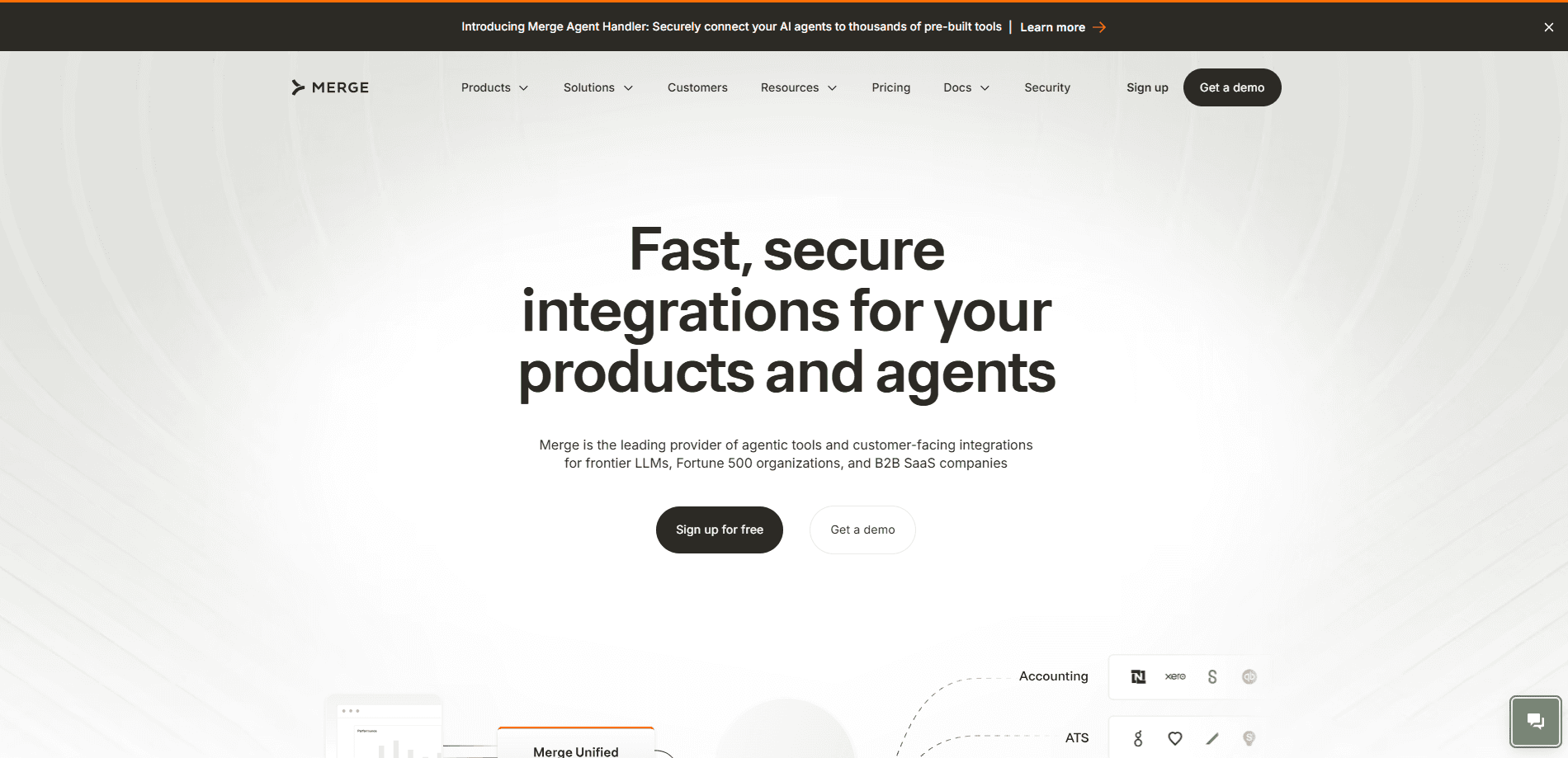
Merge is a unified API platform that lets developers connect their product or AI agent to hundreds of third-party tools, data sources, and large language models through a single interface. It's infrastructure for teams building production AI, so you write one integration and reach every accounting, HR, CRM, ticketing, and file storage system your customers already use. The platform also covers agent tooling, LLM routing, and employee AI governance under one roof. Sound like a lot to manage? That's the point. Merge puts it in one place.
About Merge
What Is Merge
Merge is connectivity infrastructure built for developers and AI product teams. Instead of writing a separate connector for every CRM, HRIS, or ticketing platform in the market, you build against Merge once and get access to a catalog of hundreds of integrations that share the same data model. That means less maintenance, faster launches, and one place to monitor what's working.
So what does that actually save you? A typical integrations team spends months keeping connectors alive as third-party APIs drift. A good data integration API moves that work behind a single normalized interface.
The company now positions itself as the connective layer for production AI, not just a data-sync tool. Its catalog spans four products: Unified for customer-facing data integrations, Merge Agent Handler for giving agents secure access to third-party tools, Merge Gateway for routing requests across LLM providers, and Workforce for governing which AI tools employees can use. If you're shipping an AI feature that touches customer systems, Merge handles the plumbing. Your team doesn't have to.
That's the pitch, anyway. Merge is a developer platform sold to companies building integrations at scale. It's a core infrastructure bet, not a quick fix. A solo builder testing a weekend idea won't get much value from the professional or enterprise tiers. Pricing is contract-based once you move past the free launch plan, which means you'll talk to sales before you scale. There's a free tier worth trying first, and the sandboxes make evaluation easy. Expect a real conversation about usage before you commit.
Getting Started
- Sign up for a free account at merge.dev and get access to your own sandbox environment.
- Pick the integration category you need, such as accounting, HR, CRM, or file storage, and enable it in your dashboard.
- Generate your API key and link a test account through Merge Link, the embeddable authentication flow.
- Call the Merge API against the sandbox to sync or write data, using the shared data model for whichever platform you connected.
- Move to production by linking real customer accounts, then watch sync health from the Merge dashboard.
Product Information
A quick look at Merge's pricing, supported platforms, and performance.
Best for
The users, tasks, and scenarios where this tool fits best.
Users
- Product engineers at SaaS and AI companies
- Engineering leads planning an integrations roadmap
- AI agent builders who need real-world tools
Tasks
- Building customer-facing integrations
- Syncing and writing data across platforms
- Routing requests across LLM providers
- Governing employee AI use
Scenarios
- A fintech app that needs to reconcile payments against several accounting platforms for different customers.
- An HR tech product that syncs candidate and employee records from whatever ATS or HRIS each client runs.
- A support tool that pulls tickets and conversation history from multiple helpdesk systems into one view.
- An enterprise rolling out AI assistants internally and needing a single place to control access and spending.
Key features
One API for hundreds of integrations
Merge normalizes dozens of platforms in each category into a common data model. You write against that model once and get consistent fields, error handling, and endpoints across every provider, which means your integration code doesn't change when a third-party platform revises its own API underneath you. It's the core reason teams pick Merge over building connectors in house. It's also what keeps maintenance down as third-party APIs change.
Merge Link authentication flow
Merge Link is an embeddable component that handles the messy part of connecting a customer account. Users pick their platform. They log in. The flow manages credentials and tokens for you, so you avoid building and maintaining a separate authentication screen for every single integration you decide to support.
Agent Handler for AI tools
Merge Agent Handler gives your AI agent secure access to thousands of pre-built third-party tools. Rather than coding each action yourself, you connect the agent and let it call the right tool for a task. It's aimed at teams whose agents need to act in the real world, not just chat.
Gateway for LLM routing
Merge Gateway puts every model provider behind one API, so you can route requests based on cost, latency, or reliability without changing your application code. You keep full spend visibility. No lock-in. When one model goes down, traffic moves without a rewrite.
Observability and logs
Merge tracks sync health, errors, and integration status across your whole catalog in one dashboard. You can see which linked accounts are failing and why. That matters. A single broken connector can quietly break a customer's workflow, and building this level of monitoring yourself usually takes months.
Security and compliance
Merge is built for enterprise buyers, with SOC 2 and HIPAA support plus role-based access control. Audit trails and data-minimization controls let you limit which fields an integration can touch. For regulated industries, that documentation is often the difference between a deal and a dead end.
Sandboxes and developer tooling
Every plan includes sandboxes that mimic third-party platforms, so you can test integrations without live customer data. SDKs and a full API reference shorten the build cycle. The free launch tier lets small teams prove a concept before spending anything.
Pros and cons
Pros
- One normalized API replaces dozens of individual connectors, cutting build and maintenance time.
- Free launch tier with three production linked accounts lets you test before committing.
- Broad catalog covers accounting, HR, CRM, ticketing, file storage, and more.
- Extends beyond data sync into agent tools, LLM routing, and employee governance.
- Sandboxes, SDKs, and observability tools make evaluation and scaling easier.
Cons
- Paid plans jump to contract-based pricing, so you'll negotiate with sales rather than see a public number.
- The $650/month starting point for the first paid tier is steep for very small teams.
- It's a developer platform. Non-technical users will struggle to adopt it.
- Newer products like Workforce and Gateway are less proven than the core Unified offering.
Frequently asked questions
Merge is a unified API platform that connects your product or AI agent to hundreds of third-party systems through one integration. Teams use it to ship customer-facing integrations, sync data across platforms, give agents real tools, and route LLM traffic. That covers a lot of ground.
Related content
Explore related tools, skills, and articles for Merge.
Merge Alternatives
Forefront
Forefront · CodingForefront is a web platform for building with open-source AI. It lets you fine-tune leading open-source language models on your own data, evaluate how they perform, and run them through an API or export them to host yourself. Developers who want the convenience of a closed-source platform but insist on owning their models and data are the target audience here.

Startkit
StartKit.AI · CodingStartkit is a boilerplate for building AI SaaS and AI wrapper products. Think of it as an AI startup boilerplate with the boring parts already wired up: authentication, Stripe and Lemon Squeezy payments, usage limits, transactional email, and an AI API starter that talks to OpenAI, Anthropic, Groq, or Llama. You clone the repo, set your price, and start on the part of your product that people actually pay for. It's Next.js under React and Tailwind, so most of the boilerplate code already feels familiar.
Testim
Tricentis · CodingTestim is an AI-powered test automation platform for building and running end-to-end tests across web, mobile, and Salesforce applications. It leans on machine learning to keep tests stable when an interface changes, so teams spend less time fixing broken selectors. Not bad for an automated testing tool you can start using today. You create tests by recording actions in a browser, then optionally add JavaScript when you need more control. It's a solid pick for busy QA teams.