

Mesh
Mesh · Business
Mesh is accrual automation software for mid-market finance teams. It reads signals from procurement, AP, contracts and chat tools to draft auditable accrual entries.
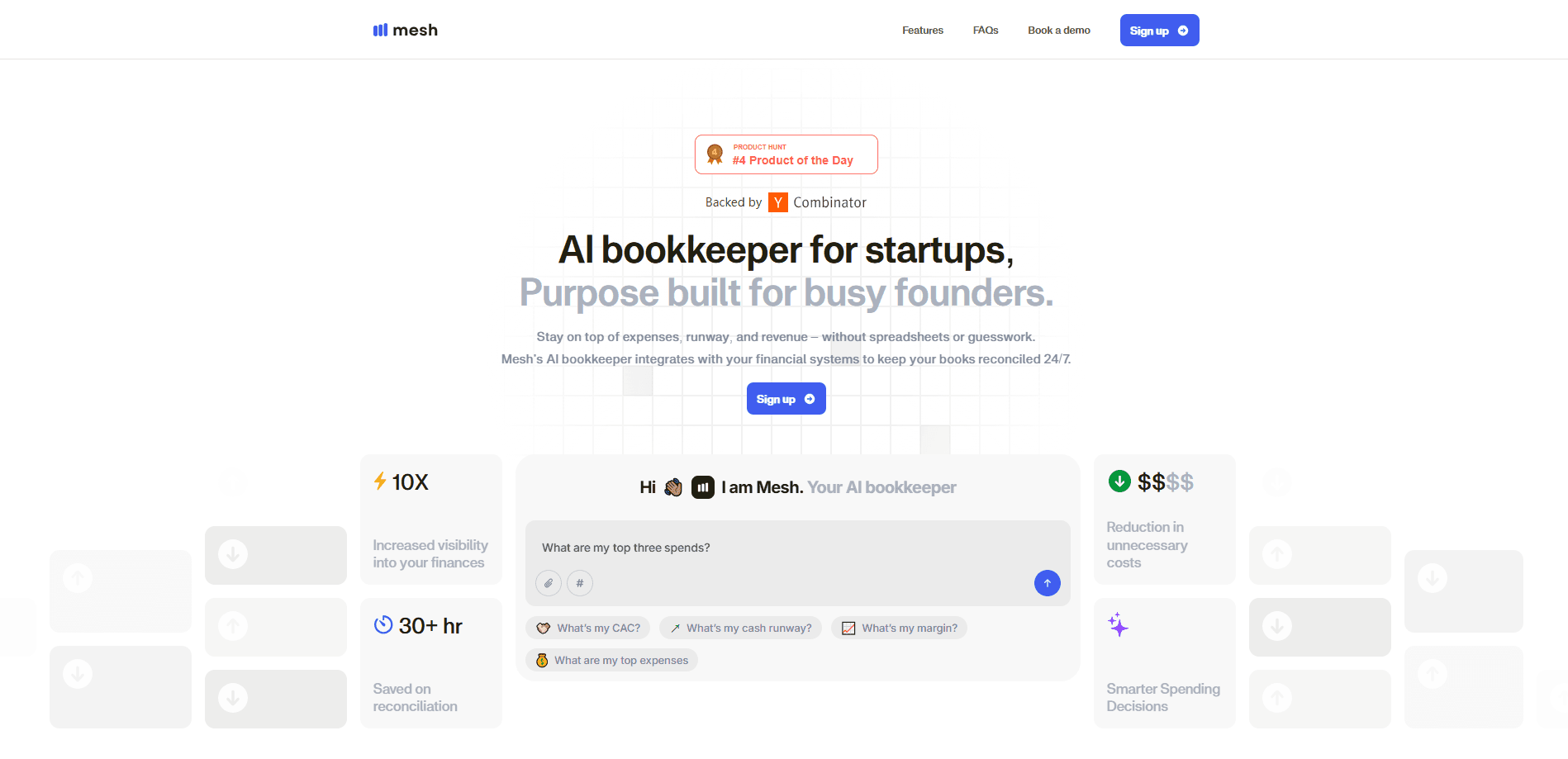
About Mesh
What Is Mesh
Mesh, at usemesh.com, is accrual automation software built for finance teams that still close their books by hand, and it sits in the AI bookkeeping category rather than the ledger itself. Instead of a person building and updating a spreadsheet schedule each month, Mesh reads the systems that already hold the evidence, such as procurement records, the AP inbox, contracts and Slack or Teams threads, and works out which vendors need an accrual entry for the period. It applies the same policy logic every time and flags only the entries that genuinely need a person to look at them.
The company is behind a common bottleneck. Accruals sit at the messy end of month-end close, where the work is chasing missing invoices, tying out vendor totals and rebuilding the same spreadsheet tabs. Mesh aims to take the gathering, calculation and tie-out off that list so controllers and accounting managers spend their time on judgment instead of data entry. The vendor says customers automate roughly 90 percent of the manual accrual workload and close several days faster each month, a figure that comes from Mesh and not from an independent audit.
Two limits are worth knowing before you book a demo. Mesh is built for mid-market companies, roughly 200 to 2,000 employees, with a high vendor count or variable spend, so it fits a finance department with real close volume rather than a solo founder. And it does not replace your accounting team. Every entry it drafts lands in a review queue, and nothing posts to your ERP until a person approves it.
Getting Started
- Book a demo and walk the team through your current accrual process and the systems that hold the data
- Connect your ERP and the surrounding tools, such as procurement, the AP inbox and chat, with read-only access
- Encode your accrual policy once. That covers the vendor categories, contract terms and rules your team already follows
- Run a proof of concept on one entity or a handful of vendors and compare Mesh's output against your own workbook
- Approve, edit or reject drafted entries in the review queue, then let the system write approved entries to your ERP
Product Information
A quick look at Mesh's pricing, supported platforms, and performance.
Best for
The users, tasks, and scenarios where this tool fits best.
Users
- Controllers
- Accounting managers
- CFOs
- Finance teams running NetSuite, Sage Intacct or QuickBooks
Tasks
- Unbilled accruals
- Prepaid expense amortization
- Recurring accruals
- Month-end tie-outs
- Audit documentation
Scenarios
- High vendor counts
- Variable spend
- Multi-entity closes
- A SOC 2 or SOX review
- A lean accounting team
Key features
Accrual and Prepaid Automation
The core of the product is the accrual engine. Mesh identifies which vendors and transactions need an accrual or prepaid entry each period, calculates the amount, and books it, using operational data rather than a hand-built schedule. It covers the three common categories: unbilled accruals, prepaid expense amortization and recurring accruals tied to contract terms. The hardest case, an unbilled accrual with no purchase order or invoice trail, is where the product claims an edge.
Signal Aggregation Across Systems
Mesh connects read-only to the systems that already hold accrual evidence, including ERP records, procurement tools, the AP inbox, contract repositories, Slack, Teams and email. It pulls those signals together and reconciles them across documents, normalizing vendor names and amounts along the way. Missing statements and mismatched totals get surfaced rather than silently smoothed over, so a person can fix the few items that need it.
Policy-Driven Logic and Exception Flagging
Instead of replaying clicks, Mesh applies your team's encoded accrual policy consistently across vendors and periods. Entries the system is confident about move to a review queue, and anything with a missing assumption or an unusual change is flagged for a person instead of being guessed at. Because the logic is versioned, a change to a vendor or a rule is traceable rather than buried in someone's memory.
Audit Trail Built Into Every Entry
Every figure carries a time-stamped record of its sources, assumptions, calculations and approvals. When an auditor asks where a number came from, the answer is a click rather than a hunt through old spreadsheet tabs. Mesh also logs every action immutably and enforces segregation of duties through role-based approvals, which is what a SOX program needs to document controls as work happens.
Human Review Before Anything Posts
Mesh runs read-only by default and drafts entries without touching your books. Accruals land in a review queue where your team approves, edits or rejects them, and write-back to the ERP only happens once you enable it and a person signs off. You choose whether approved entries post automatically or stage for a batch, so your controllers keep the final say.
ERP and Procurement Integrations
Mesh connects to major ERPs including NetSuite, Sage Intacct and QuickBooks, plus procurement systems like Coupa and Zip, AP inboxes, contract repositories and data warehouses. It reads purchase orders, receipts and approval activity from procurement, and pairs that with what lands in the AP inbox and the records native to your ERP. The vendor adds new connectors based on customer demand.
Security and Data Handling
Mesh is SOC 2 Type II certified and audited annually by a third party. Data is encrypted in transit and at rest, hosted in US-based AWS regions, and access is least-privilege by default. The vendor states it never trains shared models on your financial data and that any model use runs under data-processing terms with no retention for training, with regional data residency available on enterprise plans.
Pros and cons
Pros
- Reads operational signals from procurement, AP, contracts and chat, so it can catch unbilled accruals that live outside the ERP
- Embeds the formula and supporting evidence in every entry, which turns audit requests into a lookup rather than a reconstruction
- Runs read-only by default with a review queue, so nothing reaches the ledger without a controller's sign-off
- Covers unbilled accruals, prepaid amortization and recurring accruals in one workflow, with policy logic applied consistently
- Connects to NetSuite, Sage Intacct, QuickBooks, Coupa and Zip, so it layers on the stack a mid-market team already runs
Cons
- Pricing is quoted after a scoping call with no published list price, so you can't estimate cost before talking to sales
- Built for companies around 200 to 2,000 employees; smaller teams and solo founders are outside the core fit
- It drafts and documents accruals but doesn't replace the accounting team, so you still need reviewers and a controller
- No public API or developer docs, so teams wanting to build on Mesh have to go through the vendor
Frequently asked questions
Accrual automation is software that identifies which vendors and transactions need an accrual or prepaid entry each period and calculates the amount, using signals from procurement, AP, contracts and internal communication instead of a person building a spreadsheet schedule. Mesh is accrual automation software aimed at mid-market finance teams.
Related content
Explore related tools, skills, and articles for Mesh.
Mesh Alternatives

Knocket
Knocket (Tencent RTC team) · Productivity · Business · ChatbotKnocket is a free live chat and contact page tool that lets visitors message you from your website, app, or a shareable link, with every reply handled from Telegram or one inbox.

shippedit.me
Krawlup · Marketing · Businessshippedit.me now redirects to Krawlup, a web platform that audits SEO, AEO and page speed every week, then hands the fixes to AI coding agents over MCP.

Ayven
Alknoma · Productivity · BusinessAyven is an AI control centre by Alknoma that turns a plain-language goal into a dated plan, hands the work to your people and AI agents, and asks for your approval only when the call is yours.