

MetaMuse Marketing
MetaMuse · Marketing
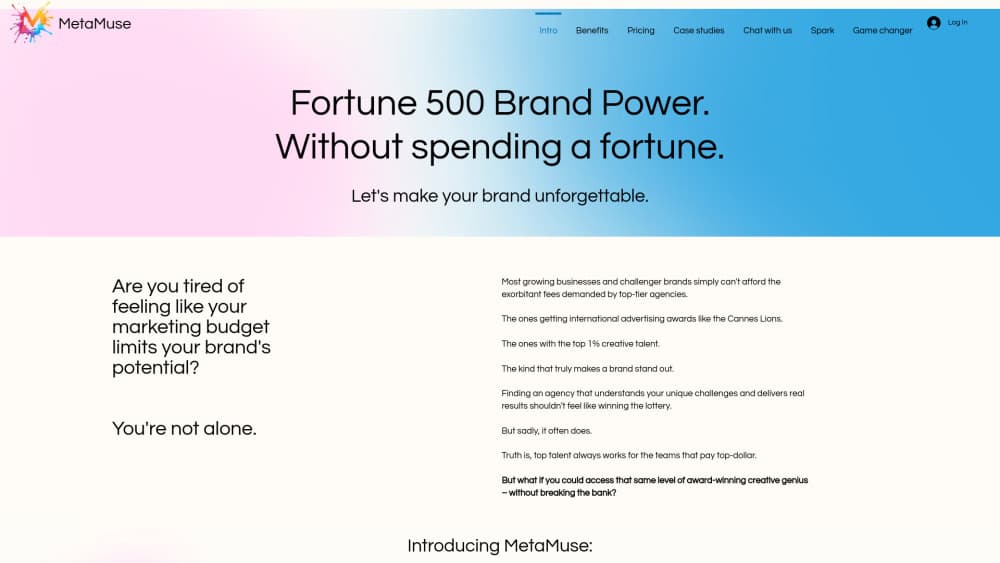
MetaMuse Marketing is an AI marketing agent that turns a short brief into campaign strategy, creative briefs, and ad concepts, drawing on 20,000 award-winning campaigns.
About MetaMuse Marketing
What Is MetaMuse Marketing
MetaMuse Marketing is a web app for marketers who need agency-grade creative thinking without agency fees. You describe a business goal, and its AI agents come back with a strategic angle, a written creative brief, and several campaign concepts built around that angle.
The selling point is the reference library. MetaMuse says it has mapped the strategic patterns behind more than 20,000 award-winning campaigns, including Cannes Lions and Effie winners, along with principles from marketing writers such as Seth Godin. Instead of asking a general chatbot for ideas, you're asking a system tuned on work that won awards and took market share.
That focus cuts both ways. MetaMuse is a planning and ideation tool. It doesn't buy media, publish ads, or run your social accounts, and weekly pricing is steep for a solo founder who needs one campaign per quarter.
Getting Started
- Create an account on the MetaMuse website and choose a plan.
- Write your marketing brief: brand, audience, goal, budget, and the problem you're solving.
- Work with the agent to turn that brief into a creative strategy.
- Generate campaign concepts, then compare and refine the ones worth keeping.
- Export your pick as a brief a designer, copywriter, or client can act on.
Product Information
A quick look at MetaMuse Marketing's pricing, supported platforms, and performance.
Best for
The users, tasks, and scenarios where this tool fits best.
Users
- Small brand marketers who handle strategy, creative, and reporting alone
- Freelance creatives and copywriters
- Agency strategists
- Startup founders with marketing budget but no marketing team
Tasks
- Turning a vague goal into a written creative strategy
- Generating campaign concepts for a product launch
- Building a pitch narrative
Scenarios
- Planning a seasonal campaign on a short timeline
- Preparing for a client pitch
- Stress-testing a concept your team already loves
Key features
Award campaign library
MetaMuse says its models have studied the strategic DNA of more than 20,000 winning campaigns, from Cannes Lions Grand Prix work to Effie winners. Each concept you generate comes with the pattern it borrows from, so you can see why a direction should work. The library is the main reason output reads differently from a generic chatbot reply.
Brief to creative brief
You start with a plain marketing brief and end with a structured creative brief: insight, positioning, big idea, tone, and execution notes. That handoff is the part most small teams skip, and it's usually where campaigns fall apart. MetaMuse keeps the reasoning attached at every step.
Campaign concept generator
Ask for concepts and the tool returns several routes, each with a headline thought, the audience tension it plays on, and sample executions. You can push a route further, ask for a bolder version, or compare two directions side by side. Treat it as a campaign concept generator with a strategist sitting next to it, useful when a blank page and a deadline are the whole problem and you need campaign ideas that carry a reason.
Consumer insight research
The platform pulls on consumer insight material and marketing research to explain why an audience would care. You get the emotional trigger behind an idea, not just a description of the ad. For teams without a research budget, that framing is often the most useful part of the output.
Idea pressure-testing
MetaMuse works as an AI creative strategist you can argue with. Feed it a concept and ask where it's weak, which assumption is unproven, or what a competitor would do in response. It answers with marketing principles rather than encouragement, which is a useful change from assistants that agree with everything.
Visual concept generation
Both main plans include image generation for mood boards and rough visuals. Spark uses faster image models, Game Changer uses stronger ones, and neither replaces a designer. The images are there to make a concept concrete in a meeting, not to ship as finished ad creative.
Pros and cons
Pros
- Output is grounded in named, award-winning campaigns, so the reasoning is easier to defend to a client or a founder.
- The brief to concept workflow keeps strategy, copy direction, and visuals in one place instead of scattered across docs.
- Weekly plans can be started for a single project and cancelled, and the first week runs at 90% off.
- A money-back guarantee lowers the risk of trying it on one campaign.
- The tool challenges weak ideas instead of flattering them, which is rare among AI marketing tools.
Cons
- Pricing is weekly and recurring: $95 to $2,700 per week adds up fast if you keep a plan running between campaigns.
- No free tier. You have to pay to see whether the output fits how your team works.
- It plans and writes, but it doesn't publish, buy ads, or measure results, so you still need your own stack for execution.
- Everything is in English, which limits usefulness for teams running campaigns in other languages.
Frequently asked questions
It turns a marketing brief into a creative strategy, a written creative brief, and several campaign concepts. You use it for thinking and planning, then hand the output to whoever produces the ads.
Related content
Explore related tools, skills, and articles for MetaMuse Marketing.
MetaMuse Marketing Alternatives

ngram 2.0
ngram · Video · Marketingngram 2.0 is an AI video generator for teams. It turns a prompt, a screen recording, or a product URL into a narrated explainer, product demo, or AI avatar video, and every scene stays editable.

shippedit.me
Krawlup · Marketing · Businessshippedit.me now redirects to Krawlup, a web platform that audits SEO, AEO and page speed every week, then hands the fixes to AI coding agents over MCP.

MePersona
MePersona, Inc. · Writing · Productivity · MarketingMePersona is an AI unified inbox for creators. It learns your voice, drafts replies to fan messages from 12 platforms, and sends only what you approve.