

Metorial
Metorial · Coding
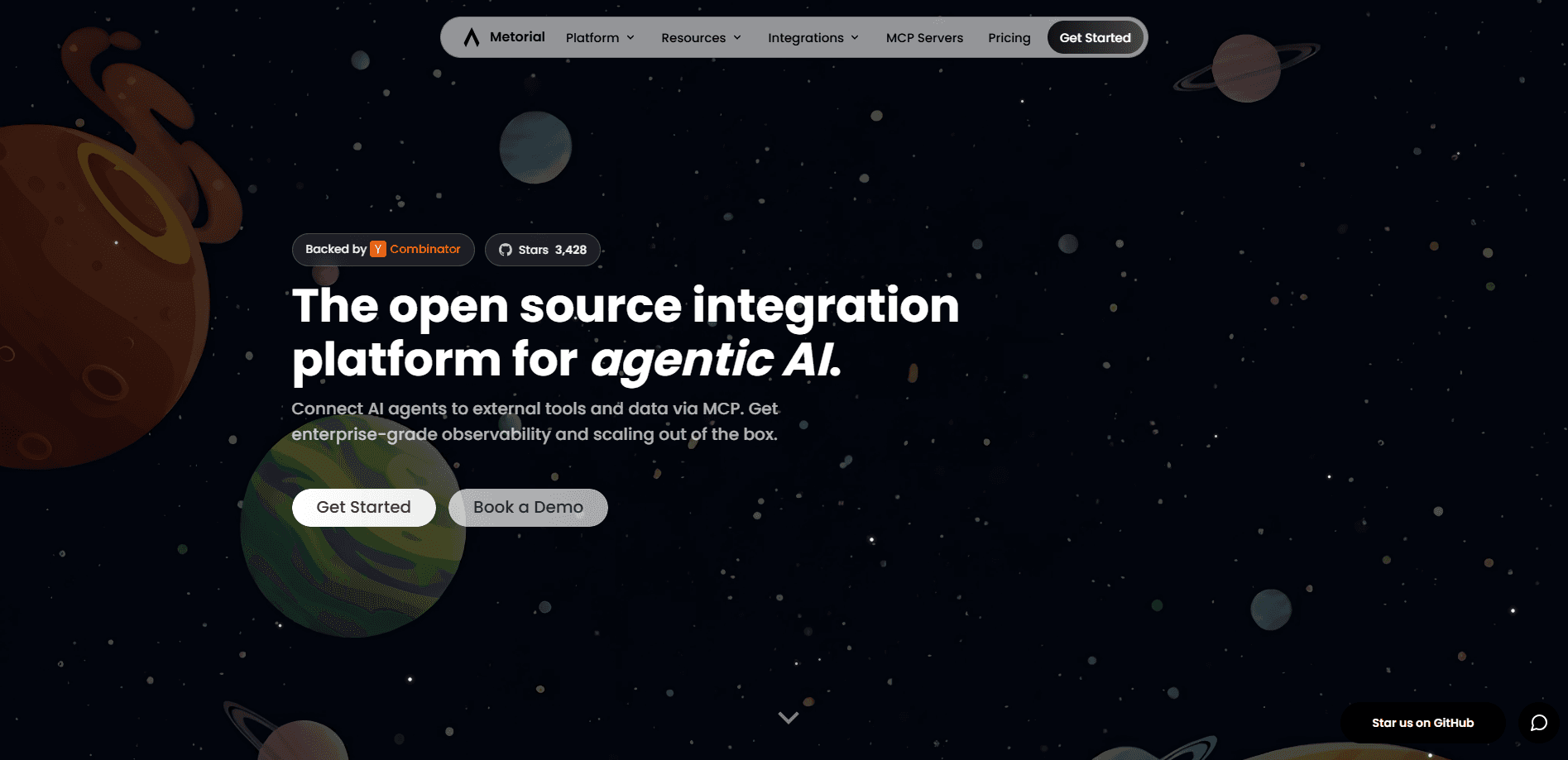
Metorial is an open-source integration platform that connects AI agents and MCP clients to the apps, APIs, and data sources a team already uses. Instead of hardcoding dozens of tool connections, you point your agent at Metorial and get access to over 1,000 hosted integrations, along with access controls, governance, and activity logs. It's built for developers who'd rather ship agent features than babysit OAuth flows and API keys.
About Metorial
What Is Metorial
Metorial is agentic infrastructure for teams building with the Model Context Protocol. The MCP standard lets AI models call external tools, but wiring up each tool by hand gets messy fast. Every service has its own auth model, its own rate limits, and its own way of breaking on a Tuesday. Metorial replaces that mess with one platform.
The pitch is simple. Connect your agent to Metorial. Metorial handles the tool catalog, the authentication, and the plumbing. It ships 1,000+ integrations out of the box and lets you build custom ones. You can also attach any remote MCP server you're already running, so nothing you've built goes to waste.
The catch is scope. Metorial is a developer and platform-administrator product, not something you hand to a non-technical teammate and expect them to run. The free tier caps you at 2 team members and 10 provider integrations, and production access only unlocks on the paid plan. If you're a solo builder testing an idea, that's fine. If you're a team, you'll hit the ceiling quickly.
Getting Started
- Sign up at platform.metorial.com and create an API key for your environment.
- Deploy a provider from the dashboard, like Exa for search, so your agent has tools to call.
- Install the SDK and a provider package, then connect your chosen AI model (OpenAI, Anthropic, Google, or an OpenAI-compatible API).
- Create a session, hand the available tools to your model, and run a tool call end to end.
- Try a tool interactively in the dashboard's MCP Explorer before wiring it into your code.
Product Information
A quick look at Metorial's pricing, supported platforms, and performance.
Best for
The users, tasks, and scenarios where this tool fits best.
Users
- AI engineers building agents that need real tools
- Platform admins running agent access for a company
- Small teams prototyping fast
Tasks
- Connecting an agent to dozens of SaaS tools
- Adding search, file, or database tools to a chatbot
- Wrapping an existing remote MCP server
- Auditing what your agents actually did
Scenarios
- Shipping an internal support or ops agent
- Keeping dev and production separate
- Centralizing AI tool access company-wide
Key features
1,000+ Hosted Integrations
Metorial ships a catalog of over a thousand integrations covering common SaaS, database, and search tools. You connect them through one platform rather than building a separate client for each service, which cuts the maintenance work that usually piles up around agent projects. Less code to own. Fewer things to break.
Support for Any Remote MCP Server
If you've already built or adopted an MCP server, Metorial can attach to it. That means you're not forced to rebuild working infrastructure just to fit the platform, and your existing setup stays usable while you adopt the rest.
Custom Integrations
Beyond the catalog, you can build reusable integrations and control exactly which tools each one exposes. It's the difference between handing an agent a blunt "everything" scope and giving it a narrow, deliberate set of capabilities.
Governance, Access Control, and Tracing
The Workforce control plane lets admins decide which integrations and skills are approved for which users, while activity logs and tracing record every tool call. For anyone worried about what an autonomous agent might do with access to production systems, this is the part that matters. It's the difference between a demo and something you'd actually deploy.
SDKs for TypeScript and Python
Metorial offers JavaScript and Python SDKs with provider packages for OpenAI, Anthropic, Google, Mistral, DeepSeek, and any OpenAI-compatible API. You wire in the model you already use instead of switching stacks to get tool access.
Environments and Production Access
Every API key belongs to one environment, and a development key never touches production. Paid plans add multiple environments and a production environment built for better scalability, so you can test in a sandbox and promote with confidence. That separation matters more than it sounds.
Pros and cons
Pros
- Open source on GitHub, so you can inspect the SDKs, provider packages, and CLI instead of trusting a black box.
- One platform covers 1,000+ integrations, custom integrations, and your own remote MCP servers.
- Governance and tracing are built in, which is rare for tools aimed at early-stage agent projects.
- Free Dev plan is genuinely usable, with 500K tool calls a month and no credit card required.
- TypeScript and Python SDKs plus broad model support means less lock-in to one AI vendor.
Cons
- Free plan caps you at 2 team members and 10 provider integrations, which blocks any real team.
- Production access and basic compliance require the $250/mo Scale plan, a big jump from free.
- It's a developer product. There's no drag-and-drop setup, so non-technical users will struggle without engineering help.
Frequently asked questions
It connects AI agents and MCP clients to the apps and tools a team already uses. Rather than writing custom code for every integration, you route your agent through Metorial and let it handle authentication, the tool catalog, and access control. It's the fastest way to connect AI agents to APIs without owning the plumbing.
Related content
Explore related tools, skills, and articles for Metorial.
Metorial Alternatives
Forefront
Forefront · CodingForefront is a web platform for building with open-source AI. It lets you fine-tune leading open-source language models on your own data, evaluate how they perform, and run them through an API or export them to host yourself. Developers who want the convenience of a closed-source platform but insist on owning their models and data are the target audience here.

Startkit
StartKit.AI · CodingStartkit is a boilerplate for building AI SaaS and AI wrapper products. Think of it as an AI startup boilerplate with the boring parts already wired up: authentication, Stripe and Lemon Squeezy payments, usage limits, transactional email, and an AI API starter that talks to OpenAI, Anthropic, Groq, or Llama. You clone the repo, set your price, and start on the part of your product that people actually pay for. It's Next.js under React and Tailwind, so most of the boilerplate code already feels familiar.
Testim
Tricentis · CodingTestim is an AI-powered test automation platform for building and running end-to-end tests across web, mobile, and Salesforce applications. It leans on machine learning to keep tests stable when an interface changes, so teams spend less time fixing broken selectors. Not bad for an automated testing tool you can start using today. You create tests by recording actions in a browser, then optionally add JavaScript when you need more control. It's a solid pick for busy QA teams.