

mia
Aureliax B.V. · Marketing · Business
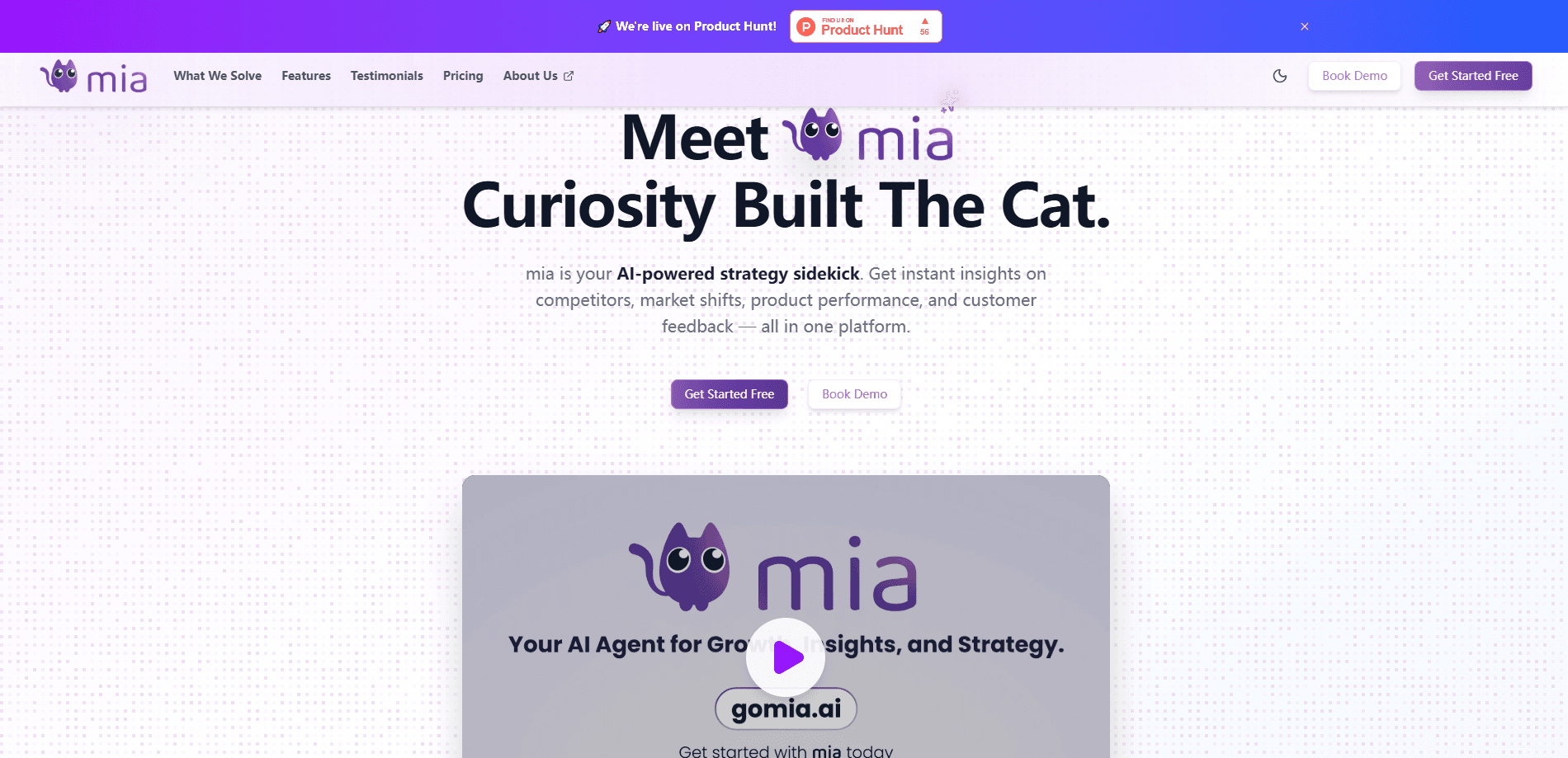
mia is an AI decision intelligence layer that pulls customer, competitor, and market signals into one place and turns them into ranked, source-cited next steps. Product, growth, and strategy teams use it to replace scattered dashboards and one-off research with a single recommendation engine. It's not just another AI analytics tool. Instead of showing another chart, the platform collects CRM records, call transcripts, support tickets, reviews, and market data, then ranks what deserves attention by revenue impact and urgency.
About mia
What Is mia
mia is a decision intelligence platform built by Aureliax B.V. out of Amsterdam. It sits above the tools you already run rather than replacing them. Your CRM stays the system of record, your business intelligence stack stays the system of analysis, and mia becomes the layer that decides what to do next.
The problem it targets is familiar to most product and growth teams. Customer feedback, market shifts, and competitor moves live in separate systems, and by the time someone connects the dots, the moment to act has usually passed. That's the gap mia fills. It ingests those signals, deduplicates them, themes them across customers, competitors, and market, and keeps every source attached to each insight so you can check the reasoning yourself.
The main limitation is access. mia runs on custom pricing with no published free tier, so you have to talk to sales before you can see the platform, and there's no self-serve signup for small teams who just want to poke around. It's also a B2B product aimed at mid-market and enterprise organizations, which means solo users and hobbyists aren't the target audience.
Getting Started
- Book a demo through the mia website and walk the sales team through your revenue stack and the outcomes you want to drive.
- Get a tailored quote with a short ROI model, usually within one business day.
- Connect your systems, including CRM, product, conversations, and any external market sources you want tracked.
- Set up custom playbooks, alerts, and Slack or email digests so the right team sees each recommendation.
- Review the ranked decisions in the Action Center and route each one to the owner who can act on it.
Product Information
A quick look at mia's pricing, supported platforms, and performance.
Best for
The users, tasks, and scenarios where this tool fits best.
Users
- Product managers
- Growth and revenue teams
- Strategy and insights leads
Tasks
- Voice-of-customer analysis
- Competitor battle cards
- Churn signal detection
- Positioning work
Scenarios
- Quarterly planning
- Win/loss reviews
- Pricing decisions
- Early market entry research
Key features
Signal Collection Across Your Stack
mia ingests CRM records, call transcripts, support tickets, product feedback, reviews, social listening, Slack threads, and external market signals into a single layer. Over 50 native connectors cover nine categories, with custom webhook and REST support for anything that isn't built in. That matters because most teams don't fail from a lack of data, they fail from data that never meets.
Ranking by Revenue Impact and Urgency
Every opportunity, risk, and shift gets ranked by how much revenue is on the line and how soon it needs attention. The team works on the things that move the number first, and everything else waits its turn. It's a small shift that changes how a Monday planning meeting feels. No more guessing what to tackle.
Source-Cited Recommendations
Each recommendation keeps its sources attached. If mia says a competitor is undercutting you on price, you can open the signal behind that claim and judge it yourself. For teams burned by black-box analytics tools, that traceability is the whole point. It builds trust.
Proactive Alerts and Digests
The platform pushes new opportunities, emerging risks, and churn signals to Slack or email rather than waiting for someone to log in and check. Alerts come with clear next steps, so a busy team doesn't have to reverse-engineer what they're supposed to do about a notification.
Battle Cards and Positioning Insights
mia combines customer needs with competitor gaps to show exactly where you win and where you need to improve. Product marketing teams use this to sharpen positioning against live evidence rather than a positioning doc from six months ago.
Smart Summaries
Complex research gets compressed into clear, digestible reports so you focus on the metrics that matter. Anyone who's spent a Friday afternoon formatting a research deck will recognize the appeal. It saves hours. That's the real win.
Action Center
Approved recommendations land in an Action Center that shows triaged revenue-at-risk insights and routes each decision to product, growth, sales, customer experience, or strategy teams where they already work. No new tool to learn, no separate inbox to remember. So where does the work actually go? Straight to the person who owns it.
GDPR and EU-Hosted Infrastructure
mia is EU-hosted and aligns with GDPR and the EU AI Act, with SSO, SCIM, audit logs, and a DPA available on the plan. That's built for European mid-market and enterprise buyers who can't send customer data just anywhere. Data residency matters here.
Pros and cons
Pros
- Unifies internal and external signals, so teams stop piecing together competitor, customer, and market data from separate tools.
- Every recommendation keeps its sources, which makes the output easier to trust and verify than a typical black-box analytics score.
- Over 50 native connectors plus custom webhook and REST support cover CRM, ticketing, knowledge bases, and storage without heavy setup work.
- EU hosting with GDPR and EU AI Act alignment matters for regulated European organizations.
- Alerts and digests push insight into Slack and email, the places teams already work.
Cons
- Custom pricing only, with no published free tier or self-serve trial, so you can't evaluate the product without going through sales.
- The focus on mid-market and enterprise means small teams and solo users are largely priced and positioned out.
- No public API documentation is visible before a demo, which makes it hard to judge integration depth up front.
Frequently asked questions
mia collects customer, competitor, and market signals into one layer, synthesizes them into themed insights, ranks opportunities and risks by revenue impact, and delivers the recommended next move to the team that owns it. Think of it as a recommendation engine sitting on top of data you already have.
Related content
Explore related tools, skills, and articles for mia.
mia Alternatives

Emailwritr
Emailwritr · Writing · MarketingEmailwritr is an AI email copywriting tool built for affiliates, course creators, and online businesses that want more revenue from the list they already own. Instead of blank pages or generic chatbot prompts, this AI email writer generates welcome sequences, launch campaigns, cart recovery emails, and promo series from frameworks modeled on well-known direct-response copywriters. You connect your autoresponder, answer a few questions about your offer, and it writes the copy for you.

Prosp
Prosp · Writing · Voice & Language · MarketingProsp is an AI LinkedIn outreach tool built for agencies and sales teams, and it writes the message and the voice note in your own voice for each prospect so they actually reply. You connect your accounts, find leads, and let the AI draft and send personalized messages at scale, all from one inbox. It's built for people running outbound at volume. That's the whole pitch. Every touchpoint still has to feel human.

On Model
On Model · Image · MarketingOn Model is an AI fashion model tool that places your clothing on virtual models so online stores can get on-model product photos without booking a photoshoot. It runs as a Shopify app, letting you swap the model in an existing image, change backgrounds, and generate faces for cropped or headless shots. The goal is simple: match your product photos to your customers and stand out from competitors using the same supplier images.