

Microsoft Phi-4
Microsoft · Coding · Other
Microsoft Phi-4 is a 14B open small language model built for math and complex reasoning tasks, aimed at developers who want strong results without cloud-scale hardware.
About Microsoft Phi-4
What Is Microsoft Phi-4
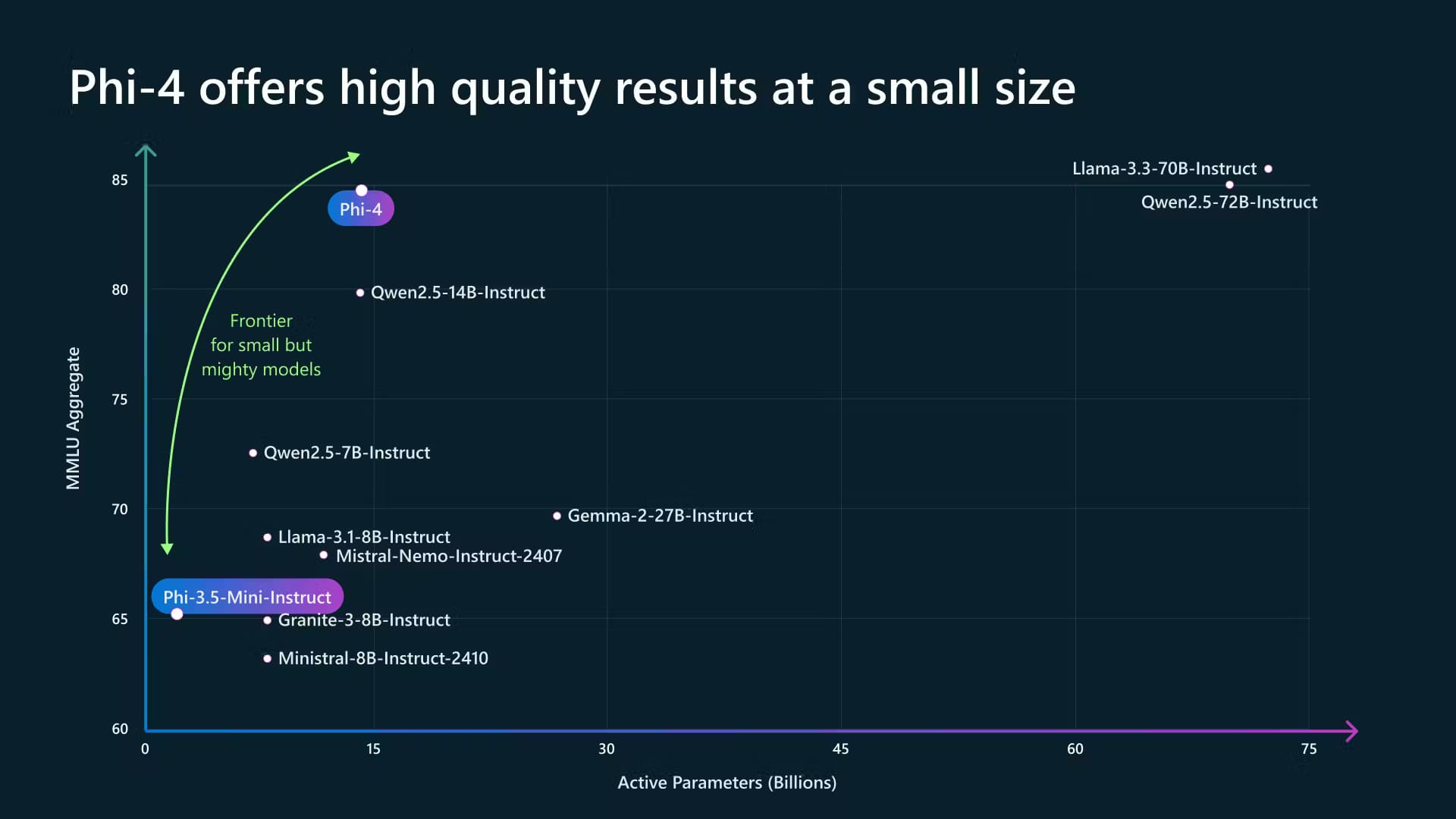
Microsoft Phi-4 is part of the Phi family of small language models (SLMs) that Microsoft developed to bring capable AI to devices and edge systems. Where large frontier models need clusters of GPUs, Phi-4 targets a much smaller footprint while still handling hard reasoning. It's a 14 billion parameter model, and its standout skill is mathematics. Microsoft trained it partly on high-quality synthetic data and curated web content, a choice the company says pushed its reasoning scores far above what its size suggests.
The pitch is straightforward. Want a model that runs on a single GPU, fits inside an app, and still works through multi-step math or logic problems? Phi-4 is one of the sharper options in that weight class. It ships under the MIT License, so you can use it commercially, modify it, and put it inside your own product.
The main limit is scope. Phi-4 is text-only. No image or audio input in the base model, so anything visual needs a sibling like Phi-4-multimodal. Its knowledge also cuts off around June 2024. And it's small, so it can still slip on niche facts that a larger model would catch. For creative writing and broad world knowledge, bigger models usually win.
Getting Started
- Pick an access route: pull the weights from Hugging Face, or call the model through Azure AI Foundry.
- Grab the model card and the Phi Cookbook for the recommended prompt formats and sample code.
- Run it locally with a framework that supports the architecture, or send requests to the hosted endpoint.
- Test it on your own math and reasoning prompts. Then adjust temperature and prompt structure to fit your task.
- Fine-tune on your own data if the base behavior isn't close enough. Then deploy to your target device or service.
Product Information
A quick look at Microsoft Phi-4's pricing, supported platforms, and performance.
Best for
The users, tasks, and scenarios where this tool fits best.
Users
- Developers building apps that need reasoning on-device
- Researchers and students working through math or logic problems
- Teams that need a commercially usable model
Tasks
- Solving multi-step math problems
- Reasoning through logic and word problems
- Running structured text generation and summarization
- Fine-tuning on a domain dataset
Scenarios
- Shipping an AI feature inside a desktop or mobile app
- Prototyping on a single developer GPU
- Offline or low-connectivity environments
Key features
Math and Reasoning Focus
Microsoft built Phi-4 around complex reasoning, with mathematics as the headline. It works through problems in steps. That matters for tutoring tools, finance calculations, and anything where a wrong intermediate result shows up in the final answer. Independent benchmark tables put it well ahead of most models its size on math tasks. Test it on your own data before trusting it in production.
Compact 14B Parameter Size
At 14 billion parameters, Phi-4 is small enough to run on modest hardware compared with frontier models that need many GPUs. That size is the whole point. Lower memory, lower latency, and a smaller bill when you host it yourself. The tradeoff is that it knows less about obscure topics than a much larger model would.
Open Source Under MIT License
The weights ship under the MIT License, one of the most permissive open licenses around. That's the open source LLM angle done right. You can use Phi-4 commercially, modify it, and redistribute it without paying Microsoft a licensing fee. Confirm the exact terms on the model card before you build a product on top of it. Licenses can carry conditions.
Multiple Access Routes
You can download Phi-4 from Hugging Face and run it yourself, or reach it through Azure AI Foundry as a hosted endpoint. NVIDIA's API Catalog offers another path. Two options matter here. You can start fast on a managed endpoint and move to your own infrastructure later without rewriting your integration.
Fine-Tuning Support
Microsoft documents fine-tuning for the Phi family through the Phi Cookbook, so you can adapt Phi-4 to a specific domain or writing style without starting from scratch. Because the model is small, a fine-tuning run costs far less than tuning a large frontier model, which means a team without a big GPU budget can still produce a model tuned to its own data. That makes custom tuning practical for smaller teams.
Built for On-Device and Edge Use
The Phi family exists to put AI on the device instead of behind a cloud call, and Phi-4 fits that goal because once it's deployed it can run locally without any network round trip. That helps with privacy, offline use, and predictable latency, all of which are hard to guarantee when every prompt has to leave the machine and come back. You'll still need hardware that can hold the model in memory, so check the requirements first.
Pros and cons
Pros
- Strong math and step-by-step reasoning for its size, backed by published benchmarks.
- Runs on far less hardware than frontier models. Hosting cost and latency both drop.
- MIT License keeps commercial use simple and free of licensing fees.
- Available both self-hosted and as a managed Azure endpoint. Pick your deployment style.
- Fine-tuning is practical and documented, so domain adaptation is realistic for small teams.
Cons
- Text-only in the base model, so image, audio, and video inputs need a different Phi variant.
- Knowledge cutoff sits around mid-2024, which means newer facts are missing unless you supply them.
- Smaller size means weaker grasp of niche topics and creative writing than the biggest models.
Frequently asked questions
It handles text generation, complex reasoning, and math problem solving. It works best on structured tasks where you need a model to reason through steps, and less well on broad world-knowledge questions that suit larger models.
Related content
Explore related tools, skills, and articles for Microsoft Phi-4.
Microsoft Phi-4 Alternatives

Base Code
Base44 (Wix) · Coding · ProductivityBase Code is a shared cloud development environment from Base44. Teammates describe changes to an existing GitHub codebase in chat, preview them live and send them back as pull requests.

Google EmbeddingGemma 2
Google DeepMind · Writing · Image · CodingGoogle EmbeddingGemma 2 is a 740M-parameter open model that turns text, code, images, audio, and video frames into vectors in one 768-dimension space, running on phones and laptops.

GitGlow
GitGlow · Coding · ProductivityGitGlow is a local-first desktop Git client that lets independent developers review their own code and their AI agents' changes in one place before shipping.