

MidReal
MINDAI · Writing · Other
MidReal was an AI story generator that turned one sentence into illustrated, interactive fiction. The service was shut down in 2025, and the site now redirects to a farewell letter from the team.
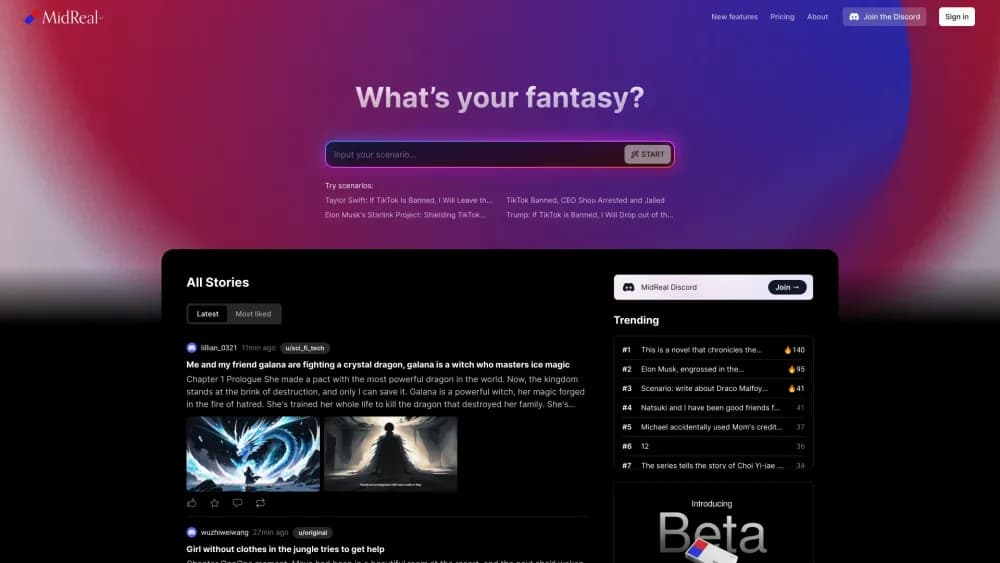
About MidReal
What Is MidReal
MidReal was an AI storytelling app built by MINDAI. You typed a premise, often just one line, and the system wrote the opening of a story around it. From there you picked from suggested directions or typed your own action, and the plot continued in the direction you chose. The output came with generated artwork, so a story read less like a wall of text and more like a light visual novel. In practice it worked as an AI novel generator for people who wanted chapters, not one-off prompts.
The draw was length. Most chat models lose the thread of a long story after a few thousand words, and MidReal was built around a memory system meant to hold character details and earlier plot points across dozens of chapters. That made it a practical tool for serialized fiction, the kind of thing people publish chapter by chapter.
Its defining limit is simple: it no longer exists. The company shifted to Macaron, a personal AI tool builder, and the old domain now shows a letter explaining the decision. Your account, your library, and the generator are gone.
Getting Started
- Open midreal.ai and sign in with an email address or a social account. The site used to drop you straight into a single prompt box on the home page.
- Describe a premise in a sentence or two. Something like "the last person on Earth hears a knock at the door" was enough to start. You could also add genre, tone, or characters if you wanted more control.
- Read the first chapter, then choose what happens next. Options appeared at the end of each segment, and a custom action box let you write your own move instead.
- Let the app illustrate key moments. Images were generated for scenes, and you could request artwork for a specific line.
- Save the story to your library or share it with a public link. Finished stories could be read by other users on the platform.
Product Information
A quick look at MidReal's pricing, supported platforms, and performance.
Best for
The users, tasks, and scenarios where this tool fits best.
Users
- Writers who stall on the opening page
- Readers of interactive fiction
- Chinese and English speakers
Tasks
- Drafting the first few chapters of a novel
- Writing serialized web fiction
- Practicing pacing and dialogue
- Building a shareable story for a community post
Scenarios
- Breaking a writing block late at night
- Testing whether a premise has legs
- Running a creative writing exercise with students
Key features
One-Sentence Story Generation
The entry point was a single text box. You wrote a premise and the model produced a structured opening with a setting, characters, and a hook. No outline, no character sheet, no setup wizard. That low friction was the main reason people tried it, and it made the tool feel closer to a writing prompt than to a word processor.
Branching Choices and Custom Actions
Every chapter ended with a few suggested paths plus a free-text box for your own move. Picking an option moved the plot; writing your own line gave the model a specific instruction, such as having a character leave the room or reveal a secret. The result was interactive fiction in the literal sense, with the reader deciding what happens next.
Long-Range Story Memory
MidReal's core claim was that it could keep a story coherent far past the usual context limit. Character traits, prior events, and established rules of the world were carried forward, which is what made multi-chapter fiction possible. In practice the memory was good, not perfect. Details could drift if a story ran very long or introduced too many named characters.
Scene Illustrations
The app generated images for story moments, and you could request a picture for a specific sentence. Artwork was attached to the story page, so a finished chapter looked like an illustrated serial rather than plain text. Quality varied by scene, and generated faces were the usual weak spot.
Story Library and Public Sharing
Saved stories lived in a personal library, and each one had a shareable page. You could browse illustrated stories other users had published, which turned the app into a small reading platform as well as a writing tool. Public stories were also how most people discovered the product.
Bilingual Support
The generator worked in English and Chinese, including mixed-language prompts. That set it apart from most Western AI writing tools at the time and explained part of its following in Chinese-language web fiction circles.
Pros and cons
Pros
- Turning a one-line idea into a readable chapter took seconds, which made it easy to test several premises in one sitting.
- The memory system held a long story together well enough for serialized fiction, something most chat interfaces struggle with.
- Choices at the end of each chapter gave the reader real influence over the plot instead of the illusion of it.
- Built-in illustrations and public story pages made finished work easy to share without extra tools.
Cons
- The service is gone. Existing accounts, saved stories, and links no longer work, so there is no way to export or continue a project.
- Prose quality was uneven. Action scenes and dialogue often needed rewriting, and the model leaned on familiar genre phrasing.
- The product stayed limited to English and Chinese, which shut out a large share of interested writers.
- Free credits ran out quickly on long stories, so anyone writing at length had to pay or wait for a reset.
Frequently asked questions
MidReal was an AI story generator from MINDAI that turned a short premise into illustrated, choice-driven fiction. You picked directions at the end of each chapter or typed your own action, and the story continued from there. It ran as a web app and as iOS and Android apps.
Related content
Explore related tools, skills, and articles for MidReal.
MidReal Alternatives

Google EmbeddingGemma 2
Google DeepMind · Writing · Image · CodingGoogle EmbeddingGemma 2 is a 740M-parameter open model that turns text, code, images, audio, and video frames into vectors in one 768-dimension space, running on phones and laptops.

MePersona
MePersona, Inc. · Writing · Productivity · MarketingMePersona is an AI unified inbox for creators. It learns your voice, drafts replies to fan messages from 12 platforms, and sends only what you approve.

Fluence
Yay Software (Yannick Huchard) · Writing · Voice & Language · ProductivityFluence is an Android app that reads PDFs, EPUBs, Word files and web articles aloud, follows each sentence as it speaks, and answers questions about the text on the phone itself.